
This tiny center in a UK seaside town is the first place vessels under attack in the Persian Gulf call
This Tiny UK Office in Portsmouth Is the First Stop for Ships in Peril Near the Persian Gulf
This tiny center in a UK seaside – When a merchant vessel caught in the crosshairs of conflict in the Strait of Hormuz needs assistance, a modest black phone in a corner of a British seaside town office becomes the focal point of a high-stakes operation. Though it appears unremarkable — a relic from the 1990s — this simple device connects the UK Maritime Trade Operations Centre (UKMTO) to the heart of a growing maritime crisis. Located just outside Portsmouth, the UKMTO serves as a vital hub for coordinating responses to emergencies in critical shipping lanes, such as the Red Sea, Persian Gulf, and northern Indian Ocean.
The centre has become increasingly busy since Iran’s strategic closure of the Strait of Hormuz more than two months ago. This move, a calculated response to US-Israeli military strikes, has created a new reality for global trade routes. With the waterway effectively under Iranian control, the volume of emergency calls to the UKMTO has surged dramatically. Every time the phone rings, it signals potential danger for vessels traversing one of the world’s most vital arteries of commerce, where a significant share of oil, gas, and fertilizer flows.
The Urgency of Immediate Action
“The first moments after a call comes in can be extremely intense,” said Commander Jo Black, head of operations at the UKMTO.
“The vessel may be under active attack. You might hear alarms and sirens in the background. On occasion, we’ve even picked up gunfire,”
she explained to CNN. These initial reports are often the only lifeline for ships facing immediate threats, and the team’s response must be swift and precise.
Iran’s tightening grip on the Strait of Hormuz has led to a variety of risks for commercial vessels. From missile attacks to drone strikes and fast-moving Iranian naval craft, the danger has evolved significantly since the conflict began. Black noted that the nature of these threats has shifted over time, with the focus now more on deterring ships rather than outright attacking them. “At the start of March, we were seeing a lot of military action,” she said. “But lately, it seems to be more about constabulary activity — vessels being challenged as they approach the strait, interrogated, and sometimes detained.”
This transformation in Iran’s tactics has made the UKMTO’s role more complex. Once a ship reports an incident, the team springs into motion. Watchkeepers — the operational staff of the UKMTO — immediately contact the vessel’s crew to gather details. They also reach out to nearby ships, alerting them to the threat and seeking any additional intelligence or aid. The process involves coordinating with shipping companies, local coastguards, and military forces in the region to ensure a comprehensive response.
The Mechanics of Maritime Surveillance
Despite the high-pressure environment, the UKMTO operates with a small but dedicated team. Comprised of just 18 personnel, the office functions on a 12-hour shift rotation, ensuring constant vigilance. At any given time, three watchkeepers are on duty, sometimes joined by an analyst for added support. The team’s daily routine includes monitoring vast amounts of data, with over 2,500 emails received each day from ships voluntarily sharing their positions, contact details, and surrounding traffic.
“If you call UKMTO, you will get a response,” Black emphasized.
“We can’t guarantee an international force will act immediately, but we’ll make sure your information reaches as many people as possible to spark a reaction,”
she said. This network of communication is crucial for generating a collective response to threats, even when the situation is still unfolding.
The UKMTO’s ability to verify incidents is bolstered by its partnerships with military organizations. By cross-referencing reports from multiple sources, the team can quickly refine the details of each event. “We take great care to validate information efficiently,” Black stated. “The initial reports shared on X and our website give a broad idea of where something happened, and then we layer on updates as we confirm the details through additional channels.” This verification process ensures that media outlets, governments, and other stakeholders receive accurate and timely updates.
The Human Element in High-Tech Operations
While the UKMTO relies on advanced technology, its work is deeply human. The watchkeepers often develop personal connections with the crews they assist, which can be especially meaningful during high-stress situations. “Dealing with a highly emotional scenario is part of the job,” Black acknowledged. “Even though we’re thousands of miles away, the impact of these incidents feels very real.”
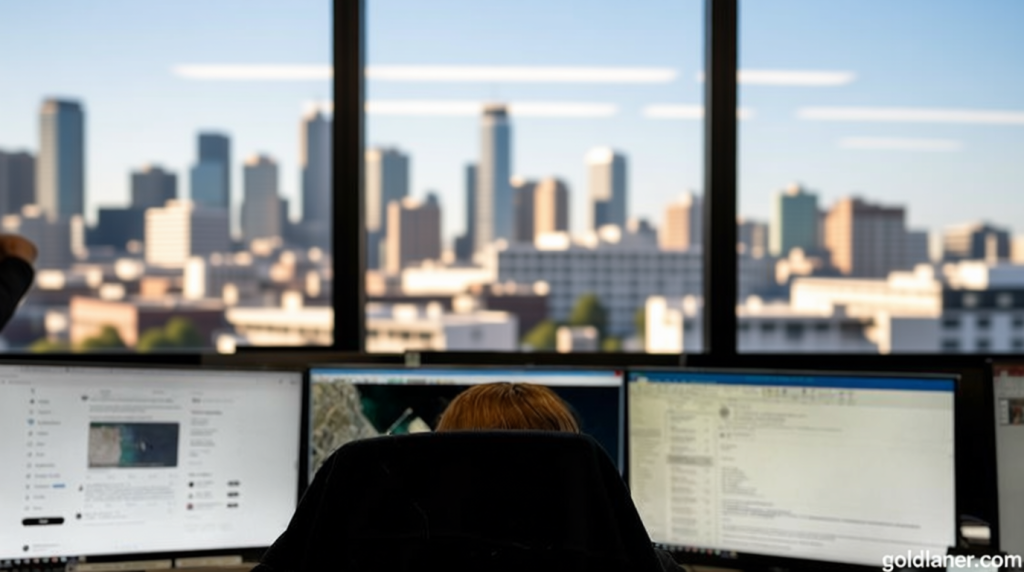
On a typical day, the atmosphere in the UKMTO office is far less chaotic than during emergencies. The space is filled with banks of monitors displaying maps of the region and real-time shipping traffic. One screen highlights the hazardous area in the Strait of Hormuz, marked with a red box that identifies potential zones of Iranian activity, such as minefields. Watchkeepers spend hours analyzing this data, tracking vessels, and anticipating risks.
The team’s vigilance is further enhanced by their ability to follow ships even when they disable their Automatic Identification System (AIS), a standard tracking tool used in maritime navigation. By monitoring voluntary reports and cross-checking them with other sources, the UKMTO ensures that no vessel slips through the cracks. “It’s about maintaining situational awareness,” Black said. “We can often track a ship’s movements even after it cuts off its AIS signal.”
Since the war in the region entered its third month, the UKMTO has documented 44 incidents involving ships in the strait. These include instances of damage, close calls, and near misses. Ten seafarers have lost their lives in these events, underscoring the gravity of the situation. For the watchkeepers, the challenge lies in balancing rapid response with meticulous analysis, all while maintaining composure in high-pressure moments.
As the crisis continues, the UKMTO remains a central player in the global effort to safeguard maritime trade. Their work highlights the intricate interplay between technology, human expertise, and international cooperation in the face of escalating tensions. Even as the world watches the Strait of Hormuz, the quiet office in Portsmouth serves as a beacon of coordination, ensuring that every ship in peril receives the attention it needs — no matter how far away the threat may be.
