
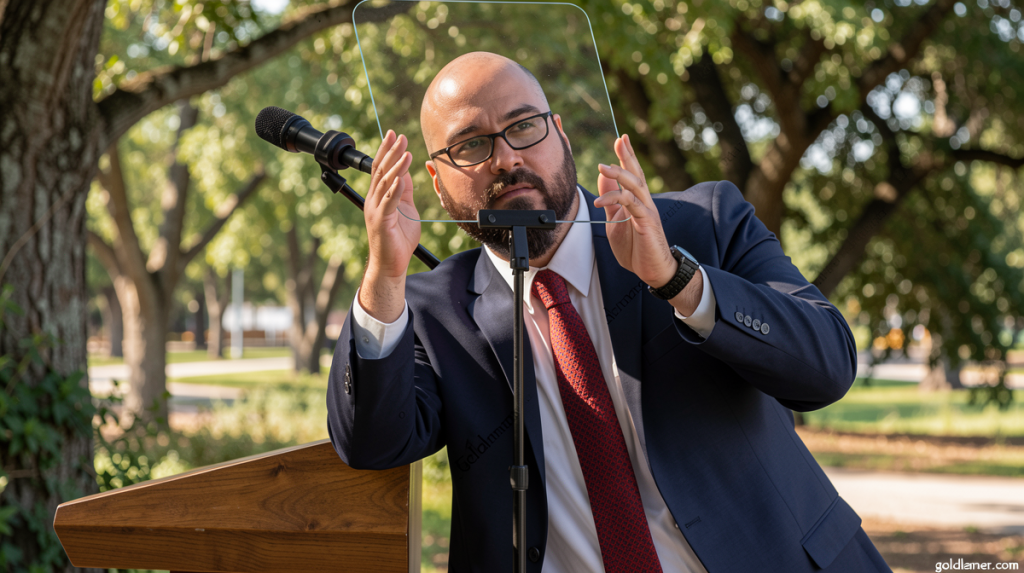
Trump’s Teleprompter Operator Settles $65K Insider Case
Goldlaner.com – The Commodity Futures Trading Commission announced Friday that Trump’s longtime teleprompter operator, Gabriel Perez, will pay a $65,000 civil penalty and surrender over $107,000 in trading profits to close what the agency described as its first insider-trading enforcement action against a sitting White House employee. The settlement stems from Perez’s use of nonpublic speech content to place wagers on prediction-market contracts tied to the president’s exact wording at scheduled events.
Perez, who has accompanied the president on the road for roughly ten years, executed 49 trades on the Kalshi platform and won 39 of them. Each bet targeted a “mention market,” a niche instrument in which traders stake money on the precise words a public figure will utter at a defined occasion. Per the CFTC filing, his positions covered the State of the Union address, the National Prayer Breakfast, a Medal of Honor ceremony, several campaign rallies, and other remarks.
Cooperation Earned a Penalty Discount
The commission found that Perez “owed a duty of trust and confidentiality to the US government” and that he “breached these duties” by converting speech drafts into trading edges. In exchange for what the agency termed “exemplary cooperation,” however, it applied a “substantial discount” to the base penalty. Perez sat for a voluntary interview in which he conceded he “made his trading decisions based on the confidential information he had learned from his review of the speeches.”
When the probe first surfaced in July, the White House confirmed that Trump called the conduct “frankly a disgrace” and placed Perez on unpaid leave pending resolution. The administration did not respond to follow-up questions on Friday evening after the settlement was published.
Access, Detection, and Industry Sanctions
The teleprompter role placed Perez in a uniquely privileged position: he was often the final person to review a speech before delivery, giving him advance knowledge of exact phrasing that the CFTC classified as “misappropriated material” and “nonpublic information” exploited for “own personal, financial benefit.” Kalshi’s own enforcement team, led by Bobby DeNault, flagged the “prohibited trading activity” and reported it directly to the commission. Beyond the federal fine and disgorgement order, Kalshi imposed a three-year trading ban on Perez.
“It doesn’t matter who you are: violate our rules or federal law and you will face the consequences,” DeNault posted on social media Friday night.
Former CFTC commissioner Christy Goldsmith Romero, a Biden-era appointee, publicly questioned whether the modest penalty sends an adequate deterrent signal. “Generally, the CFTC should provide an incentive for defendants to cooperate,” she said. “But this is insider trading at the highest level of government – the White House. With this small penalty, the CFTC gave away the chance to send a strong message to deter future insider trading.”
The case arrives amid a live debate over how prediction markets should be regulated. Michael Selig, the Trump-appointed CFTC chairman, has championed the industry while pledging to police insider trading within it. Trump told reporters the chairman was “doing a great job” in preserving federal rather than state authority over the sector, and Selig attended a cryptocurrency event alongside the president at the White House last week — a reminder of how tightly the administration and the newly regulated industry now orbit one another.
Frequently Asked Questions
What exactly is a “mention market”? A mention market is a type of prediction-market contract in which participants buy or sell shares tied to whether a specific word or phrase will appear in a public figure’s remarks at a scheduled event. Unlike broader outcome markets, the scope is narrowed to particular language at a defined time and place.
Why was the penalty considered low? Critics, including former commissioner Romero, argued that insider trading at the White House warranted a stiffer fine to deter future abuse. The CFTC justified the reduced amount by citing Perez’s voluntary cooperation and full admission during his interview, applying what it called a “substantial discount.”
What happened to Perez’s job? The White House placed him on unpaid leave in July when the investigation became public. The settlement announcement did not specify whether he would return to his role or depart the administration.