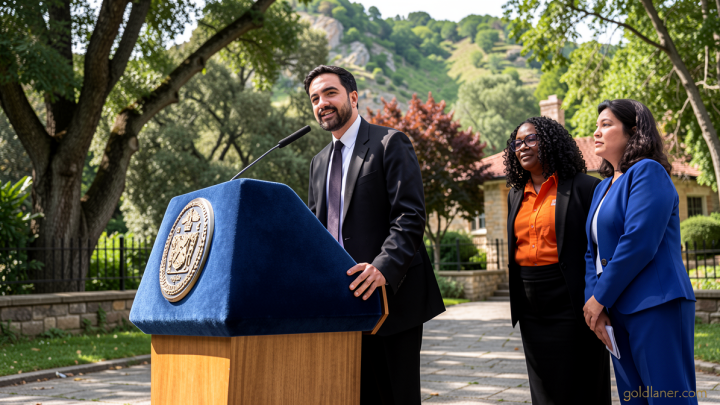
Kevin Warsh has a plan for the Fed. Scott Bessent is getting in the way

Daftar Isi
Warsh’s Transparency Experiment Collides With Bessent’s Bond-Market Intervention
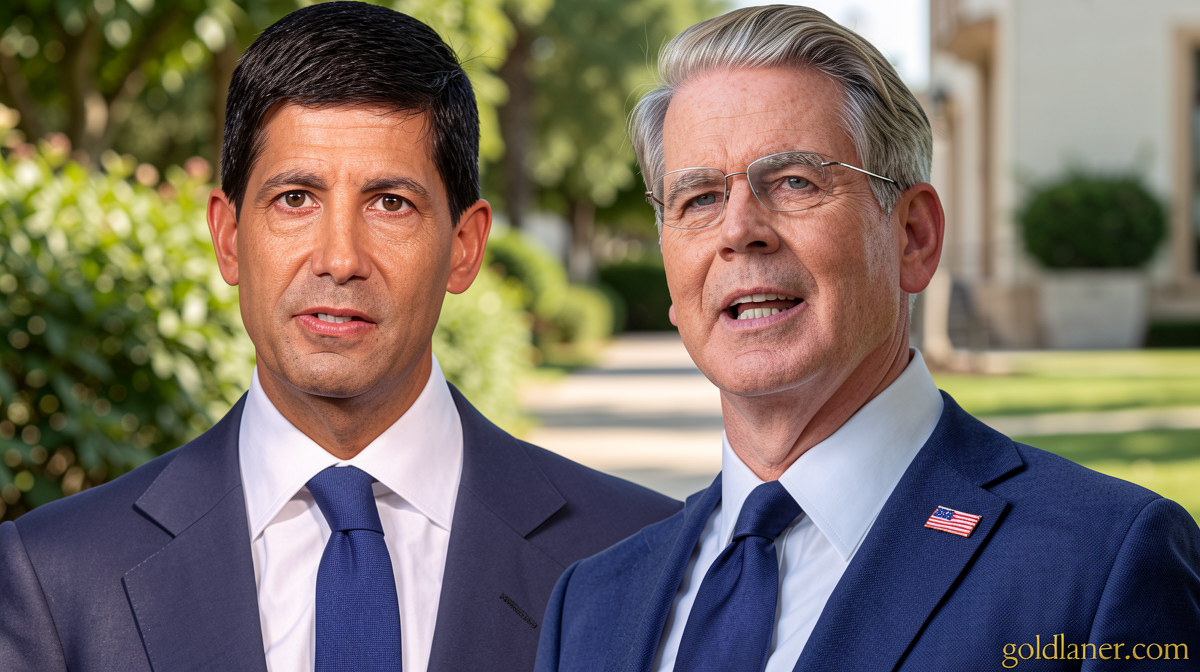
Goldlaner.com – The two most powerful figures in American economic policy are pulling in opposite directions, and the bond market is caught in the crossfire. Federal Reserve Chair Kevin Warsh, installed by President Donald Trump, has dismantled the central bank’s decades-long habit of telegraphing its next moves. Treasury Secretary Scott Bessent, Trump’s chief economic voice, has simultaneously stepped into the market to suppress the very signals Warsh depends on. The result is a policy environment where the two agencies’ objectives no longer align.
Warsh’s Bet: Let the Data Speak
Warsh’s central thesis is straightforward in concept but radical in execution. By abandoning what economists call “forward guidance” — the practice of hinting at future rate decisions through speeches, press conferences, and published projections — he hopes to strip away the layer of Fed interpretation that markets have come to obsess over. In his view, if investors stop decoding every data release through the lens of “what will the Fed do next,” they will instead react to the raw economic numbers. That unfiltered market response, he argues, becomes a cleaner compass for policymakers debating whether to tighten or ease monetary policy.
The gamble is enormous. Markets have spent two decades calibrating their behavior around Fed communications. Reversing that conditioning in real time, while inflation remains above the central bank’s 2 percent target for roughly five and a half years, creates a volatile transition period. Fed officials this summer have debated whether to raise short-term rates in response to persistent price pressure; at minimum, they have agreed to hold rates steady. Warsh’s silence on the direction of travel amplifies uncertainty precisely when the economy needs clarity.
Bessent’s Counter-Move: Engineering Lower Yields
Into that already turbulent environment, Bessent introduced a surprise announcement last week: a plan to at least double the pace of Treasury buybacks. The Treasury Department framed the initiative in technical language, describing it as a liquidity-enhancement measure. Yet most analysts read the move differently — as a deliberate effort to push down bond yields that had climbed to uncomfortable levels. The 30-year Treasury note recently touched its highest yield since 2007, the eve of the Great Financial Crisis, a level that raises borrowing costs for homeowners, corporations, and the federal government itself.
The intervention immediately distorted the very price signals Warsh wants to read. US Treasury rates fell after the buyback announcement, muddying the data. If the Treasury is actively shaping yields, the market’s price no longer reflects pure economic fundamentals. The windshield Warsh needs to navigate monetary policy has been fogged by his own administration’s other principal.
Expert Reactions: A Split in the Administration
Former Federal Reserve officials and market veterans have been blunt about the contradiction.
“If timing is everything in love, the bromance between Bessent and Warsh may be coming to end,” said Tim Mahedy, a former San Francisco Fed official now serving as CEO of research firm Access/Macro.
Eric Rosengren, former president of the Federal Reserve Bank of Boston, was more pointed about the market mechanics.
“It’s not a clean signal of what the market wants if Treasury is intervening,” Rosengren said. “There is no chaos in the Treasury market. The liquidity argument doesn’t hold. It looks a lot more like window-dressing before the midterms.”
He added that the two agencies are now at odds in a way that undermines both their mandates.
“The Fed and Treasury are working at cross purposes, which is not productive,” Rosengren said.
Legendary investor Stanley Druckenmiller, who served as a mentor to Bessent, published an op-ed in The Wall Street Journal under the headline “Let the Bond Market Speak,” in which he labeled the buyback expansion “artificial yield suppression.” The commentary later drew criticism after it emerged that Druckenmiller had used artificial intelligence to draft the piece, a detail that complicated his credibility on the issue.
The Transparency Reversal: History in Reverse
Warsh’s communication style marks a sharp break from the post-crisis era. Under Alan Greenspan, who led the Fed through the late twentieth century, the central bank offered minimal detail about its reasoning. Beginning in the mid-2000s, however, the Fed progressively expanded transparency: regular press conferences after every policy meeting, published dot-plot projections from individual policymakers, and even appearances by bank officials on mainstream television programs such as “60 Minutes.” Each addition was designed to reduce surprise and anchor expectations.
Warsh is now attempting to reverse that trajectory. Benson Durham, a former Fed official and founder of independent research firm DASM LLC, cautioned that the rollback will not be smooth.
“Taking back transparency will be really difficult to pull off smoothly,” Durham said. “It’s hard to put the genie back in the bottle.”
He summarized the administration’s internal tension in a single observation.
“You have a Fed chair who doesn’t say enough and a US Treasury secretary who says too much,” Durham said.
The Ball-and-Referee Problem
At the July Federal Open Market Committee meeting, Warsh defended his approach with a sports metaphor, arguing that elevated Treasury yields were evidence markets were finally focusing on real data rather than Fed rhetoric.
“Market participants are learning to play the ball, not the referee,” Warsh said.
Many economists find the analogy flawed. The Federal Reserve is not a passive official watching from the sideline; it actively sets short-term interest rates and influences longer-term yields through balance-sheet operations. It is, in effect, both player and rule-maker. Treating its own actions as background noise while expecting markets to respond only to GDP prints and payroll reports ignores the institutional reality of how monetary policy transmits through financial markets.
The practical stakes extend well beyond academic debate. If Bessent succeeds in engineering lower long-term rates, mortgage payments, corporate borrowing costs, and the government’s own interest bill all decline. Those cheaper financing conditions can stimulate spending and investment, but they also risk feeding the very inflation that Warsh says has been stuck above target for over five years. The two men, appointed to the same administration, are thus optimizing for contradictory outcomes — one trying to let prices find their natural level, the other trying to push them down before the market can adjust. Until that tension resolves, investors face a policy landscape with no reliable compass.
Related Reading
Frequently Asked Questions
What is Kevin Warsh has a plan?
Kevin Warsh has a plan is the main topic of this guide. The article explains the context, practical details, and next steps readers should understand.
Why does Kevin Warsh has a plan matter?
Kevin Warsh has a plan matters because readers are looking for a useful answer, not just a short summary. Good content should match search intent and help them decide what to do next.