
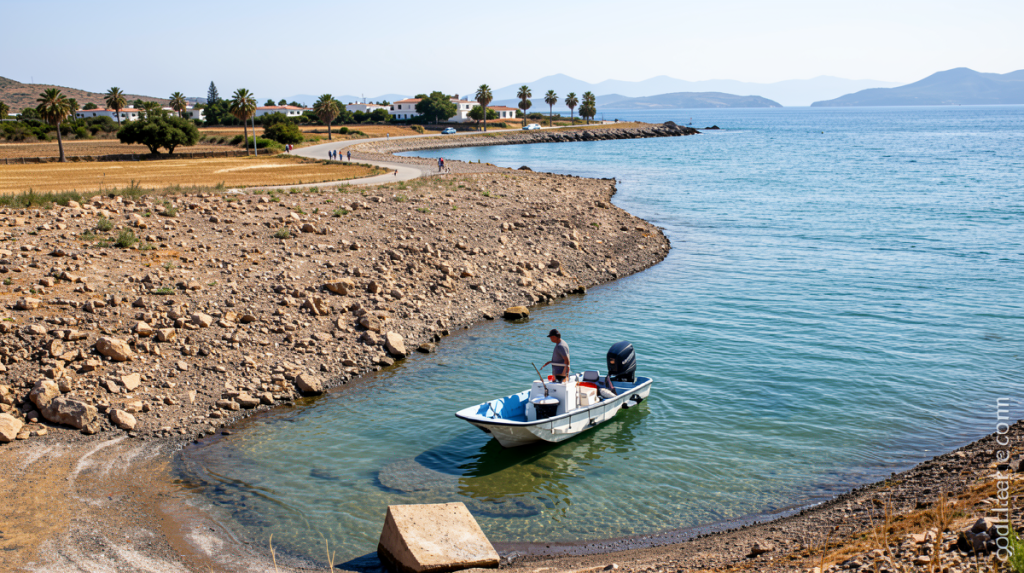
Record-Low Reservoirs Force Historic Water Reductions Across Three Southwest States
Goldlaner.com – Lake Mead and Lake Powell — the twin reservoirs that anchor the Colorado River system — have both sunk to levels never before recorded since their creation nearly a century ago. Against that backdrop, the Department of the Interior released a two-year operating plan on Friday that compels Arizona, California, and Nevada to slash their annual water allocations from the river. The directive lands after years of stalled negotiations among the seven basin states and follows a broader ten-year operating framework published by the US Bureau of Reclamation in July, which established that allocation adjustments would be recalibrated every two years.
The new plan governs the first of those biennial windows, running through 2028, and assigns the burden almost entirely to the lower-basin states. No mandatory reductions are imposed on the upper-basin states of Utah, Colorado, Wyoming, or New Mexico.
Who Bears What
The arithmetic of the cuts breaks down as follows: Arizona absorbs the deepest reduction at 760,000 acre-feet; California’s allocation shrinks by 440,000 acre-feet, the smallest of the three; and Nevada sees its intake trimmed by 50,000 acre-feet. Translated into percentages, Sarah Porter, director of the Kyl Center for Water Policy at Arizona State University, calculated that Arizona faces roughly a 27 percent reduction, California about 10 percent, and Nevada approximately 16 percent. For Arizonans who draw directly on Colorado River water, the effective cut reaches 50 percent, Porter noted.
The asymmetry between upper and lower basin obligations has been a flashpoint throughout the protracted talks. The lower-basin states, which historically consumed the lion’s share of the river’s flow to sustain sprawling agricultural operations and fast-growing metropolitan areas, had proposed voluntary reductions in prior years while pressing the upper-basin states to share the burden. The Interior Department’s plan effectively sides with the lower basin’s position for this cycle.
State Officials Weigh In
Tom Buschatzke, director of the Arizona Department of Water Resources, framed the outcome as a negotiated compromise rather than a capitulation. He told reporters that the reductions reflect earlier discussions and recommendations exchanged among the three downstream states.
“It could have been draconian,” Buschatzke said. “I would like the reductions for Arizona to be zero but that’s not the reality we’re facing. It’s a pretty good outcome.”
Arizona’s two Democratic senators, Ruben Gallego and Mark Kelly, issued a joint statement endorsing the new operating guidelines, signaling bipartisan legislative support within the state most exposed to the cuts.
In California, the Metropolitan Water District of Southern California announced that agricultural and urban water users will enter negotiations to craft a state-level implementation plan meeting the mandated reduction. General Manager Shivaji Deshmukh emphasized in a statement that the obligation extends beyond any single sector.
“Water users across the Basin must ma[ke]…” Deshmukh’s statement underscored that the cuts are not confined to one industry or municipality but ripple through the entire allocation structure.
A River Under Siege
The Colorado River supplies drinking water to roughly 40 million people and irrigates more than five million acres of farmland across the American Southwest. For over two decades, a climate-change-driven megadrought compounded by soaring temperatures and sustained high demand has eroded the river’s flow to a fraction of its historical average. Last month, combined storage in the two principal reservoirs hit a record low. Lake Mead, the nation’s largest reservoir, now sits below every level recorded since its impoundment nine decades ago. Lake Powell breached its own all-time low on August 15.
Porter described the trajectory in stark terms in earlier commentary: the system faces the prospect of “crashing,” a condition in which reservoir elevations fall so far that gravity-fed delivery of water becomes physically impossible.
The 1922 Compact Meets a Changed Climate
The legal architecture governing the river dates to the Colorado River Compact of 1922, which partitions annual flow into 7.5 million acre-feet for the upper basin and an equal allotment for the lower basin. That framework was drafted when regional populations were a small fraction of today’s numbers and Rocky Mountain snowpacks delivered far more runoff to the river’s headwaters. With those hydrological assumptions now obsolete, the compact’s rigid allocations no longer match available supply, locking the seven states into an endless cycle of negotiation over how to divide a shrinking pie.
Celene Hawkins, director of the Colorado River Program at the Nature Conservancy, placed the plan within that longer arc of institutional adaptation.
“We are at a time of tremendous change in how we are managing water in this system and what that means for both communities and the river itself,” Hawkins said.
What Comes Next
Some water-policy analysts expressed relief that a binding framework is finally in place, even if its scope is limited to a single two-year window. Others cautioned that the magnitude of the shortfall dwarfs what the plan addresses, particularly given that snowpack forecasts offer little prospect of near-term relief. Legal observers also flagged the risk of litigation: tensions over which states shoulder the deepest cuts have simmered for years, and the upper-basin states’ exemption in this cycle could prompt a challenge in federal court.
For the tens of millions of residents, farmers, and energy producers downstream of Glen Canyon and Hoover Dams, the coming months will test whether the political machinery of seven states can translate a two-year allocation into operational reality before reservoir levels cross thresholds that make delivery itself untenable. The river’s next biennial review will arrive in 2028 — but the hydrology, as the record lows attest, will not wait that long.
Related Reading
Frequently Asked Questions
What is Three Colorado River states must take?
Three Colorado River states must take is the main topic of this guide. The article explains the context, practical details, and next steps readers should understand.
Why does Three Colorado River states must take matter?
Three Colorado River states must take matters because readers are looking for a useful answer, not just a short summary. Good content should match search intent and help them decide what to do next.