
Why the search for Lynette Hooker just resumed 2 months after her disappearance in the Bahamas
Why the search for Lynette Hooker just resumed 2 months after her disappearance in the Bahamas
Why the search for Lynette Hooker – Two months after Lynette Hooker vanished from the Bahamas, sparking an urgent search operation, the Coast Guard has launched a renewed effort to locate the missing American woman. This time, the focus has shifted to a new area within the Sea of Abaco, a body of water that surrounds the island of Elbow Cay, where Brian Hooker claimed he and his wife were sailing on the night of April 4. The search, which initially concentrated on the Abaco Islands, now spans a different stretch of the cay, according to a US official familiar with the ongoing criminal investigation.
The Disappearance and Initial Search Efforts
Lynette Hooker, a 55-year-old avid sailor, disappeared during a night journey in the Abaco Islands. Her husband, Brian Hooker, told authorities that the couple was returning to their yacht after a dinner in Hope Town, a small town on Great Abaco. The incident reportedly occurred as they navigated rough waters in an 8-foot dinghy, a small boat used for launching from larger vessels. Brian Hooker stated that his wife had fallen from the dinghy when it struck turbulent currents, but inconsistencies in his account have raised questions about the events of that night.
Within hours of Lynette’s disappearance, local police, the Royal Bahamas Defence Force, and fire and rescue teams initiated a search of the surrounding waters. The Coast Guard joined the operation by air, deploying drone technology and professional divers to cover the area. The search quickly transitioned from an active rescue mission to a recovery effort on April 7, as the likelihood of finding Lynette alive diminished. By April 8, the Coast Guard had officially opened a criminal investigation, seeking to determine whether her disappearance might have been intentional.
Shifting Narratives and Investigative Scrutiny
The investigation has uncovered discrepancies between Brian Hooker’s statements and the location data from his electronic devices. For instance, he initially described the dinghy as losing power after Lynette fell, but the data suggests a different route and timeline. These inconsistencies have intensified the focus on the circumstances surrounding her disappearance, with investigators now considering the possibility of foul play.
“The wind blew me away from her and she swam towards the sailboat and we lost sight of each other pretty quickly as it was just about sundown,” Brian Hooker told his friend Daniel Danforth over Facebook Messenger.
Brian Hooker recounted that he paddled for hours before reaching the shore, where he sought help. According to Richard Cook, the fire team lead with Hope Town Volunteer Fire and Rescue, the husband eventually made his way through dense brush to a boatyard, where he contacted police. This account, however, has been challenged by the evidence collected from the dinghy, which the Coast Guard has taken custody of as part of its criminal inquiry.
On the day the Coast Guard began its investigation, Bahamian police arrested Brian Hooker and questioned him repeatedly as a suspect. Despite this, he was released shortly after and returned to the United States. While he has consistently denied any wrongdoing, the case continues to draw public attention, with new search efforts underway to uncover the truth.
The New Search and Challenges Ahead
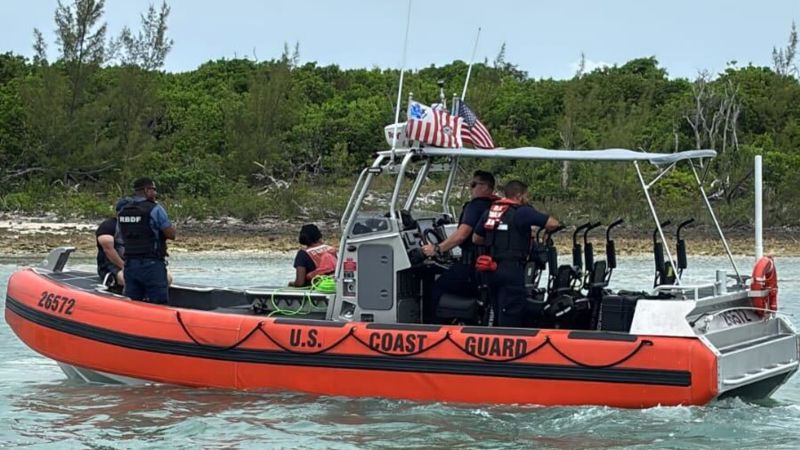
As of Thursday morning, divers have entered the waters of the Sea of Abaco to resume the search for Lynette Hooker. The Royal Bahamas Police Force has granted the Coast Guard permission to investigate this area, which includes the cay where the couple was last seen. On Wednesday afternoon, a bright orange Coast Guard dinghy was spotted near Hope Town, accompanied by a Royal Bahamas Defence Force vessel. Searchers disembarked the boat, carefully wading through shallow waters to comb the shoreline for any trace of the missing woman.
While the focus is on the maritime expanse, land-based efforts have also intensified. Cadaver dogs are now sniffing the shores of the Sea of Abaco, a move that highlights the growing urgency of the investigation. These dogs are trained to detect human remains, a critical tool as the search transitions from finding a living person to recovering evidence that could reveal the cause of her disappearance.
The challenges faced by investigators are multifaceted. The Sea of Abaco, known for its unpredictable weather and strong currents, complicates search operations. Additionally, the time elapsed since Lynette’s disappearance has allowed for environmental factors to obscure clues, such as ocean currents and marine life activity. The Coast Guard is also working to reconcile the conflicting narratives, including Brian Hooker’s claim that his wife fell into the water and the data suggesting a more complex sequence of events.
Key Developments and Public Interest
Since the initial search, the case has evolved into a criminal investigation, with the possibility that Lynette’s death may not have been accidental. The US official emphasized that the new search in the Sea of Abaco could provide crucial evidence to support or refute the theory of foul play. This includes examining the dinghy for signs of damage, analyzing the movement patterns of the boat, and assessing whether any physical evidence could point to a different cause of her disappearance.
The search has reignited public interest in the case, with many following updates on social media and news outlets. Brian Hooker’s account, which initially seemed straightforward, now stands under closer examination. For example, he claimed that Lynette had the engine safety key when she fell, causing the dinghy to lose power. However, the location data contradicts this, showing that the boat may have drifted differently than he described. These details are critical for piecing together the events of that night and determining whether Lynette was intentionally left behind or whether an accident led to her disappearance.
As the search resumes, the Coast Guard is relying on advanced technology and a multidisciplinary team to cover all bases. The use of drones, sonar equipment, and underwater cameras has expanded the scope of the investigation, allowing for a more thorough analysis of the area. The team is also working closely with local authorities to coordinate efforts, ensuring that all potential leads are explored. While the search for Lynette Hooker has been ongoing for over two months, the renewed mission offers a fresh opportunity to uncover the mystery surrounding her fate.
The circumstances of her disappearance have also sparked broader discussions about safety protocols for sailors and the importance of accurate testimony in such cases. Critics have pointed out that the initial search was limited in scope, focusing on areas near Hope Town rather than the entire Sea of Abaco. Now, with the Coast Guard extending its efforts to a new region, the investigation is gaining momentum. The key to solving the case may lie in reconciling the husband’s statements with the physical evidence, a task that requires meticulous analysis and collaboration between agencies.
As the search continues, the hope remains that Lynette Hooker’s remains will be found, providing closure to her family and critical insights into the events of April 4. The challenges ahead are significant, but the determination of the Coast Guard and its partners in the Bahamas underscores the importance of this case. Whether the new search will yield new clues or deepen the mystery remains to be seen, but the effort to uncover the truth is now in full swing.
