
Venezuela’s acting president defends country’s territory and rejects Trump’s 51st state remarks
Venezuela’s Acting President Rejects U.S. 51st State Allegations Amid Border Dispute
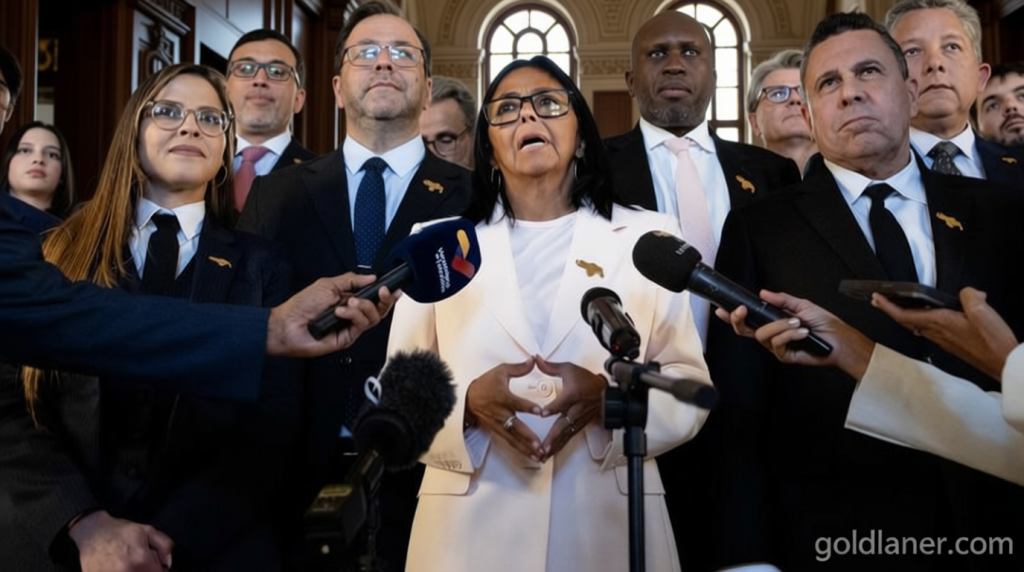
Venezuela s acting president defends country – Delcy Rodríguez, the interim president of Venezuela, made clear Monday that her nation has no intention of becoming the 51st state of the United States. The remarks came during a press conference held at the International Court of Justice in The Hague, where Venezuela was concluding its legal arguments in a long-standing territorial dispute with Guyana. Rodríguez emphasized her country’s commitment to preserving its political identity and sovereignty, countering President Donald Trump’s suggestion that the U.S. might annex Venezuela.
Legal Battle Over Essequibo Region
The dispute centers on the Essequibo region, a vast territory rich in natural resources that Venezuela claims as its own. This land, which constitutes two-thirds of Guyana’s total area, is known for its gold, diamonds, timber, and offshore oil reserves. According to recent data, the region’s oil production averages nearly 900,000 barrels per day, rivaling Venezuela’s daily output of about 1 million barrels. This makes Essequibo a critical asset for Guyana’s economy and energy sector.
“We will continue to defend our integrity, our sovereignty, our independence, our history,” said Rodríguez, who took the helm in January following the U.S.-led military operation that removed then-President Nicolás Maduro from power.
During the court proceedings, Rodríguez highlighted that political dialogue, not judicial intervention, should resolve the conflict. She argued that the 1966 Geneva agreement—signed between Venezuela and Guyana—effectively invalidated the 1899 arbitration that had previously defined the border. This historical context underscores the complexity of the dispute, which has simmered for over a century.
The 1899 decision by British, Russian, and U.S. arbitrators had largely favored Guyana, placing the Essequibo River as the boundary. However, Rodríguez contended that this ruling was later superseded by the 1966 pact. She accused Guyana of making a tactical move by submitting the case to the International Court of Justice in 2018, just after ExxonMobil discovered significant oil reserves off the region’s coast in 2015. “This change was not accidental; it coincided with the discovery in 2015 of the oil field that would become world-renowned,” she stated.
Trump’s Remarks and U.S. Response
Trump’s comments about Venezuela as the 51st U.S. state were made during an interview with Fox News’ John Roberts on Monday. While the exact context of the remark remains unclear, it has sparked debate about the president’s foreign policy stance. The White House has yet to provide an official statement, leaving room for interpretation.
“We will continue to defend our integrity, our sovereignty, our independence, our history,” said Rodríguez, who assumed power in January following a U.S. military operation that ousted then-President Nicolás Maduro.
Trump’s suggestion was not entirely new. He had previously mentioned Canada in similar terms, though the implications of such a declaration for Venezuela are more contentious. White House spokesperson Anna Kelly, who later spoke with Roberts, acknowledged Trump’s tendency to challenge the status quo but praised Rodríguez for her cooperative approach with the U.S. “The president is famous for never accepting the status quo,” Kelly noted, adding that the two nations have been engaging in discussions to foster mutual understanding.
Rodríguez confirmed that diplomatic channels remain open, with Venezuelan and U.S. officials working to strengthen bilateral ties. However, she insisted that the court’s role was secondary to the political negotiations that should ultimately determine the Essequibo’s fate. Her remarks reflect a broader strategy to assert Venezuela’s legal and historical claims while avoiding direct confrontation with Guyana.
Historical Claims and Recent Escalations
Venezuela’s claim to the Essequibo region dates back to the Spanish colonial era, when the territory was incorporated into its borders. Despite the 1899 arbitration, the country has consistently maintained its sovereignty over the area. The 1966 Geneva agreement was meant to formalize this stance, offering a framework for resolving the dispute through dialogue rather than force.
Yet, tensions flared in 2023 when Maduro, Rodríguez’s predecessor, threatened to annex the region by force after a referendum supported the idea of Essequibo becoming a Venezuelan state. Maduro’s capture in January by U.S. forces during a military operation in Caracas has since shifted the narrative, with Rodríguez now leading Venezuela’s diplomatic efforts. The president did not address the referendum directly in her recent remarks, focusing instead on the legal mechanisms in place.
The International Court of Justice is expected to take months to deliver a final ruling. Venezuela has warned that its participation in the hearings does not equate to accepting the court’s authority. The country remains steadfast in its position, arguing that the dispute should be resolved through political means rather than a judicial verdict. This stance highlights Venezuela’s determination to protect its territorial integrity, even as it engages with the U.S. on other fronts.
The court’s decision could have far-reaching consequences, with Guyana’s foreign minister, Hugh Hilton Todd, asserting that the dispute has “been a blight on our existence as a sovereign state from the very beginning.” He stated that 70% of Guyana’s territory is at risk, emphasizing the urgency of the case. Meanwhile, Venezuela’s legal team has worked to counter these arguments, stressing the importance of the 1966 agreement in maintaining its historical claim.
As the legal battle unfolds, the question of Essequibo’s future remains unresolved. With the court’s ruling still pending, both nations are left to navigate a delicate balance between legal advocacy and political strategy. Rodríguez’s defense of Venezuela’s sovereignty underscores the nation’s resolve to uphold its territorial rights, even in the face of high-profile U.S. remarks. The outcome of this case may shape the region’s geopolitical landscape for years to come.
