
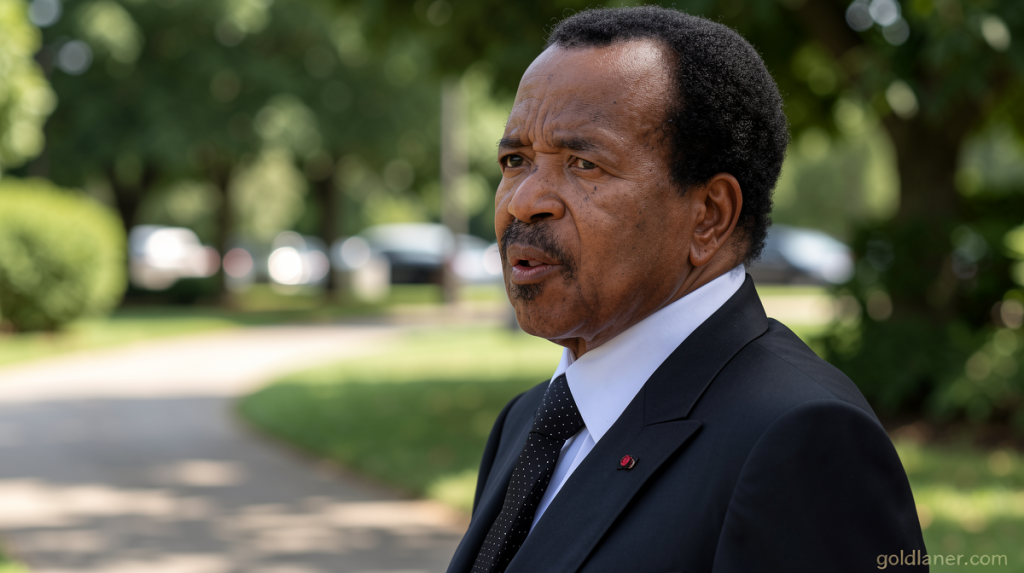
Cameroon’s Elder Statesman Extends European Sojourn Amid Renewed Scrutiny
Goldlaner.com – Paul Biya, the 93-year-old leader who has guided Cameroon through more than four decades of political transformation, remains in Europe for what has become his most extended departure from the nation since assuming power in 1982. The government initially characterized his June 7 departure as a “brief private stay,” yet nearly two months have passed without his return to Yaoundé.
A Leader Beyond Centuries of History
Biya’s longevity in office places him among the world’s most enduring heads of state. Having first captured the presidency in 1984 under Cameroon’s one-party system, he subsequently secured six additional electoral victories following the introduction of multiparty democracy. His most recent contested victory, won last year, carries the potential to extend his tenure until he approaches his century mark. Before that election, Biya expressed confidence in his future, declaring that “the best is yet to come.” His opponents, however, characterized the vote as fraudulent and noted that it was accompanied by violent confrontations between demonstrators and security forces.
The current situation has prompted renewed examination of Cameroon’s governance structure. Government spokesman René Emmanuel Sadi provided limited updates to French radio station RFI last week, confirming that Biya resides in Geneva, Switzerland, and is not undergoing hospitalization, though he offered no further specifics regarding the president’s activities or planned return date.
Health Speculation and Media Management
Rumors concerning Biya’s wellbeing and location have circulated throughout Cameroonian public discourse for years, particularly given the president’s infrequent appearances in public settings. His administration has consistently countered narratives suggesting serious illness or even death. In 2024, authorities elevated this issue to national security status by prohibiting media coverage of Biya’s health condition.
Despite his prolonged absence, Biya has maintained executive authority from abroad. Earlier this month, he authorized a significant reorganization of military leadership, demonstrating that his operational capacity remains intact. Sadi addressed concerns about potential governance gaps, asserting to RFI that “President Paul Biya is alive” and emphasizing that his return “will soon” occur.
Generational Perspectives on Biya’s Rule
The contrast between Cameroon’s youthful demographics and its aging leadership represents a broader continental pattern. While Africa possesses the world’s youngest population, numerous nations continue to be governed by leaders whose political trajectories originated decades ago, many of them former liberation movement figures navigating contemporary challenges.
For millions of Cameroonians, Biya represents continuity across generations. Nformi Bime, now 65 and retired from teaching, was merely 23 years old and still pursuing his education when Biya first won the presidency in 1984. Bime’s own children span a remarkable age range—his eldest is 32 while his youngest has just turned 18. This generational span illustrates how Biya’s presidency has encompassated virtually every stage of Cameroonian social development.
Abit Riassai Acha, a 26-year-old doctoral candidate and community youth leader at the University of Yaoundé II, shares this perspective. “Growing up, President Biya was the only president I knew, so his presidency has been part of my entire experience of Cameroon,” Acha explained. Notably, Acha participated in last year’s presidential election for the first time, casting a ballot for Samuel Hiram Iyodi, the 38-year-old opposition candidate.
Political Implications and Constitutional Questions
Biya’s extended European stay has reignited debates about presidential accountability. Iyodi, who placed eighth in last year’s contested election—despite several candidates, including one of Biya’s principal challengers, being excluded from the ballot—has petitioned parliament to request that Cameroon’s Constitutional Council evaluate whether the president’s absence constitutes a vacancy in the office.
Such a constitutional challenge faces considerable obstacles given the Cameroon People’s Democratic Movement’s entrenched dominance in the country’s political apparatus. Nevertheless, Acha emphasized that familiarity with prolonged absences does not eliminate the necessity for democratic oversight. “Because this has happened repeatedly over the years, many Cameroonians have become used to it,” she observed. “But becoming accustomed to something does not necessarily mean that people should stop asking questions about how the country is being governed.”
Historical Echoes
Bime’s recollections extend even further back than Biya’s presidency. He first encountered the future president’s name during the 1970s, when Biya served as secretary-general of the presidency under Ahmadou Ahidjo, Cameroon’s inaugural post-independence leader. Following Ahidjo’s resignation in 1982, Biya assumed the presidency. When Biya first appeared on the electoral ballot two years later, Bime viewed him as “a representation of hope,” describing him as “young and dynamic – handsome too” and noting that “he meant so much to Cameroonians.”
Very few observers at that time could have anticipated that the figure they perceived as a fresh beginning would remain at the helm of Cameroonian affairs for more than four decades. For Biya’s detractors, the frustration extends beyond mere longevity; it encompasses what they perceive as insufficient progress in improving citizens’ daily lives during his extended tenure.
Related Reading
Frequently Asked Questions
What is The world s oldest president left?
The world s oldest president left is the main topic of this guide. The article explains the context, practical details, and next steps readers should understand.
Why does The world s oldest president left matter?
The world s oldest president left matters because readers are looking for a useful answer, not just a short summary. Good content should match search intent and help them decide what to do next.