
The smell of death lingers in Venezuela’s ruined streets as overwhelmed hospitals race to save lives
The Smell of Death Lingers in Venezuela’s Ruined Streets as Overwhelmed Hospitals Race to Save Lives
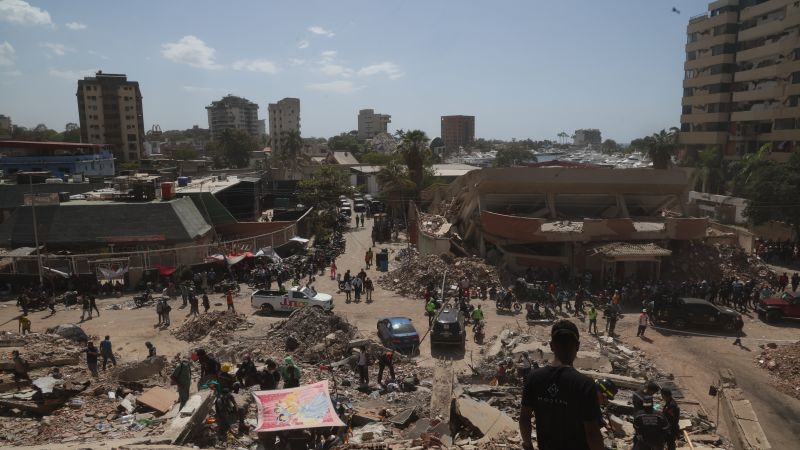
The smell of death lingers in Venezuela – Two powerful earthquakes struck Venezuela last Wednesday, tearing through its already fragile infrastructure and exposing the nation’s deepening crisis. While the tremors have left a trail of destruction, the real challenge lies in the overwhelmed healthcare system, which struggles to cope with the growing number of casualties. The Dr. José Manuel de Los Ríos Children’s Hospital in Caracas stands as a stark symbol of this struggle, where medical staff are forced to treat only a handful of patients despite the scale of the disaster.
Years of Strain Beneath the Surface
Venezuela’s healthcare system has been under siege for over a decade, with government mismanagement and economic sanctions exacerbating its decline. Dr. Huníades Urbina-Medina, a physician at the Dr. José Manuel de Los Ríos Children’s Hospital, described the situation as dire. “We used to handle up to 10 patients in the ICU, but for at least a decade, we’ve lacked enough personnel, medicines, and mechanical ventilators,” he said. Now, with the earthquakes, the hospital can only accommodate four children at a time, highlighting the long-term neglect that has left the country unprepared for such a catastrophe.
“No hospital in Venezuela is prepared for the day-by-day,” Urbina-Medina said. “But with this disaster, it’s worse because we don’t have enough medicines, personnel, equipment here.”
Among the four patients in the ICU is a 12-year-old girl who was crushed by a collapsed building. Her condition is critical, with multiple life-threatening injuries that require constant attention. While this case is heartbreaking, it represents just a fraction of the 100 children treated at the hospital since the earthquakes. The numbers are expected to rise as rescue teams sift through the rubble.
Uncertain Casualty Counts and Underestimated Damage
The Venezuelan government has released casualty figures that many believe understate the true scale of the disaster. As of now, more than 1,900 people are reported dead, and over 10,000 are injured. However, experts warn that this tally is likely incomplete. The US Geological Survey estimates that the magnitude 7.2 and 7.5 earthquakes could have claimed tens of thousands of lives, a figure that may never be confirmed. This uncertainty is partly due to the lack of transparency in reporting.
Historical precedents suggest the government may continue to downplay the death toll. In 1999, when a similar earthquake hit the La Guaira state, officials never released an official count. On Monday, Ecuadorian rescuers reported pulling a 12-year-old boy alive from the rubble, a moment of hope in a city where the “golden window” for survival after an earthquake has already closed. The dwindling chances of rescue are a grim reminder of the limited resources available.
Impact on Education and Community Shelters
While hospitals grapple with overcrowding, the earthquake has also damaged 432 schools in Caracas, some of which are now being used as temporary shelters. The situation has forced families to set up camp near collapsed buildings, enduring the stench of decay that lingers in the air. “It’s overwhelming, but we don’t let it stop us,” said Mirella Herrera, a mother waiting for news of her child trapped in the rubble.
Earlier this week, the government extended school closures as part of its emergency response. Schools that remain standing are serving as makeshift homes for thousands of displaced individuals, with overcrowded conditions adding to the strain. The dual crises of healthcare and education reflect a broader pattern of systemic failures that have deepened over years of economic turmoil.
Brain Drain and the Loss of Critical Resources
Before the earthquakes, Venezuela’s healthcare system was already facing a severe shortage of skilled professionals. Doctors who spoke with CNN echoed Urbina-Medina’s concerns, noting that eight hospitals in Caracas have been forced to close, and the rest are operating at maximum capacity. “We lack basic cleaning supplies like bleach and disinfectant,” said Dr. Andrés Cortiz, a volunteer with Healing Venezuela, a British charity providing free medical care in the country. “It’s not just about treating patients—it’s about preventing infections and keeping the environment safe.”
Many qualified medical staff have left the country in search of better opportunities, a brain drain that has worsened as the socialist government’s policies have faltered. This exodus has left hospitals understaffed and under-equipped, with supplies dwindling to critical levels. The end of Cuba’s long-standing medical mission in Venezuela, following the U.S. capture of then-President Nicolás Maduro in January, further cut off access to essential care in underserved regions.
A Nation in Crisis: Challenges Beyond the Immediate
The World Health Organization (WHO) confirmed that hospitals are now under “significant strain,” with overcrowding and chaotic operations threatening to worsen the situation. A spokesperson for the UN agency, Christian Lindmeier, noted that at least three health centers are critically damaged, while six others are only partially functional. “This is not just a temporary crisis—it’s a systemic breakdown,” Lindmeier said.
The earthquakes have accelerated existing problems, but their roots lie in years of mismanagement. The country’s economic sanctions, imposed by the United States, have contributed to hyperinflation, shortages, and a collapse in public services. Even before the disaster, the government had defended its healthcare system as resilient, blaming external pressures for its shortcomings. However, the reality on the ground tells a different story—one of crumbling facilities and exhausted workers.
As the days pass, the smell of death becomes more persistent in Caracas. The stench of decay clings to the ruins of buildings that once housed families, creating an environment of grief and resilience. Families who remain hopeful continue to gather at the edges of collapsed structures, waiting for any sign that their loved ones may still be alive. For them, the battle is not just against the earthquake, but against the slow erosion of Venezuela’s ability to respond to its people’s needs.
The earthquakes have acted as a catalyst, revealing the cracks in a system already on the brink. With no clear end to the crisis in sight, the question remains: how many more lives will be lost before Venezuela can stabilize its healthcare and infrastructure? As rescuers move on and the search for survivors slows, the road ahead grows darker, but the determination of those working to save lives remains unyielding.
