
The Milky Way’s black hole is eerily quiet. Scientists have now found evidence of its missing wind
The Milky Way’s Black Hole Wind Discovered: Study Solves 50-Year Mystery
Uncovering a Silent Giant
The Milky Way s black hole – The Milky Way’s black hole, Sagittarius A*, has long been a mystery to astronomers. For over half a century, scientists have questioned why this supermassive black hole appears so quiet, unlike its counterparts in distant galaxies. Despite its immense gravitational pull, Sagittarius A* has shown minimal visible activity, prompting researchers to search for hidden phenomena that might explain its behavior. A recent breakthrough in imaging technology has now revealed compelling evidence of a previously unseen wind, challenging existing theories and offering new insights into the dynamics of galactic centers.
Mapping the Invisible Forces
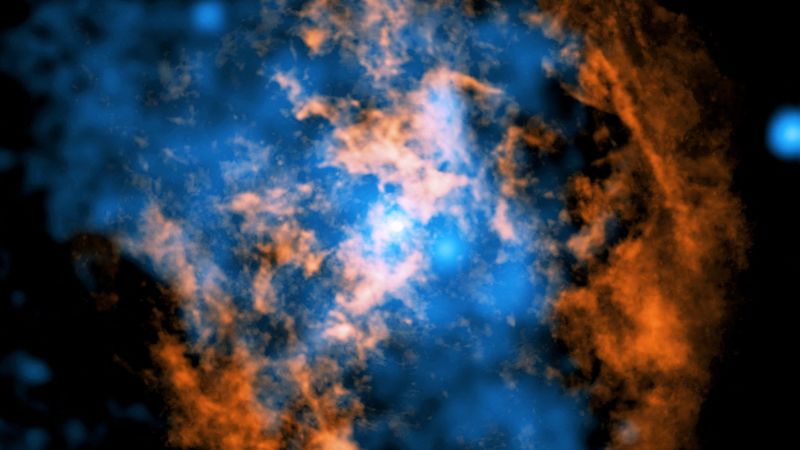
Using advanced data from the Atacama Large Millimeter/Submillimeter Array (ALMA) in Chile, researchers Mark Gorski and Lena Murchikova have uncovered a striking feature in the galaxy’s core: a large, cone-shaped cavity devoid of cold gas. This discovery suggests that a high-energy wind is actively shaping the environment around The Milky Way’s black hole. The cavity, stretching about 3 light-years in length, points directly back to Sagittarius A*, providing direct evidence of a plasma-driven outflow. This wind, though not as intense as those observed in other galaxies, is powerful enough to push aside surrounding material, creating the observed void.
Further analysis by NASA’s Chandra X-ray Observatory has corroborated this finding. The interaction between the hot plasma and cold gas indicates that the wind’s energy is sufficient to disturb dense material, much like a hair dryer affects damp hair. “The wind is warm and strong enough to heat and move the cooler gas around, but not enough to completely strip it away,” Gorski explained in a statement. This analogy helps visualize how The Milky Way’s black hole exerts its influence on the galactic ecosystem.
Revisiting Galactic Dynamics
Black holes are known to expel high-speed particles through winds or jets, which play a vital role in regulating star formation and galaxy evolution. However, The Milky Way’s black hole has defied expectations by showing minimal signs of such outflows. Gorski noted that this is our closest and best-studied supermassive black hole, yet it seemed to lack a detectable wind. The absence of recent activity raised questions about whether its behavior was unique or if our observational tools had been insufficient.
Historical observations of Sagittarius A* had only captured faint traces of ancient eruptions, dating back more than 20,000 years. These remnants suggested that the black hole had been active in the past but had since become dormant. The new study, however, reveals that the wind has been present all along, hidden in plain sight. By combining data from multiple sources and refining analytical techniques, researchers have finally identified its subtle yet significant impact on the surrounding medium.
Implications for Galactic Evolution
Christopher Reynolds, a professor of astronomy at the University of Maryland, highlighted the study’s importance in understanding The Milky Way’s black hole. “This research provides a strong case that a wind from our galaxy’s central black hole has been shaping the interstellar medium,” he said. The wind’s interaction with dust and gas may regulate the growth of Sagittarius A* and influence the formation of new stars. This finding bridges a critical gap in our knowledge of how black holes interact with their host galaxies, offering a more complete picture of their role in cosmic evolution.
While the wind is not as intense as those seen in other galaxies, its presence underscores the complexity of black hole dynamics. The discovery also raises questions about the variability of supermassive black holes. Are they uniformly active, or do factors like their mass or environment affect their behavior? As more studies emerge, the role of The Milky Way’s black hole in the galactic ecosystem will continue to be refined, deepening our understanding of these cosmic powerhouses.
