
NASA reveals Artemis III crew that will take the next big step on its journey back to the moon
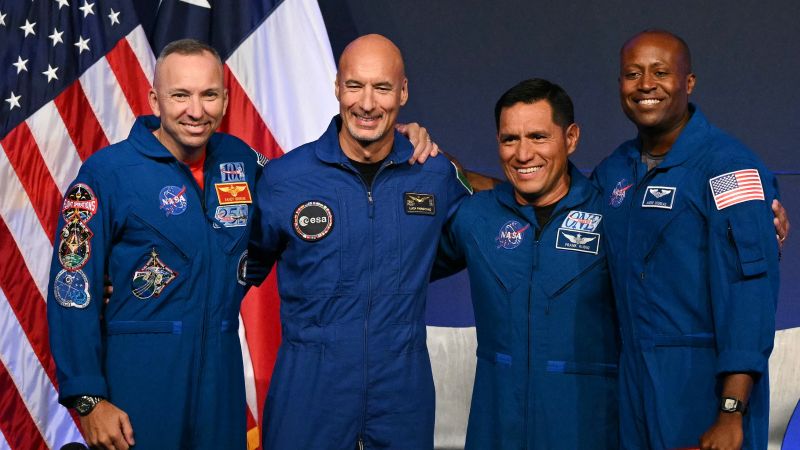
NASA Reveals Artemis III Crew: Key to Lunar Return
NASA reveals Artemis III crew that – NASA has announced the final selection of astronauts for the Artemis III mission, marking a significant milestone in its quest to return humans to the moon. The four crew members, chosen after a rigorous process, will embark on a two-week journey aimed at validating critical technologies for future lunar landings. This mission, scheduled for launch in late 2027, represents a strategic step toward NASA’s broader goal of establishing a sustainable presence on the moon. The Artemis III crew includes three NASA astronauts—Andre Douglas, a first-time space traveler; Frank Rubio, a veteran with extensive flight experience; and Randy Bresnik, a seasoned test pilot—as well as Luca Parmitano, an ESA astronaut.
A Step Toward Sustainable Lunar Exploration
Artemis III is designed to test the integration of NASA’s Orion spacecraft with a lunar lander, a crucial component for the eventual moon touchdown. The mission’s primary focus is to reduce risks associated with landing on the lunar surface, which NASA aims to achieve by 2028. During the flight, astronauts will simulate the complex process of transferring from the Orion capsule to a lander while in lunar orbit, though the exact vehicle will be tested in low-Earth orbit for simplicity. This approach allows for thorough system evaluation without the challenges of deep-space travel.
Testing Compatibility with Commercial Partners
The Artemis III mission may involve docking with both the SpaceX Starship and Blue Origin Blue Moon lander, as NASA administrator Jared Isaacman highlighted during Tuesday’s press conference. “Orion will rendezvous and dock with the Blue Origin lander, and then again with the SpaceX lander,” he stated, underscoring the agency’s intent to validate multiple systems simultaneously. This flexibility is vital as NASA evaluates which lunar lander will be most reliable for long-term missions. However, the recent explosion of Blue Origin’s New Glenn rocket during a ground test has introduced uncertainty into the timeline, though the company remains committed to meeting its goals.
The Artemis III crew has been assembled with speed and precision, reflecting NASA’s commitment to aggressive progress in space exploration. This mission’s structure builds on earlier programs like Mercury and Gemini, which laid the groundwork for the Apollo missions. By focusing on incremental testing, NASA ensures that each phase is mastered before moving to the next. The Artemis III crew will play a pivotal role in this strategy, bridging the gap between current capabilities and the next phase of lunar exploration.
Experience and Diversity in Crew Selection
The Artemis III crew is composed of astronauts with diverse backgrounds and expertise. While the team is currently male-dominated, NASA has emphasized its dedication to gender diversity in future missions. “We’ll certainly have female military test pilots—or other female astronauts—on the follow-on Artemis missions,” said Randy Bresnik, who acknowledged the necessity of selecting experienced personnel for this critical phase. The inclusion of Luca Parmitano, an ESA astronaut, also highlights international collaboration, a key aspect of NASA’s Artemis program. This blend of expertise ensures the mission’s success and sets the stage for more inclusive crews in upcoming missions.
Artemis III’s timeline is tightly woven with the development of NASA’s Space Launch System (SLS) rocket. A key milestone is the completion of a “wet dress rehearsal” by the end of 2026, which simulates the full launch sequence to identify any technical challenges. Despite the SLS’s delays and higher costs compared to commercial alternatives like SpaceX’s Falcon Heavy or Blue Origin’s New Glenn, it remains central to NASA’s lunar
