
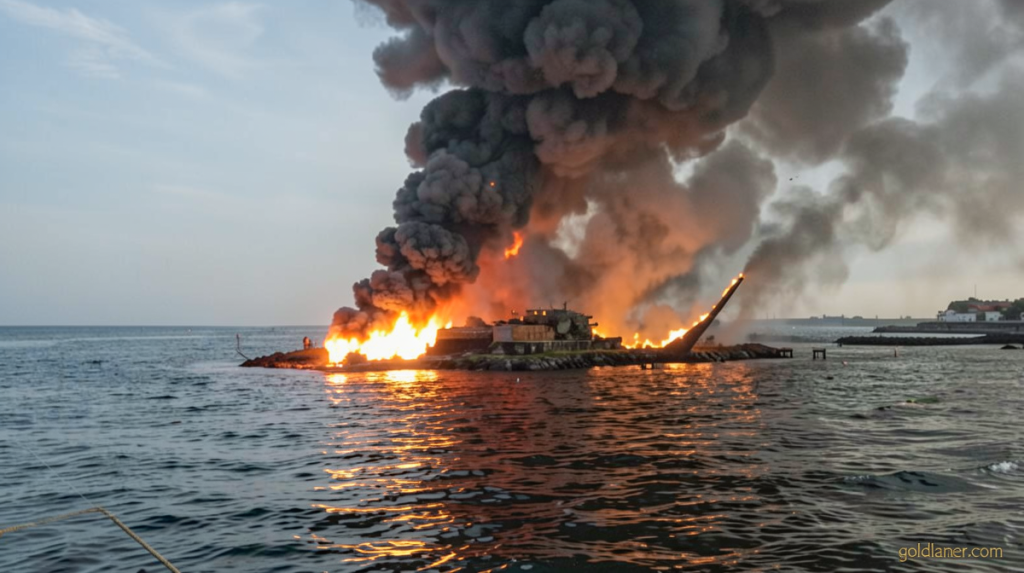
Two Ecuadorian Fishing Crews Describe Being Hunted by Drone Strikes in Pacific Waters
Goldlaner.com – In the vast stretch of open ocean roughly 170 miles southwest of the Galápagos Islands, two separate Ecuadorian fishing vessels were struck by small rotor drones carrying explosives in March, their crews say. The incidents, which left multiple fishermen wounded and one boat ablaze, have drawn sustained attention in Washington, where a claim has surfaced that the strikes formed part of a covert Central Intelligence Agency operation. A CIA spokesperson, when asked for comment, offered only: “We do not have any guidance to offer on this.”
The two crews — aboard the La Negra Francisca Duarte II and the Don Maca — describe nearly identical sequences of events, though the attacks occurred on different dates and targeted different boats. What follows is reconstructed from the fishermen’s own accounts, supplemented by satellite imagery, flight-registration data, and testimony shared by their attorney, Jorge Chiriboga Dávalos.
The Approach: A Blue Ship and Distant Rotor Noise
Both crews were several days into routine fishing voyages when they first noticed something unusual on the horizon: a blue-hulled vessel keeping a steady distance. Alongside it, small drones appeared to shadow the boats without closing in. At the time, neither crew felt threatened. They continued hauling nets and working their stations, assuming the craft belonged to another commercial operation or a research vessel.
Within a day or two, that assumption shattered.
The Strikes
The La Negra Francisca Duarte II was hit on March 17. The Don Maca followed on March 26. In both cases, the fishermen describe no warning, no hail, no visible launch platform nearby. A pair of drones appeared almost overhead and either dropped ordnance or collided directly with the hulls.
Hernán Flores, captain of the La Negra Francisca and its crew of 16, recalls the moment with visceral clarity:
“We heard the explosion – boom! It was the kind of blast that left my ears ringing. Right then, I felt blood running down me.”
Flores says one drone crashed into the vessel and struck his nephew, Jordyn, in the foot, causing a severe injury. Flames from the detonation also scorched the upper back of another crew member, according to Chiriboga Dávalos, who shared photographs of the wounds with journalists.
On the Don Maca, whose complement numbered 20, the effects were equally violent. Jaime Rubén Cervantes Macías, a deckhand, described being thrown by the first blast:
“I went flying and slammed into a diesel tank that was sitting there. People were shouting, ‘Drone, drone, drone!’ So, I jumped up quickly to take a look – and it was a drone firing at us, dropping the bomb on us.”
Crewmate John Sebastián Palacios reported lasting hearing damage from the concussive noise. Another fisherman said the attack injured his left eye, robbing him of most of his vision in that eye.
What the Drones Looked Like
Both crews describe the aircraft as compact — roughly the dimensions of a household pillow — with rotors mounted at each of four corners and a cylindrical tube suspended beneath the center frame. That tube, they believe, served as the dispensing mechanism for the explosives. On the La Negra Francisca, the first drone apparently detonated after impacting the vessel’s gas tanks; on the Don Maca, the second drone appears to have released a free-falling charge before departing.
The Gray Aircraft Overhead
At some point during each incident, both crews report sighting a second, larger craft circling above the scene. Flores called it a “mini plane” with elongated wings. A sketch he produced shows a fuselage with a rounded, bulbous nose tapering toward the rear body — a profile consistent with a small fixed-wing surveillance platform.
Public flight-registration records indicate that an aircraft registered to a company whose mailing address is listed as a private mailbox at a United Parcel Service store in Richmond, Virginia, was patrolling the vicinity of the boats’ last recorded positions around the time of the strikes.
The Blue Ship and Armed Detention
After their vessels were damaged, both crews abandoned the burning or listing boats, transferred to smaller auxiliary craft, and rowed toward the blue ship they had seen days earlier. When they arrived, armed men aboard trained rifles on them. Only after several fishermen indicated they were wounded did the armed men permit boarding.
Once aboard, the fishermen say they were detained and questioned. In the second incident, involving the Don Maca, the attackers reportedly carried out additional strikes to ensure the vessel sank before departing with the survivors. The La Negra Francisca was left burning in place.
Hours after the first alleged attack, another fishing crew happened upon the site and recorded video of the vessel engulfed in flames, Chiriboga Dávalos confirmed. That crew logged the burning vessel’s coordinates at 1.591783, −87.741783 — a position well within Ecuador’s exclusive economic zone, far from any commercial shipping lane. A National Oceanic and Atmospheric Administration satellite detected a thermal signature consistent with a fire at that location on March 17 at 3:02 p.m., shortly after the reported first strike.
Why It Matters
Ecuador’s Pacific coastline and the waters surrounding the Galápagos archipelago have long been focal points for regional and international interest. The zone supports a modest but economically vital artisanal and semi-industrial fishing sector, and its proximity to major trans-Pacific shipping corridors makes it a natural corridor for surveillance, interdict, or covert operations. The Galápagos themselves, a UNESCO World Heritage site, sit at the intersection of several national maritime claims and have drawn periodic attention from foreign navies and intelligence services.
The claim that a U.S. intelligence agency orchestrated the strikes, if accurate, would raise questions about the legal basis for kinetic operations inside another nation’s exclusive economic zone, the status of the armed men aboard the blue vessel, and the chain of command behind the drone launches. Ecuador’s government has not, as of this writing, issued a formal statement identifying the perpetrators or requesting a diplomatic explanation.
For the fishermen involved, the questions are more immediate: who ordered the strikes, why their boats were singled out, and whether the injuries sustained — shattered feet, burned skin, lost vision, permanent hearing damage — will be compensated. Chiriboga Dávalos, representing both crews, has indicated that legal proceedings are being prepared. Until answers arrive, the two groups remain in limbo, their livelihoods interrupted by an event they can describe in precise, sensory detail but place in no familiar framework.
Related Reading
Frequently Asked Questions
What is Mysterious bomb dropping drones sank their?
Mysterious bomb dropping drones sank their is the main topic of this guide. The article explains the context, practical details, and next steps readers should understand.
Why does Mysterious bomb dropping drones sank their matter?
Mysterious bomb dropping drones sank their matters because readers are looking for a useful answer, not just a short summary. Good content should match search intent and help them decide what to do next.