
Putin’s Predator Metaphor: A Window Into Moscow’s War Posture at the SCO Summit
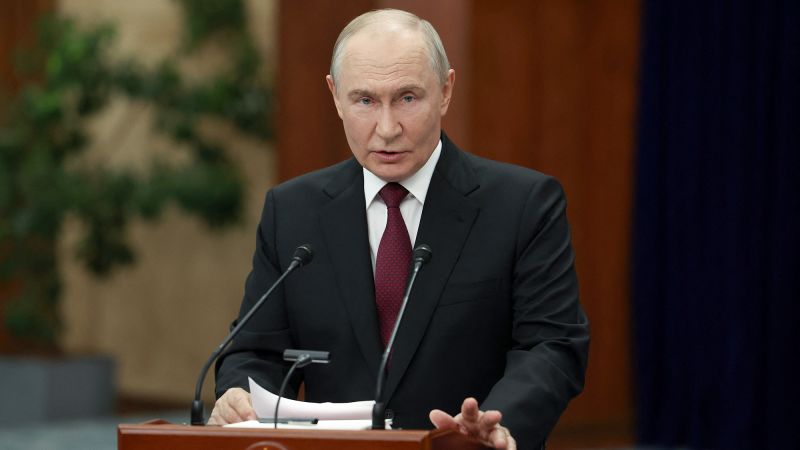
Goldlaner.com – The Shanghai Cooperation Organization gathered its member-state leaders in Bishkek, Kyrgyzstan, this week for what was meant to be a routine multilateral summit. Vladimir Putin arrived alongside Chinese President Xi Jinping, Indian Prime Minister Narendra Modi, and Iranian President Masoud Pezeshkian, all of whom convened during a period of acute regional instability. Iran and the United States had just exchanged another round of retaliatory strikes, Russian aviation drones and ballistic missiles continued to rain down on Ukrainian cities, and Berlin had publicly accused Moscow of responsibility for a drone that struck Leipzig airport last month. Against that backdrop, the Russian president seemed entirely at ease, delivering a message that left little ambiguity about how he views the ongoing conflict and his negotiating posture toward Washington.
The Orca and the Shark
In a press conference late Tuesday, Putin seized on a comparison he had made days earlier — one involving killer whales consuming polar bears — and expanded it into a full geopolitical parable. Kremlin pool reporter Pavel Zarubin pressed him on the marine-biology analogy, and Putin framed his earlier remark as a “spontaneous” illustration of Russia’s standoff with Western powers.
“I would say that the orca is, without doubt, a formidable predator, yet it is also a highly intelligent creature, a cunning one,” he said. “The collective West, for its part, was assigned a specific definition in the Soviet era, which remains current to this day – the sharks of imperialism.”
He pressed the metaphor further, drawing a line between the apex predator and the pack hunter.
“The thrust of my remarks was that if anyone attempts to drag us down the food chain and devour us, to consume us, they would be well advised to expect their teeth to be broken,” he said. “And Russia stands ready to do precisely that, despite the insatiable appetites and ever-sharpening teeth of these sharks.”
The rhetorical choice was deliberate. By casting Russia as the orca — solitary, intelligent, dominant — and the West as a school of sharks, Putin reinforced a narrative of asymmetric strength. The domestic audience hears a message of invincibility; international counterparts hear a signal that Moscow will not concede ground on the battlefield regardless of economic pressure or territorial setbacks.
Ukraine Under Fire and the Airspace Debate
The timing of the remarks coincided with Ukraine’s new school year, in which children in several oblasts were instructed to head to underground shelters before entering classrooms as Russian strikes continued. Ukrainian President Volodymyr Zelensky warned on Tuesday that Russian airspace “will effectively be closing” because of the growing density of Ukrainian drones operating inside or near Russian borders. Putin, asked about the comment, said he had not heard it and dismissed the framing outright.
“Such comments amount to nothing less than a call for state-sponsored terrorism. And I would point out that they are asking us to resume negotiations and requesting face-to-face meetings. One does not negotiate with terrorists.”
The characterization matters because it forecloses a diplomatic pathway. If Ukrainian drone operations are branded terrorism, then any Ukrainian demand for talks while those operations continue becomes, in Putin’s framing, an incoherent ask. It also insulates Moscow from criticism over its own deep-strike campaign, which has targeted energy infrastructure and civilian areas across multiple regions.
Leipzig and the Question of Proof
Germany’s accusation that a Russian drone was behind last month’s incident at Leipzig airport drew a characteristically combative response. Putin suggested Berlin had staged the scene — planting evidence to manufacture a pretext for further escalation.
“There is only one explanation offered: the need to counter an ‘aggressive Russia,'” he said. “But where is the proof? Well, now some ‘proof’ has been planted.”
The Leipzig episode has complicated relations between Moscow and Berlin at a moment when Germany is ramping up its own defense spending and seeking to anchor a European security architecture that does not depend solely on American guarantees. Putin’s flat denial, without offering any alternative forensic account, leaves the question unresolved but signals that Moscow will not accept Western attribution absent what it considers irrefutable evidence.
Back Channels to Washington
Despite the bellicose tone aimed at Kyiv and Berlin, Putin struck a noticeably softer register when the conversation turned to the Trump administration. He was asked about a recent trip to Moscow by CIA Director John Ratcliffe, and while he offered no specifics about what was discussed, he characterized the intelligence-to-intelligence contacts as constructive.
“Contacts are always there, even during the most difficult times of the Cold War, and they are even more so now,” he said. “We favor negotiations, any negotiations, being filled first and foremost with concrete content. And if someone makes or can make a concrete contribution to this process, we’re all for it.”
Putin then identified the two figures he considers most useful as intermediaries with President Donald Trump: special envoy Steve Witkoff and Jared Kushner, the president’s son-in-law. Both have been informally involved in back-channel diplomacy since early in the current administration.
“These are people close to President Trump. In my opinion, they are sincere people and strive to bring concrete substance to our work. And the president trusts them, which is very important, and without this it is generally impossible to conduct any negotiations,” the Russian leader said. “Both Mr. Kushner and Witkoff are always welcome guests to us, and we are happy to work with them.”
The preference for Witkoff and Kushner over formal State Department channels is itself a signal. It suggests Moscow views the Trump White House as a transactional partner in which personal trust substitutes for institutional process. For Trump’s Ukraine peace hopes, that dynamic cuts both ways: it opens a fast lane for deal-making, but it also concentrates enormous leverage in two individuals whose mandates remain opaque to Congress, to NATO allies, and to Kyiv.
What the Bishkek Signals Mean
Read together, the Kyrgyzstan remarks sketch a strategy. On the battlefield, Putin intends to sustain pressure — drone saturation, deep strikes, and the erosion of Ukrainian air defenses — until Kyiv’s capacity to contest Russian operations degrades further. Diplomatically, he keeps a narrow door open to Washington through trusted personal intermediaries while publicly branding any Ukrainian initiative as terrorist posturing. The SCO summit itself, with its emphasis on multipolarity and non-Western institutional architecture, provided a stage where Putin could project strength without the scrutiny of a Western-organized forum.
For Trump, the calculus is uncomfortable. The president has spoken repeatedly of wanting a swift end to the war, yet his counterpart in Moscow is simultaneously sharpening his teeth, as it were, and inviting the very people closest to the American president into his orbit. Whether that invitation leads to a durable settlement or to a managed continuation of the conflict depends on whether “concrete content” ever materializes — and whether the sharks, in Putin’s own taxonomy, decide to keep swimming.
Related Reading
Frequently Asked Questions
What is It s always Shark Week in Putin?
It s always Shark Week in Putin is the main topic of this guide. The article explains the context, practical details, and next steps readers should understand.
Why does It s always Shark Week in Putin matter?
It s always Shark Week in Putin matters because readers are looking for a useful answer, not just a short summary. Good content should match search intent and help them decide what to do next.