
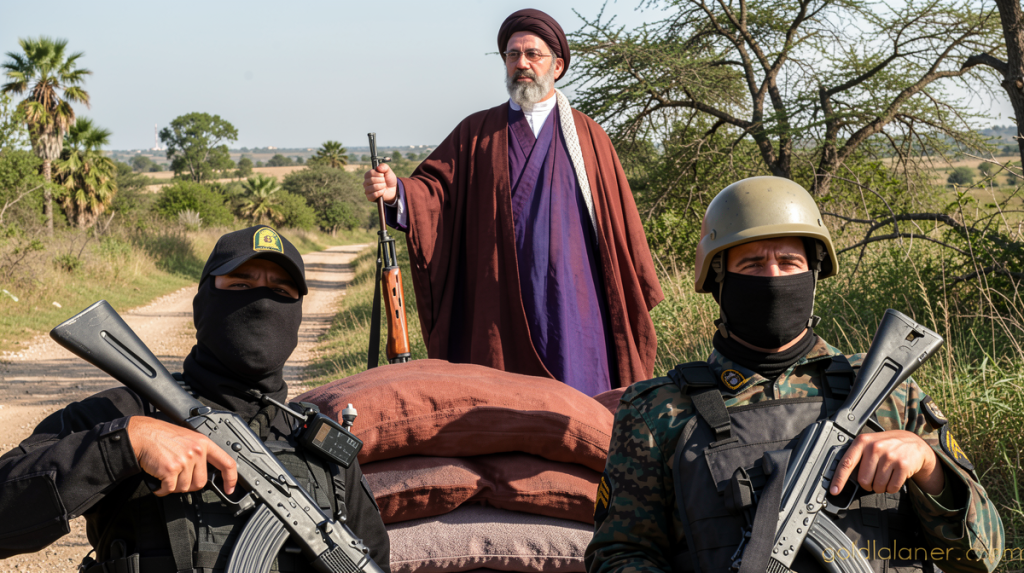
Tehran’s New Offensive Doctrine: How Iran’s Hardliners Are Redrawing the Rules of the War
Goldlaner.com – The Memorandum of Understanding that was supposed to bring the US-Iran conflict to a close is running out of time, and with it, the fragile architecture of a ceasefire that never fully held. Control of the Strait of Hormuz remains contested, and Washington’s President Donald Trump — who launched the war roughly six months ago — continues to oscillate between telling the world that Tehran is “begging” for a negotiated settlement and warning that military strikes will resume. Into that vacuum of ambiguity, Iran’s hardline establishment is now stepping forward with a deliberately sharpened posture: not merely to defend, but to strike first, strike often, and force the United States to negotiate from a position of weakness.
Leadership Shuffles Signal a Strategic Pivot
The institutional machinery behind this shift was set in motion last week through a series of decrees issued under the name of Supreme Leader Mojtaba Khamenei, reorganizing the country’s security command structure. Among the most consequential appointments was the confirmation of Ahmad Vahidi as head of the Islamic Revolutionary Guards Corps (IRGC). The decree accompanying that decision explicitly called for heightened readiness toward what it termed “strong offensive operations against the enemy” — language that departed markedly from the defensive framing that had dominated Iranian military rhetoric since the war began.
Mohsen Rezaie, installed as the new chair of the Supreme National Security Council, belongs to an IRGC faction whose strategic calculus is blunt. As Sina Azodi, an assistant professor of Middle East politics at George Washington University, put it earlier this month, that faction holds that
“the only way to get concessions from the US is the continuation of fighting, exerting pressure on the US and a steady dose of pain on Donald Trump.”
Hamidreza Azizi of the Clingendael Institute in the Netherlands read the Vahidi appointment as an unambiguous signal: the new IRGC chief’s mandate was to recalibrate Iranian military planning toward a more assertive, forward-leaning posture.
From Defense to “Enemy Soil”
Within days of the decree, Brig. Gen. Yadollah Javani, the IRGC’s political deputy, told the semi-official Fars news agency that Iran’s actions remained defensive in character but “may also take on an offensive aspect in the future.” Mohammad Reza Naqdi, another adviser close to Vahidi, went further in remarks to state broadcaster IRIB, stating that the corps was building the capacity to conduct operations
“on enemy soil… We need to be able to move the operations to the enemy’s soil, whenever this is needed and ordered.”
In practical terms, that language points toward renewed targeting of American military installations across the Gulf region. The IRGC has been tasked with launching attacks in what Naqdi described as an “intelligent, selective, and targeted manner.” On the hardware side, analysts note that a newer generation of more maneuverable ballistic missiles fitted with cluster warheads, combined with increasingly creative drone employment, suggests Tehran has adapted its tactical playbook at speed over the past several months.
Allies Mobilized: Yemen, Iraq, and the Saudi Periphery
The offensive doctrine does not operate in isolation from Iran’s broader axis of partners. In recent weeks, Houthi forces in Yemen have pressed threats against Saudi commercial shipping and carried out strikes on Saudi oil refineries. Simultaneously, Iranian-backed militias operating in Iraq have turned their attention to Saudi energy infrastructure. The geographic spread of these actions — from the Red Sea corridor through Iraqi territory to the eastern Saudi flank — mirrors the kind of multi-front pressure that Tehran’s new leadership appears to want institutionalized rather than improvised.
Why Now: The Calculus of Escalation
The timing of this doctrinal shift is not accidental. With the MoU expiring and no replacement framework in sight, Iran finds itself in what Azizi characterizes as a “no-war-no-peace” limbo, compounded by deepening domestic economic strain. In that environment, he argues, the leadership faces a binary choice: escalate to compel Trump to lift the naval blockade or accept terms more favorable to Tehran, or accept the slow attrition of its own capabilities under the twin pressures of sanctions and maritime restriction.
“The Iranian leadership may conclude that the costs of entering another war are lower than the costs of the gradual erosion of its capabilities under the dual pressure of wections and the blockade.”
H.A. Hellyer, a senior associate fellow at the Royal United Services Institute in London, frames the moment differently but convergently. In his assessment, the regime has absorbed a sustained US-Israeli bombardment along with retaliatory strikes from Gulf Arab states and is “still standing.” What matters now, he argues, is whether Tehran converts that demonstrated resilience into a durable political advantage in the region rather than watching the initiative dissolve over time.
Trita Parsi of the Quincy Institute for Responsible Statecraft underscores the geographic and temporal stakes: by moving to the offensive, Iran would not merely respond to American strikes but would seize control over the scope, geography, and timing of the conflict itself — a fundamental inversion of the dynamic that has defined the past six months.
For Washington, the implications are direct. A Trump administration already struggling to articulate a coherent exit strategy now faces an adversary that is openly planning to dictate the tempo of engagement. The question is no longer whether Iran will defend its interests; the question is how far Tehran is willing to push the confrontation before the cost of doing so exceeds the concessions it hopes to extract.
Related Reading
Frequently Asked Questions
What is Iran s latest warning to the US?
Iran s latest warning to the US is the main topic of this guide. The article explains the context, practical details, and next steps readers should understand.
Why does Iran s latest warning to the US matter?
Iran s latest warning to the US matters because readers are looking for a useful answer, not just a short summary. Good content should match search intent and help them decide what to do next.