
From Fear to Farce: How Democrats Are Redefining Their War on Trump
Goldlaner.com – For most of Donald Trump’s first term back in the White House, the Democratic strategy was straightforward: terrify the electorate. Paint the president as an authoritarian figure consolidating unchecked power, and voters would rally behind the party’s warnings. That playbook, however, is being quietly retired. With polling showing Trump’s approval ratings sliding toward historic lows and his sprawling construction projects reinforcing the image of a leader more interested in monuments than governance, Democrats are pivoting toward something older and more corrosive — sustained, public ridicule.
The shift carries real electoral stakes. With midterm elections now less than two months away, the question facing the party is whether relentless mockery can accomplish more than energize base voters and pad campaign coffers. Can it inflict genuine political damage on a president who still has two years of executive authority remaining? The answer may determine whether the 2026 cycle becomes a referendum on Trump’s second term or merely another round of partisan theater.
Ossoff Steps Into the Spotlight
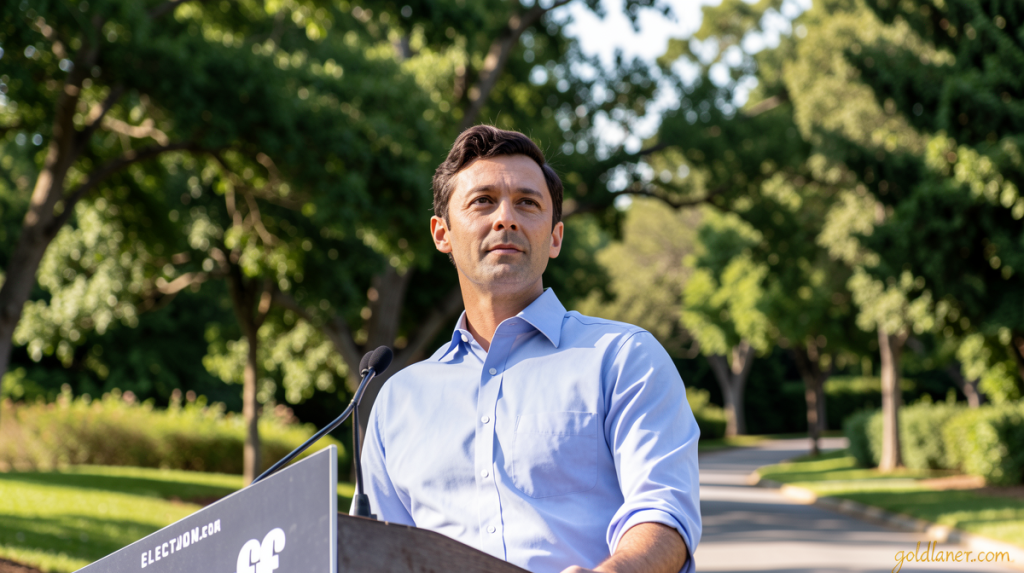
At the vanguard of this new rhetorical posture stands Georgia Senator Jon Ossoff, whose reelection campaign has begun to resemble a audition for the 2028 Democratic presidential field. On Tuesday, Ossoff delivered what he framed as a blunt assessment of the commander in chief:
“A draft-dodging, crook president who has plunged our nation recklessly into a war he knows not how to end or to win.”
The language was deliberately inflammatory, designed to land in clip-length segments across cable news and social feeds. But Ossoff went further than most predecessors have dared. He singled out Natalie Harp, a senior aide whose constant proximity to the president has made her a fixture of White House footage, and wove her into his critique. That choice invited immediate criticism from some Democrats who felt a third party was being dragged into a partisan fight. Yet it also demonstrated a willingness to play hardball in a race where the incumbent’s own staff has become a target of public fascination.
The president’s reaction was swift and volcanic. At a Monday event, when pressed on Ossoff’s remarks about Harp, Trump lashed out, comparing the senator to Pee Wee Herman — the bumbling, bespectacled figure from 1980s comedy. The comparison, four decades removed from its cultural peak, did little to project the youthful vigor the White House so desperately wants associated with its occupant. Within hours, conservative commentators who have long absorbed Trump’s sometimes-misogynistic barbs without comment found themselves condemning the president for what they framed as a petty, undignified retort. The White House issued its own furious pushback, signaling that the administration views sustained mockery as a threat to be neutralized rather than a political reality to be absorbed.
A Pattern Older Than Ossoff
The Georgia senator is not the first Democrat to weaponize absurdity against the president. Illinois Governor JB Pritzker, last year, took aim at Trump’s self-mythology by declaring on camera that “he cheats on his wives, he cheats at golf” — a line that played less like policy critique and more like a late-night monologue. California Governor Gavin Newsom has taken the approach further still, running social media accounts that mimic Trump’s own online cadence. One recent post read:
“MANY ARE SAYING HE CAN’T EVEN DO THE ‘BIG STAIRS’ ON AIR FORCE ONE ANYMORE.”
The tactic mirrors something Trump himself perfected: selecting a foil, amplifying the contrast, and letting the audience do the rest. In that sense, Democrats are borrowing the president’s own playbook and turning it against him. Whether that borrowing translates into votes remains the open question.
What Mockery Can and Cannot Do
The political logic behind the ridicule strategy is not frivolous. Trump has spent two decades cultivating an aura of invincibility — the strongman who bends institutions to his will. If sustained, specific attacks can chip away that mystique and expose what critics describe as brittleness and decline, the president’s already-fragile political position could deteriorate further. Moments when he appears to doze at Oval Office briefings, for instance, do double duty: they look terrible for a wartime leader, and they hand Democrats a ready-made image of diminished authority.
Yet history offers cautionary notes. At the 2024 Democratic National Convention, Barack Obama took aim at what he called “childish nicknames, the crazy conspiracy theories, this weird obsession with crowd sizes.” Vice presidential nominee Tim Walz scored a brief moment of traction by mocking Trump for serving fries at a McDonald’s drive-thru and labeling MAGA loyalists as “weird.” Neither effort altered the election’s outcome. Trump reclaimed the White House largely because the decisive variable was not his eccentricities but the catastrophic decision by a fading Joe Biden to seek reelection, followed by an unconvincing ticket pairing with Kamala Harris.
The 2026 landscape differs in important respects. Two years ago, Trump was riding the crest of what many called the greatest political comeback in modern history, projecting near-invincibility after surviving an assassination attempt. Today, the atmospherics have shifted. His first year back in office produced a relentless accumulation of executive power that lent credibility to earlier Democratic warnings about authoritarian drift. His struggles against Iran, his apparent dismissal of affordability concerns affecting millions of households, and the spectacle of his legacy-building construction projects all furnish openings that even a clumsy opposition might exploit.
The Risk of Joining the Brawl
Still, the calculus is not without danger. Trump operates as a feral street fighter in the political arena, and those who descend into his gutter tend to get roughed up. Every jab invites a counterpunch that can dominate the news cycle for days. Moreover, the broader appetite for stunt politics may be waning among voters who grew weary of spectacle during the 2024 cycle. Newsom’s parody accounts, for example, may gratify partisan Democrats while leaving swing voters unmoved or mildly irritated.
The midterm window is narrow. Democrats must decide, within weeks, whether ridicule functions as a wedge issue capable of pulling undecided voters away from a president whose popularity is at its lowest ebb — or whether it merely deepens the partisan trench, leaving the center of the electorate untouched. Ossoff’s steely-eyed takedowns have already elevated his national profile well beyond Georgia’s borders. Whether that elevation translates into electoral consequence, or simply into another memorable clip that fades by Friday, will become clear before the ballots are counted.
Related Reading
Frequently Asked Questions
What is Why Ossoff s savage lampooning of Trump?
Why Ossoff s savage lampooning of Trump is the main topic of this guide. The article explains the context, practical details, and next steps readers should understand.
Why does Why Ossoff s savage lampooning of Trump matter?
Why Ossoff s savage lampooning of Trump matters because readers are looking for a useful answer, not just a short summary. Good content should match search intent and help them decide what to do next.