
Inside a grass scientist’s 6-year quest to grow World Cup stadium turf
Inside a Grass Scientist’s 6-Year Quest to Grow World Cup Stadium Turf
Inside a grass scientist s 6 year – As the World Cup kicks off next week, the focus of many will shift to the action on the field. But for John Trey Rogers, the true spotlight lies beneath the players’ feet. A professor of turfgrass research at Michigan State University, Rogers has been instrumental in ensuring the grass across 16 North American venues meets the highest standards for the global tournament. While players chase goals and referees study strategies, Rogers meticulously oversees the turf that influences the game’s rhythm, player performance, and even injury risk.
The Grass Guru Behind the World Cup Pitch
Rogers, often referred to as a “grass guy” rather than a “soccer guy,” has dedicated six years to this endeavor. His expertise has been critical in replacing the fields at all 16 host stadiums, a task that demands precise calibration for each location’s unique climate and conditions. The World Cup, spanning six weeks and featuring 48 teams across the United States, Mexico, and Canada, presents a diverse range of environments—from the humid south to the cooler north. This variation complicates the selection of turf, as the grass must perform flawlessly under varying temperatures, humidity levels, and light exposure.
Eight of the venues are typically equipped with artificial turf, but for the World Cup, all fields are being converted to natural grass. This shift means the grass must be tailored to each stadium’s specific needs. In some cases, this involves completely removing artificial surfaces and installing fresh turf. The process is further challenged by the presence of five domed stadiums, which drastically limit sunlight—a vital factor for grass growth and health. Rogers and his team have had to develop innovative solutions to sustain the turf in these enclosed spaces.
A Unique Challenge: Adapting to Diverse Climates
The demand for natural turf stems from FIFA’s preference for surfaces that offer players the most control and comfort. “Natural grass is the best for top-level play,” Rogers explained. “It’s what the world’s best athletes have trained on their entire lives.” This philosophy requires careful selection of grass species, as different regions demand different blends to thrive under local conditions. For example, cooler climates like Toronto, Philadelphia, and Mexico City, despite its southern location, call for a mix of Kentucky bluegrass and perennial ryegrass. In contrast, warmer regions such as Miami, Guadalajara, and Monterrey, Mexico, are suited to Bermuda grass, which is more resilient to heat and drought.
However, not all challenges are tied to temperature. The domed stadiums, such as those in Houston, Dallas, and Atlanta, introduce a new layer of complexity. These venues, with their glass ceilings and climate control systems, create an environment where sunlight is scarce, and the temperature is artificially regulated. “Indoor settings are like a controlled experiment,” Rogers noted. “You have to simulate the natural conditions the grass would receive, but in a different way.” To achieve this, the team has deployed advanced irrigation systems and artificial grow lights, which mimic the intensity and duration of sunlight required for optimal growth.
Innovative Solutions for Indoor Venues
Their work in domed stadiums has pushed the boundaries of turf science. “We’ve not had World Cup games in multiple domed stadiums over multiple-day periods before,” Rogers said. This is a significant departure from previous tournaments, where only a few venues might have had artificial turf. The grass in these stadiums must be engineered to withstand the rigors of continuous play while maintaining a playable surface. To do this, the team uses specialized equipment that replicates the stress of cleated shoes and measures how the ball bounces, ensuring consistency across all venues.
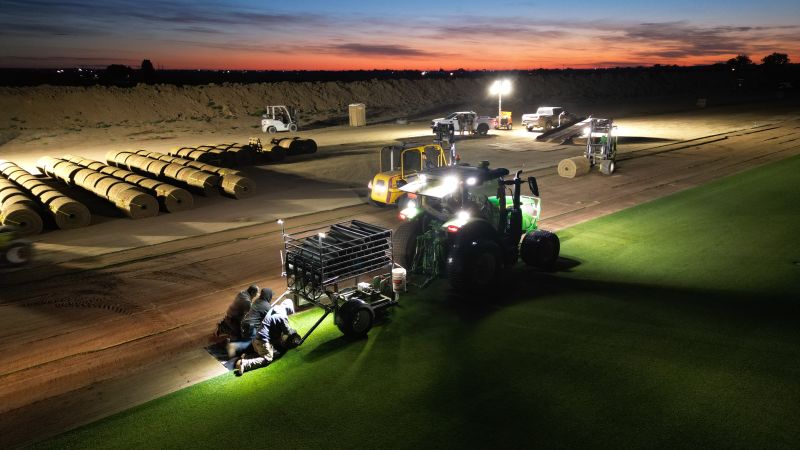
Joe Wilkins III, the general manager and owner of Green Valley Turf Co. in Platteville, Colorado, plays a key role in this effort. He grows the grass for Atlanta, Houston, and Dallas stadiums, transporting it thousands of miles to meet the tournament’s requirements. “It seems a little strange that the grass is coming all the way from Colorado,” Wilkins admitted, “but the science behind it makes it necessary.” Rogers and his collaborators visit these sites regularly to monitor growth and make adjustments, ensuring the turf remains in peak condition throughout the event.
The process of preparing the fields has been a long-term collaboration, with research beginning in late 2020. Rogers and his team have had to experiment with various grass blends, testing their performance in extreme conditions. For instance, in the sweltering climates of Houston, Dallas, and Atlanta, the team opted for cool-season grasses instead of the typical warm-season species. This decision was based on the understanding that indoor environments, with their reduced sunlight and air-conditioning, would benefit more from grasses that adapt well to shade and cooler temperatures.
The Science of Optimal Turf
Rogers’ work involves more than just selecting the right grass. The team uses customized systems to replicate the wear and tear of professional play, ensuring the turf can handle the intensity of the World Cup. These systems measure bounce height, root density, and recovery time, factors that determine how well the grass performs during matches. The research also extends to the microscopic structure of the turf, analyzing how different species interact with moisture, nutrients, and foot traffic.
“The goal is to create a uniform playing surface, no matter where the game is held,” Rogers said. This uniformity is essential for maintaining fairness and consistency in the tournament. While the natural grass in most venues will be under the open sky, the domed stadiums rely on technology to mimic the ideal conditions. “They look like big birds that get wheeled out and put on the turf,” he joked, describing the artificial grow lights used to simulate sunlight. These lights are programmed to deliver specific hours of illumination, ensuring the grass receives the right amount of energy to grow and stay vibrant.
The collaboration between researchers and turf farmers has been a cornerstone of this project. Sorochan, Rogers’ former student and now a professor at the University of Tennessee, has worked alongside him to refine the grass blends. Their combined expertise has allowed for a nuanced approach to turf management, blending scientific analysis with practical farming techniques. “It’s a team effort,” Sorochan emphasized. “No single person could tackle this without the support of others.”
As the World Cup approaches, the success of this six-year initiative will be judged by the performance of the grass under the pressure of international competition. Rogers’ work ensures that every pitch, whether in a sun-drenched stadium or an air-conditioned dome, will provide the foundation for world-class play. For fans, the grass may be an unnoticed element, but for the players, it’s a silent partner in their pursuit of victory.
Rogers’ Collaborative Effort
“FIFA wants the top games to be played on natural turf,” Rogers said. “It’s not just about aesthetics—it’s about the physics of the game and the players’ ability to perform.” This sentiment underscores the team’s meticulous attention to detail. Every decision, from the grass species to the lighting systems, has been made to enhance the quality of play while meeting the demands of the tournament. The result is a network of pitches that are not only visually impressive but also functionally superior, ensuring the World Cup delivers the best possible experience for athletes and spectators alike.
With the tournament just weeks away, the culmination of this scientific journey is evident. The grass in every stadium has been carefully selected and maintained, reflecting the dedication of Rogers, Sorochan, and their team. Their work bridges the gap between natural and artificial turf, proving that even in the most challenging environments, the right combination of science and care can create a flawless playing surface. As the final whistle blows, the legacy of their six-year quest will be etched into the fabric of the World Cup’s history.
