
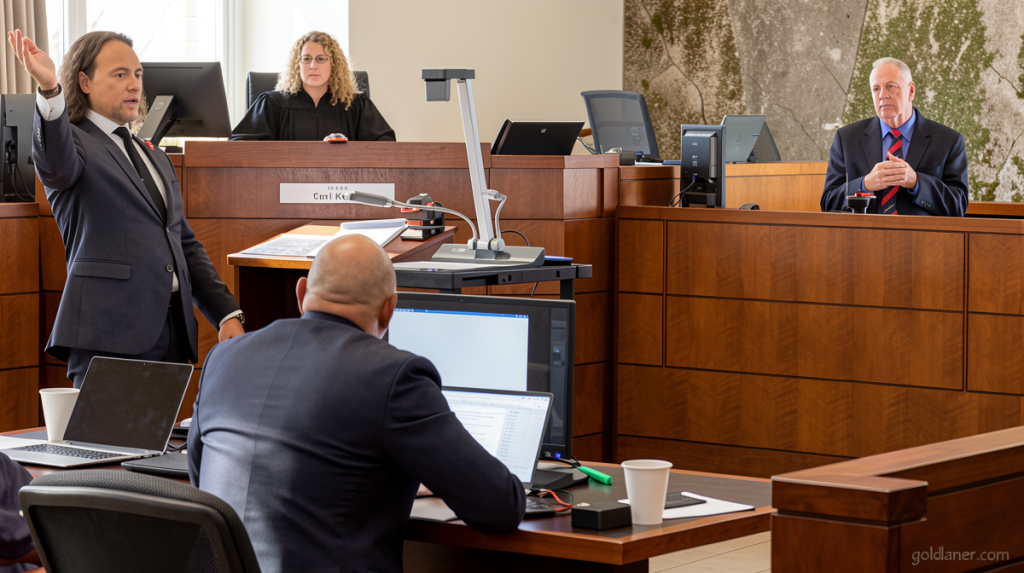
Thirty Years Later, a Jury Weighs Whether One Man’s Confession Is Truth or Theater
Goldlaner.com – The first week of the Duane Davis trial in Las Vegas has raised a question that cuts far deeper than any single verdict: can a justice system still deliver accountability when nearly three decades have eroded the very evidence it depends on? The answer, jurors at the Regional Justice Center are now tasked with determining, hinges on whether the man sitting in the defendant’s chair is a compulsive storyteller who spent twenty years embellishing his past, or a cold-blooded participant in the drive-by shooting that killed rapper Tupac Shakur on September 7, 1996.
Davis — known to fans of 1990s hip-hop as “Keffe D.” — remains the sole individual ever formally charged in connection with Shakur’s death. His trial, which opened on Monday, August 17, is expected to run roughly a month. Outside the courthouse, the desert heat presses toward 110 degrees and tourists zip-line down Fremont Street as if nothing historic is unfolding three blocks away. Inside, the proceedings carry the weight of an unresolved chapter in American music history.
A Name Buried in Bureaucracy
Before court convened on opening day, a queue of motorists snaked through the lobby of the downtown courthouse, there to settle traffic citations. The trial’s presence was nearly invisible to the casual observer. A bank of 14 video monitors, listing every case scheduled that day in alphabetical order and microscopic type, carried one entry tucked mid-screen: “DAVIS, DUANE KEITH.” That is how the Nevada court system files him. The rest of the world, for three decades, has known him by a different name entirely.
The Defense Case: A Fabrication Spanning Two Decades
Defense attorney Michael Sanft framed his opening statement around a single, sweeping accusation. From a covert interview with the Los Angeles Police Department in 1998 through public interviews, podcast appearances, and a published book, Davis had repeatedly described his role in the fatal shooting. Sanft told the jury that every one of those accounts constituted “a nearly two-decades-long work of fiction.” On a projected slide, he capped the point with a single word rendered in all capitals: “BULLSH*T.”
“The length of time is going to be a huge problem for anybody to try to recall things,” Sanft told reporters outside the courtroom. “That’s why police reports are important.”
Sanft’s strategy leans heavily on the absence of formal police documentation for several events in the prosecution’s timeline, including the assault on Orlando “Baby Lane” Anderson, Davis’s nephew, at the MGM Grand. Without written reports, the defense argues, the state’s narrative rests on memory alone — and memory, thirty years on, is unreliable.
The Prosecution’s Counter: Davis Told the Story Himself
Prosecutor Binu Palal turned the defense’s own argument against it. If Davis could not be trusted to recall events accurately, Palal reasoned, then his own repeated, detailed, and emotionally charged accounts of planning and executing a revenge shooting carry no weight. The state’s position is that Davis effectively confessed, over and over, in settings both private and public, right up until the eve of trial.
“Even in private calls, Duane Davis has repeatedly told us over and over again about the anger he felt and his own role in the revenge drive-by shooting of Tupac Shakur,” Palal told the jury.
Palal also offered a broader philosophical frame for the week’s testimony:
“In this world, silence means survival. The one person who has a hard time being silent is Duane Davis.”
1996 in a 2026 Courtroom
Each day of proceedings has required the jury to mentally transport itself back to a world that no longer exists. Cellphones capable of voice calls were not yet standard personal equipment, though certain figures involved in the case already owned them. A paper hotel folio itemizing a string of 75-cent local telephone charges now reads like a relic from another century. Surveillance footage capturing Shakur’s entourage exiting the MGM Grand after the Anderson assault — the incident prosecutors say triggered Davis’s plan for murderous retaliation — carries the wavy distortion characteristic of analog videotape.
“We had to maintain a VHS player in homicide to be able to view those things,” former Las Vegas police officer Dean O’Kelley testified.
Witnesses Carried by Time
The passage of nearly thirty years is written plainly on the faces and circumstances of those called to testify. Investigators who have not already died are almost universally retired; several appeared via video link, hampered by connectivity issues from homes far from Nevada. A young partygoer who witnessed the shooting from a passing vehicle in 1996 now occupies the witness stand as a modestly dressed middle-aged woman. Reggie Wright Jr., once the feared head of security at Death Row Records, arrived on an electric scooter, too weakened by Long Covid to walk the distance to the stand.
Sanft has repeatedly told witnesses not to fret over gaps in their recollection. For the defense, that erosion is an asset. For the prosecution, the absence of contemporaneous documentation is a gap that Davis’s own words fill.
A Confession That Started in 2018
Davis first lifted the lid on his gang history publicly in a 2018 documentary, explaining that he needed to get the story off his chest. From that point forward, his accounts grew more frequent and more specific, spanning interviews, audio programs, and print. The trial now asks the jury to decide which version of Duane Keith Davis is real: the man who spent two decades narrating his own guilt, or the man who, by his own counsel’s account, invented the narrative entirely.
What the first week has made unmistakable is that this trial is as much about the impossibility of perfect memory as it is about a single shooting in a Las Vegas parking lot. Witnesses age. Tapes degrade. Officers retire or die. The young men who once ran the streets of 1990s hip-hop are now elderly, infirm, or gone. And yet a jury must still find a verdict — a fact, a date, a name — from what remains.
Related Reading
Frequently Asked Questions
What is Gangbangers rap feuds and old tapes?
Gangbangers rap feuds and old tapes is the main topic of this guide. The article explains the context, practical details, and next steps readers should understand.
Why does Gangbangers rap feuds and old tapes matter?
Gangbangers rap feuds and old tapes matters because readers are looking for a useful answer, not just a short summary. Good content should match search intent and help them decide what to do next.