
Far-right Alternative for Germany party reelects leaders as protesters and police clash
Far Right Alternative for Germany Reelects Leaders Amid Protests
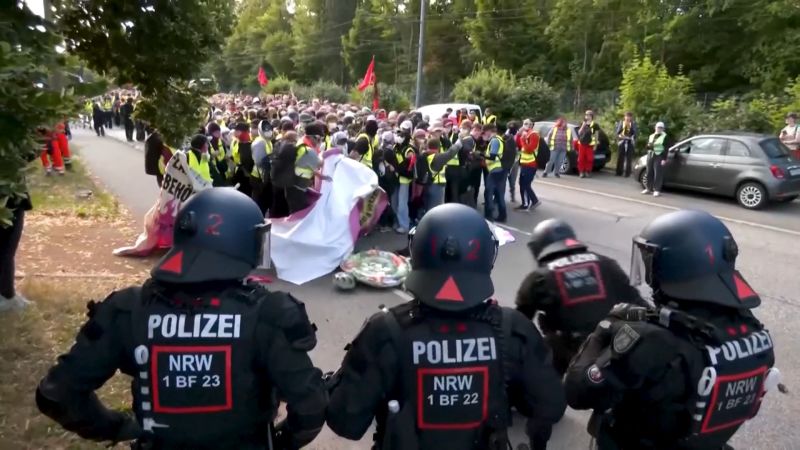
Far right Alternative for Germany party – The Far Right Alternative for Germany (AfD) party has reaffirmed its leadership, with Alice Weidel and Tino Chrupalla re-elected as delegates gathered in Erfurt for their national convention. The event unfolded against a backdrop of significant public unrest, as thousands of demonstrators clashed with police to challenge the party’s perceived extremist stance. Despite the interruptions, the AfD proceeded to finalize its leadership slate, highlighting its resilience in the face of opposition. Weidel, who secured 81% of the votes, and Chrupalla, who received 70%, have led the party since 2022, navigating a turbulent political landscape marked by rising far-right sentiment.
Historical Context and Symbolic Tensions
The convention’s timing coincided with the 100th anniversary of a key Nazi Party meeting in Erfurt, a historical event that symbolized the rise of fascism in Germany. This connection has fueled accusations that the AfD is leveraging the past to justify its present actions. While the party denies any intentional link to the Nazi era, opponents argue that the choice of date underscores its ideological alignment with extremist movements. The Far Right Alternative for Germany has consistently emphasized its commitment to representing the interests of traditional German values, though critics remain skeptical.
Protests outside the convention were led by anti-fascist groups, including widersetzen, who gathered over 31,000 people to voice their concerns. Demonstrators carried signs such as “For Diversity, Against Nazis,” reflecting broader anxieties about the party’s influence on national discourse. The Far Right Alternative for Germany’s focus on immigration and economic policies has drawn sharp criticism, with some accusing it of adopting rhetoric reminiscent of past authoritarian regimes. Yet, the party maintains that its platform is rooted in contemporary issues, not historical nostalgia.
“Our opponents have used every tool to destabilize us, from street protests to legal battles. We are here to show that the Far Right Alternative for Germany stands firm, united, and ready to lead,” said Tino Chrupalla, the party’s co-leader.
Legal Battles and Strategic Moves
The Far Right Alternative for Germany has faced legal challenges in recent years, including a classification as a right-wing extremist group by Germany’s Federal Office for the Protection of the Constitution. Last year, the party successfully contested this designation in court, prompting a temporary suspension of the label. A Cologne court ruled in February that the office could not maintain the classification while evaluating the party’s case, which has since been used to bolster the AfD’s political narrative.
With its legal standing temporarily secured, the Far Right Alternative for Germany continues to position itself as a legitimate political force. The party’s policies, which center on strict immigration controls and economic reforms, have resonated with voters disillusioned by mainstream parties. Alice Weidel, a central figure in the AfD, has called 2026 a pivotal year, aiming to capitalize on public discontent to secure a strong showing in the upcoming state election in Saxony-Anhalt. The AfD’s strategy hinges on both legal defense and grassroots mobilization to solidify its presence in German politics.
While the Far Right Alternative for Germany has made strides in recent elections, its trajectory remains contentious. Critics argue that its emphasis on migration control has mirrored Nazi-era rhetoric, while supporters view it as a necessary response to Germany’s changing demographics. The Erfurt protests, though disruptive, have intensified the debate over the party’s influence and its potential to shape the country’s future. As the Far Right Alternative for Germany prepares for its next political campaign, the balance between unity and ideological clarity will be crucial in determining its success.
