
Egypt uncovers lost Byzantine-era city in the western desert
Two Major Byzantine-Era Discoveries Highlight Egypt’s Rich Archaeological Heritage
Egypt uncovers lost Byzantine era city – On Saturday, Egypt unveiled two groundbreaking archaeological findings that shed new light on the country’s ancient history. These discoveries, made in the Dakhla Oasis and the Marina el-Alamein site near Alexandria, are expected to invigorate the nation’s tourism industry, which remains a cornerstone of Egypt’s economy. With the Suez Canal acting as a strategic trade route, the sector plays a crucial role in generating foreign currency, especially in a country facing financial challenges. The recent excavations provide valuable insights into daily life, urban evolution, and economic practices during the fourth century AD, when Egypt was part of the Byzantine empire.
Unveiling the Dakhla Oasis Settlement
The first discovery, located in the Dakhla Oasis within Egypt’s western New Valley province, has revealed a well-structured residential area that dates back to the fourth century. According to Hisham el-Leithy, the secretary general of Egypt’s Supreme Council of Antiquities, the site features a grid-like layout of north-south and east-west streets, creating open squares and communal spaces. This design suggests a planned urban development, indicating advanced administrative practices for the era.
“The unearthed quarters show a sophisticated arrangement of thoroughfares and public areas,” el-Leithy explained. “It’s a glimpse into how people lived and organized themselves in this region during the Byzantine period.”
Among the notable finds is a basilica church, constructed around the mid-fourth century, which sits at the heart of the settlement. The church’s location above the main thoroughfares suggests its central role in the community. Alongside it, remains of two defensive watchtowers were identified, likely used to guard the city’s perimeter. Mahmoud Massoud, who leads the archaeological mission, noted that these structures highlight the strategic importance of the site.
“The basilica church stands as a dominant feature, overlooking the city’s primary streets,” Massoud said. “The watchtowers reinforce the idea that this settlement was both a cultural and defensive hub.”
Archaeologists also uncovered a heavily fortified complex, complete with thick walls that suggest the city was a place of significance during its time. Within the area, several houses were discovered, some of which contained reception halls and vaulted roofs. One of the most intriguing finds is the “house of Tisous,” attributed to a church deacon and dating to the latter half of the fourth century. This structure is believed to have functioned as a house church before the construction of the main basilica.
Additional artifacts include bread ovens, kitchens, and stone grinding tools, which offer a glimpse into the culinary and domestic practices of the inhabitants. The presence of these tools indicates a thriving economy centered around food production. Moreover, the team recovered a collection of about 200 pottery fragments, known as octraca, which were used as writing materials. These fragments contain inscriptions detailing commercial agreements, personal correspondence, and other aspects of daily life, according to Diaa Zahran, head of the Islamic, Coptic, and Jewish Antiquities department.
“The pottery fragments provide a unique window into the lives of people from this era,” Zahran remarked. “They document everything from trade transactions to personal messages, enriching our understanding of their society.”
Excavations at Marina el-Alamein
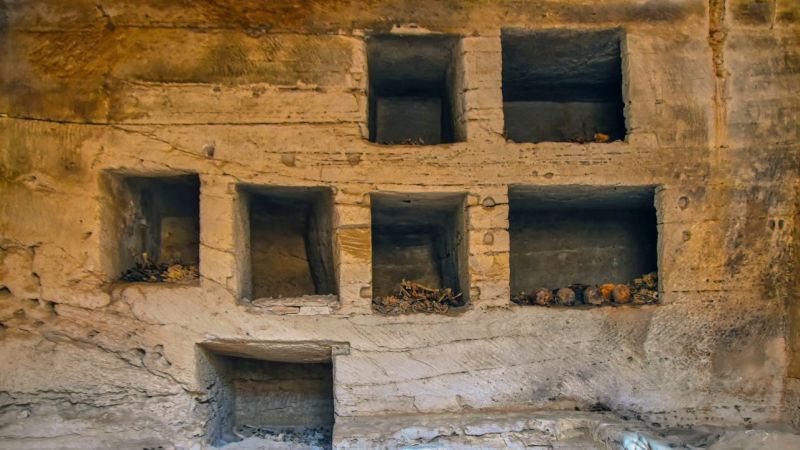
Meanwhile, the Marina el-Alamein site, situated approximately 100 kilometers west of Alexandria, yielded 18 ancient tombs, bringing the total to 48. The findings include 11 rock-cut tombs, each averaging 8 meters in depth, and seven surface-built tombs made of limestone. These tombs offer insight into burial customs and the social hierarchy of the region during its Greco-Roman heyday.
Among the artifacts discovered in the tombs are pottery vessels, amphorae, lamps, plates, altars, and limestone basins. These items, likely used in funerary rites, reflect the religious and cultural practices of the time. One of the most remarkable items is a 2.5-meter-long granite sarcophagus, where skeleton remains are currently being analyzed. Close to the sarcophagus, archaeologists found the remnants of a plaster sphinx statue, which may have held symbolic or ritual significance.
“We discovered 4 gold pieces placed in the mouths of some deceased individuals,” Eman Abdel-Khaliq, the mission chief, stated. “This practice, known as ‘the golden tongue,’ was common in funerary traditions of the era, believed to ensure the deceased’s voice in the afterlife.”
The Marina el-Alamein site, originally thought to be a Greco-Roman port city called Leukaspis, has a storied history. Unearthed in 1986, it has been a focal point for researchers studying the transition from Roman to Byzantine rule. The recent findings at the site, however, include a surprising element: a fossil preserved in a drawer for decades, which has been identified as the first ever dinosaur bone discovered in Antarctica. This discovery adds an unexpected layer to the site’s significance, linking it to broader geological and paleontological studies.
Marina el-Alamein’s role as a key hub in ancient trade networks is also underscored by the presence of a burial ground that dates back to the Roman period. The site’s connection to the Mediterranean Sea, as it was once a port city, suggests it was a vital center for commerce and cultural exchange. The artifacts found, including the fossil, may provide clues about the interactions between different regions and peoples during this time.
Reviving Egypt’s Tourism Industry
Egypt’s tourism sector, which
