
Asia’s airport wars continue as Hong Kong reveals revamped Terminal 2
Asia’s Airport Wars Continue as Hong Kong Reveals Revamped Terminal 2
Asia s airport wars continue as Hong – Hong Kong International Airport has unveiled its newly upgraded Terminal 2, marking a pivotal moment in its quest to strengthen its position as a major global aviation hub. The expansion, which took over five years to complete, reflects the city’s ongoing efforts to compete with its neighbors in the region, particularly Singapore’s Changi Airport, which has long been a dominant force in the industry. While the opening ceremony drew modest attention, the terminal’s modernization is part of a broader strategy to attract more passengers and reclaim lost ground in the world’s elite airport rankings.
A Step Toward Global Recognition
The 3.2 million-square-foot Terminal 2 is a key component of Hong Kong’s plan to elevate its status among top-tier airports. Officials emphasized that the facility will be powered by advanced automation, including self-service bag drop stations and smart check-in kiosks, which promise to streamline the passenger experience. One airport representative claimed that the streamlined process could allow travelers to complete their check-in in as little as 45 seconds, a figure that underscores the terminal’s focus on efficiency and innovation.
Despite these upgrades, Hong Kong International (HKG) remains ranked fourth in global airport rankings, lagging behind Changi (SIN) in both public perception and international acclaim. The airport’s expansion aims to address this gap, offering a more modern and competitive environment for travelers. Fred Lam, the authority’s chairman, highlighted that the new terminal is tailored to appeal to younger demographics, a shift that aligns with the city’s broader goal of modernizing its appeal. This strategy is evident in the inclusion of amenities such as a Filipino fried chicken chain, a local fashion boutique, and an arcade with claw machines, all designed to create a unique and engaging atmosphere for passengers.
Technology and Design: A New Era for Travelers
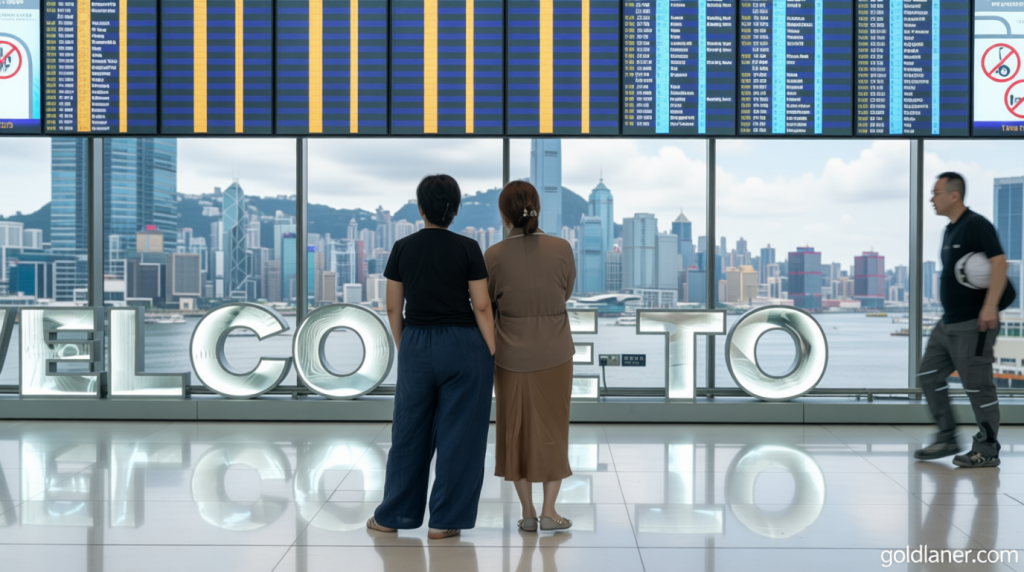
The design of Terminal 2 incorporates striking architectural elements, including a curved ceiling decorated with parallel lines that evoke a sense of dynamic movement. Upon entering, visitors are greeted by bright LED screens showcasing visuals of ocean waves and floating fish, a digital welcome that sets the tone for the terminal’s contemporary aesthetic. These design choices are not just for show; they aim to enhance the passenger journey, blending functionality with a modern, inviting environment.
While the terminal’s technological advancements are impressive, the opening day saw a surprisingly quiet reception. Social media users took to platforms to highlight the underutilized nature of the new concourse, with some posting videos of the largely empty space. This observation contrasts sharply with the bustling energy of Changi’s Jewel, a shopping mall that has become a global tourist hotspot. Shukor Yusof, an aviation analyst at Singapore-based Endau Analytics, noted that Jewel’s success lies in its ability to merge retail with entertainment, creating an experience that goes beyond mere shopping. “Jewel is huge. It’s a mall, obviously, but the attraction is not just retail. There’s a huge waterfall there, there’s a garden,” he remarked.
The Challenge of Competition
HKG’s expansion comes at a time when regional competitors are pushing harder to capture market share. The airport’s projected capacity of 30 million travelers annually by 2027—up from 61 million in 2025—highlights the scale of the challenge. With Terminal 1 already handling 70 million passengers per year, the new terminal is expected to contribute significantly to the airport’s overall growth. However, the 100 million annual travelers target for the entire complex is ambitious, requiring sustained investment and strategic management.
Meanwhile, the Hong Kong Airport Authority, which oversees operations, has faced scrutiny over the project’s cost. Initial estimates from 2010 projected a $1.2 billion budget, but the final figure ballooned to $1.65 billion. This financial commitment has been justified by the airport’s officials as essential for modernizing infrastructure and improving services. Yet, the underperformance of the adjacent 11 Skies megamall has raised questions about whether the investment is being fully utilized. The mall, with its glowing purple facade, was originally intended to serve as a retail and entertainment landmark. However, only two restaurants (out of over 100 planned) are currently operational, leaving the space feeling sparse and underdeveloped.
The terminal’s opening also coincides with broader shifts in global aviation. The Iran war has led to changes in air traffic routes, potentially benefiting Hong Kong by drawing more flights from the Middle East. This development adds pressure on HKG to showcase its capabilities as a destination for international travelers. The airport’s officials hope that Terminal 2 will not only improve operational efficiency but also serve as a magnet for new airlines and routes. On opening day, only Hong Kong Airlines operated flights, but AirAsia, Hainan Airlines, and Malaysia’s Batik Air are now beginning service, signaling a gradual increase in activity.
Strategic Ambitions and Regional Rivals
Hong Kong’s ambition to become a global aviation hub is closely tied to Beijing’s strategic vision for the city. The airport authority has been instructed to prioritize international connectivity, a goal that aligns with the nation’s broader plans to position Hong Kong as a key gateway to the world. However, this vision faces competition from other regional airports, including Guangzhou and Shenzhen, which have been rapidly expanding their facilities. Andrew Yuen, executive director at the Aviation Policy Research Center of the Chinese University of Hong Kong, pointed out that these airports are not only improving infrastructure but also enhancing passenger experiences, making them formidable rivals.
The rivalry between HKG and SIN has intensified in recent years. Skytrax, the international organization that annually ranks airports, named Changi number one in both 2025 and 2026. Hong Kong, meanwhile, earned recognition for its world-class airport bathrooms and efficient security processes, but these accolades have not translated into the same level of public enthusiasm. The new terminal’s features, while innovative, may still struggle to match the appeal of Changi’s iconic shopping and dining experiences. This discrepancy is evident in the way social media has reacted to the opening, with many highlighting the terminal’s modernity but also its current lack of activity.
As Hong Kong International continues to refine its offerings, the success of Terminal 2 will depend on its ability to balance efficiency with the kind of immersive experiences that define top-tier airports. While the expansion is a critical step forward, it also underscores the challenges of competing in a region where Singapore and other Chinese hubs are constantly raising the bar. The airport’s future will be shaped by how well it can adapt to these pressures, leveraging its unique position as a bridge between East and West to carve out a distinct identity in the global aviation landscape.
The Road Ahead
The launch of Terminal 2 has been met with mixed reactions, both from officials and the public. While the Hong Kong government pledged support during a ceremony earlier this week, the airport’s ability to attract travelers remains uncertain. The terminal’s design and technology are impressive, but its success will also hinge on the development of surrounding facilities like the 11 Skies mall. For now, the new concourse looks largely empty, a stark contrast to the vibrant energy of Changi’s Jewel. As the airport authority works to address these challenges, the focus remains on positioning Hong Kong as a vital player in Asia’s ever-evolving aviation race.
