
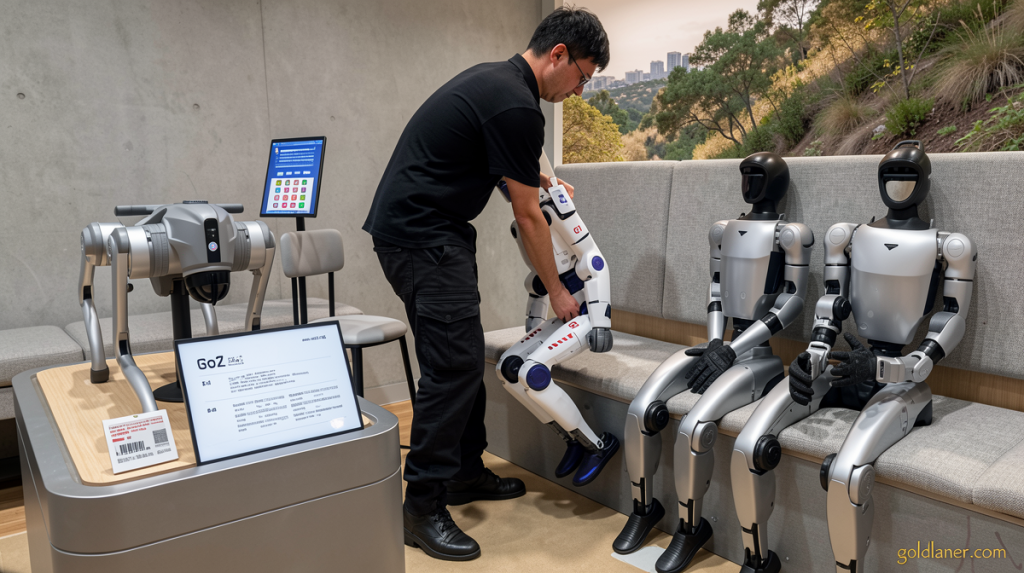
Unitree’s Shanghai Debut Sends Humanoid Robot Shares Soaring Past 600%
Goldlaner.com – On Wednesday, the trading floor in Shanghai witnessed what many observers are calling a watershed moment for China’s robotics sector. Shares of Unitree, the Hangzhou-based firm that has become the globe’s biggest seller of humanoid robots by unit volume, surged more than 600 percent in their first session of public trading. The listing, conducted on the STAR Market — the exchange segment widely compared to the Nasdaq — marked the first time a dedicated humanoid-robot manufacturer has been listed on mainland China’s stock exchanges.
The offering itself broke records. Unitree collected 6.1 billion yuan (approximately $905 million) in its initial public offering, a tranche that was oversubscribed by a factor exceeding 8,000, the highest demand ratio ever recorded on the STAR Market. The company’s prospectus earmarked the proceeds for advancing embodied-AI model research, upgrading robot hardware, and expanding factory capacity.
A Company Built on Viral Moments and State Ambition
Unitree was founded in 2016 in Hangzhou, China’s eastern technology corridor, and spent its early years developing quadruped platforms — the so-called robot dogs that still generated roughly 42 percent of its revenue last year. The firm’s breakout, however, came when its bipedal machines took the stage at China’s annual Lunar New Year gala, executing polished dance choreography before a national television audience. That single performance transformed a niche engineering outfit into a symbol of Beijing’s broader technological ambitions.
The company’s founder, Wang Xingxing, has since occupied a visible seat in the country’s tech-policy establishment, appearing in the front row at President Xi Jinping’s rare symposium with leading technology firms last year. For a government watching its economic growth decelerate and its working-age population contract, humanoid robots represent more than a commercial opportunity. A 2023 policy document describes them as the “new high ground of technological competition and a fresh frontier for future industries,” framing the sector as a strategic priority on par with semiconductors and artificial intelligence.
Beijing has poured billions of dollars into the space, viewing early dominance as a lever in the intensifying technology rivalry with the United States. Unitree’s listing, in that framing, is not merely a corporate finance event but a signal of state-backed industrial direction.
“Superman” and the Push Toward Greater Capability
Just days before the bell rang, Unitree unveiled a new humanoid platform it has branded “Superman.” The machine, the company stated, can leap to a height of two metres and sprint at 12.66 metres per second — figures that place it among the fastest bipedal robots yet disclosed by any manufacturer. The reveal underscored the firm’s emphasis on raw locomotion performance, a capability that has already made its products a fixture of viral video, from backflips captured at trade shows to a routine set to Lady Gaga’s “Abracadabra” on America’s Got Talent.
Financial Trajectory and Profitability
The numbers behind the spectacle are striking. Unitree’s revenue multiplied by more than tenfold over two years, reaching nearly 1.7 billion yuan ($252 million) in 2025, according to its prospectus. Last year the company delivered over 5,500 humanoid robots worldwide, cementing its position as the sector’s largest seller. It also posted a net profit of 278 million yuan ($41 million), a rare achievement in a field where most competitors are still burning cash.
Its investor base includes several of China’s most prominent technology and consumer companies: food-delivery platform Meituan, internet conglomerate Tencent, e-commerce giant Alibaba, and AI startup DeepSeek.
Where the Robots Actually Go
Despite the spectacle, the commercial reality remains early-stage. Unitree’s earlier filing showed that research laboratories and educational institutions accounted for the bulk of its sales, while industrial deployments represented less than 10 percent of shipments in the first three quarters of 2025. Experts note that bipedal platforms still face unresolved hardware and software constraints and remain years from full-scale deployment on factory floors or in domestic settings.
“Unitree has demonstrated strong technology and commercial traction, but moving from demonstrations and early deployments to widespread industrial adoption will take time,” said Kangyuxiao Li, equity analyst at Morningstar.
Competitive Landscape and Strategic Caveats
China already commands the overwhelming share of global humanoid-robot deliveries, far outpacing American entrants such as Tesla, Figure AI, and Boston Dynamics. Within the country, UBTECH and Dobot have listed in Hong Kong, while Agibot, another sector frontrunner, is pursuing its own IPO on the island. Unitree’s mainland listing thus sets a pricing and valuation benchmark for the next wave of robotics IPOs.
“Unitree IPO is regarded as a key milestone for the humanoid industry and can serve as a benchmark for other IPOs in the pipeline,” said Ethan Qi, associate director at market analysis firm Counterpoint Research.
Qi nonetheless cautioned that Unitree’s current competitive edge leans heavily on hardware engineering and motion-control sophistication. The firm, he argued, must substantially increase investment in embodied-AI models — the software layer that functions as the machine’s cognitive core — if it is to sustain its lead as the industry matures beyond locomotion showpieces.
For now, the market has spoken with extraordinary enthusiasm. Whether that enthusiasm translates into sustained industrial utility, rather than continued spectacle, will depend on the next several years of R&D execution — and on whether Beijing’s policy tailwind outlasts the technical hurdles still separating today’s agile androids from dependable, scalable workhorses.
Related Reading
Frequently Asked Questions
What is World s top humanoid robot maker?
World s top humanoid robot maker is the main topic of this guide. The article explains the context, practical details, and next steps readers should understand.
Why does World s top humanoid robot maker matter?
World s top humanoid robot maker matters because readers are looking for a useful answer, not just a short summary. Good content should match search intent and help them decide what to do next.