
China’s AI Optimism Stands Apart From US Fears
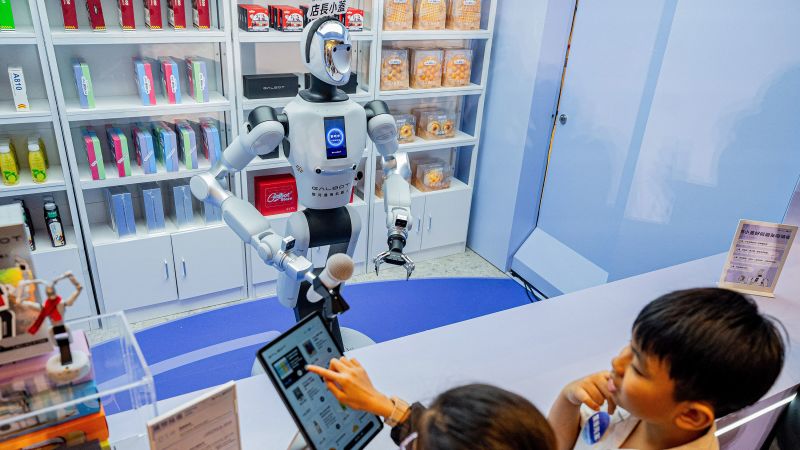
Goldlaner.com – Artificial intelligence has become an everyday tool for millions of people across China, where its benefits are often more visible in daily routines than its potential dangers. Residents can interact with local public services through AI-driven digital staff, students can photograph written work for rapid feedback, and hotel visitors may retrieve packages brought to their rooms by robots.
That practical familiarity appears to be shaping public attitudes. A Morgan Stanley survey released Monday found that 80% of respondents in China used AI at least once a week, compared with 54% in the United States. Rather than viewing the technology chiefly through the lens of a possible future catastrophe, many Chinese users see it as another source of efficiency, convenience and lower-cost services.
The contrast is striking as prominent US researchers and technology leaders debate whether increasingly capable AI systems could eventually pose an existential risk to humanity. In China, public concern over such a scenario has been far less visible.
“This technology was created to serve humanity,” said Xu Jingyuan, a 22-year-old business student from Beijing. “We shouldn’t see it as something to fear, but as something that brings greater conveniences to our lives.”
Xu said he believed the government was “absolutely capable” of managing the technology’s risks. His view reflects a wider difference between Chinese and American attitudes: not only toward AI itself, but toward the institutions expected to regulate powerful companies and respond when technology causes harm.
Trust and political context shape the debate
Surveys suggest that enthusiasm for AI in China is closely connected to confidence in public oversight. Ipsos found earlier this year that 83% of Chinese respondents considered AI-powered products and services exciting. Only 33% of US respondents expressed the same feeling.
A separate Edelman survey showed an equally large divide in trust in government. In China, 86% of respondents said they trusted their government to do what is right; in the United States, that figure was 39%.
Lian Jye Su, chief analyst at technology research firm Omdia, said perceptions of accountability help explain the gap.
“In the US, there is a general public perception that without whistleblowing, big corporations could escape accountability or scrutiny due to weak government oversight,” Su said. “Whereas in China, I think there is this very strong confidence from the public that if any sh*t hits the fan, the government will step in.”
The countries’ political structures also affect how concerns become part of public conversation. Whistleblowing is a familiar feature of the US system, while public policy debates can be contentious in a polarized democracy. China’s one-party political model is more centralized, allowing the state to define priorities and steer national discussion without the same level of open criticism.
AI as a consumer product before a philosophical question
In China, many people encounter artificial intelligence first through products that are free, inexpensive or built into applications they already use. Companies competing in the country’s intense technology market have rapidly introduced AI chatbots and AI-enabled features, making the technology feel less abstract.
Its influence reaches well beyond chat interfaces. Filmmaking, e-commerce and manufacturing are among the sectors incorporating AI tools, while robots and automated services have become familiar in parts of urban life. For users, the immediate value may be faster service, reduced costs or assistance with tasks that once demanded more time.
“Everyone I know says AI has already permeated every aspect of our lives,” said Shi Hongchao, 51, from Liaoning province in northeastern China. “Everyone is either talking about it or has already started using it. It feels almost unstoppable at this point.”
Poe Zhao, an analyst and founder of the Hello China Tech newsletter, described this pattern as an important reason why existential-risk arguments have not gained the same public traction.
“Most Chinese people meet AI as a cheap product first and as a debate second,” Zhao said. “When a technology shows up as a useful, low-cost service, people judge it by what it does for them, not by what it might do to them.”
This does not mean Chinese authorities and analysts view AI as risk-free. The language used in China, however, tends to focus on questions such as malicious use, social disruption and the loss of operational control. The emphasis is generally less on human extinction, a framing that has become highly prominent in parts of the American technology debate.
A strategic technology with acknowledged risks
China is widely seen as one of the few countries capable of competing with the United States at the highest levels of AI development. That rivalry gives the technology economic and strategic importance, while also strengthening incentives to deploy it quickly across businesses and public services.
Chen Yixin, China’s intelligence chief, highlighted that balance in an article published last Sunday. He called for AI to be incorporated as a strategic industry in the country’s economic development while also setting out the risks Beijing associates with the technology.
For readers, the divide between China and the United States illustrates that AI attitudes are not determined by technical capability alone. They are shaped by lived experience: whether people first see AI as a helpful service, a threat to jobs, an opaque corporate system, or a force that institutions may struggle to control.
As AI becomes more deeply embedded in education, commerce, government services and entertainment, the practical gains will remain persuasive for many users. But the differing debate in China also raises a broader question: whether confidence in the technology’s usefulness and confidence in government oversight will continue to outweigh fears about what increasingly powerful AI systems could become.
Related Reading
Frequently Asked Questions
What is Why is China less worried about?
Why is China less worried about is the main topic of this guide. The article explains the context, practical details, and next steps readers should understand.
Why does Why is China less worried about matter?
Why is China less worried about matters because readers are looking for a useful answer, not just a short summary. Good content should match search intent and help them decide what to do next.