
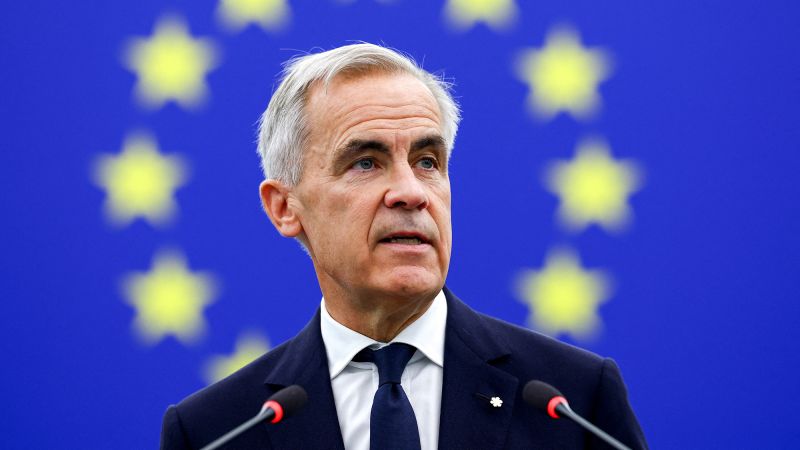
Carney promotes Canada-EU partnership amid trade pressure
Goldlaner.com – Canada EU alliance isn t meant to create a new power bloc that competes with the United States, Canadian Prime Minister Mark Carney said while calling for closer ties between Canada and Europe. Instead, he argued that the partnership should help democratic countries protect their economies, sovereignty and shared values.
Speaking to European lawmakers in France on Thursday, Carney backed stronger Canada-EU cooperation during a period of growing trade uncertainty. His remarks followed European Commission President Ursula von der Leyen’s suggestion that Canada could become the European Union’s first “associate member,” an idea that drew a new tariff threat from US President Donald Trump.
Canada and the European Union have both faced tariffs imposed by the Trump administration. That common experience has heightened interest in expanding trade, investment and security cooperation across the Atlantic.
“I’m not proposing a third bloc in order to become a great power rival, only with better manners,” Carney said.
Resilience, not rivalry
Carney said the Canada EU alliance isn t meant to undermine another country’s influence. He described it as a way to ensure that open markets, democratic institutions, territorial integrity and the rule of law cannot be weakened by outside pressure.
“We do not seek power to dominate others. On the contrary, we are pursuing resilience so no one can control our open markets, impair our sovereignty, threaten territorial integrity or undermine our freedoms, our democracies, our rule of law.”
He said democracies face “new storms,” including climate change, trade used as a geopolitical weapon and declining democratic standards. In his view, Canada and Europe can respond more effectively by working together while maintaining their own independence.
Von der Leyen’s associate-member proposal would create a new kind of relationship between Canada and the EU. It would not make Canada an EU member state, but it could offer a deeper framework for cooperation. Carney welcomed the proposal and said polling showed an “overwhelming majority” of Canadians favored closer connections with Europe.
Energy, minerals and technology
Carney outlined a broad agenda for cooperation covering energy, natural resources, technology, defense and educational exchanges. The Canada EU alliance isn t meant to be limited to trade disputes; it would also address longer-term economic security and resilience.
Critical minerals were a central priority. These materials are important for manufacturing, clean-energy technologies, electronics and defense supply chains. More reliable supply relationships could reduce the risk of disruptions in global markets for both Canada and European countries.
Energy security was another focus. Carney highlighted Canada’s potential to supply liquefied natural gas and hydrogen to Europe, where diversified energy sources have become a major strategic concern. He also called for closer defense production links, cooperation on payments and common approaches to artificial intelligence safety.
Carney said young Canadians and Europeans should have greater freedom to live, work and study across the Atlantic. Expanding exchanges for students and researchers could strengthen the practical links behind the proposed partnership.
FAQ: Canada and the European Union
Would Canada become a member of the EU?
No. The associate-member idea discussed by von der Leyen would not make Canada an EU member state. Canada would remain an independent country outside the union.
Why are Canada and the EU considering closer ties?
Both have faced US tariffs and are seeking stronger economic, energy, technology and security cooperation. Carney said the goal is greater resilience for democratic partners.
What could a deeper Canada-EU partnership include?
Potential areas include critical minerals, liquefied natural gas, hydrogen, defense production, financial systems, AI safety, and opportunities for people to study and work across the Atlantic.