
Two Rivals, One Unstoppable Demand: How AI Is Forging an Unlikely Tech Alliance in Asia
Goldlaner.com – The cavernous server halls stretching from Virginia to Bavaria hold hundreds of thousands of machines whose sole purpose is to churn through trillions of arithmetic operations per second, training the generative models that now power search engines, creative tools, and enterprise software. Each of those machines is a small act of diplomacy between two East Asian economies that spent decades trying to outbuild, outprice, and outbrand one another. South Korea and Taiwan, once locked in a grinding contest over who would dominate the components of the digital age, are now bound together by a single, insatiable customer: the global AI infrastructure buildout.
The Anatomy of an AI Server
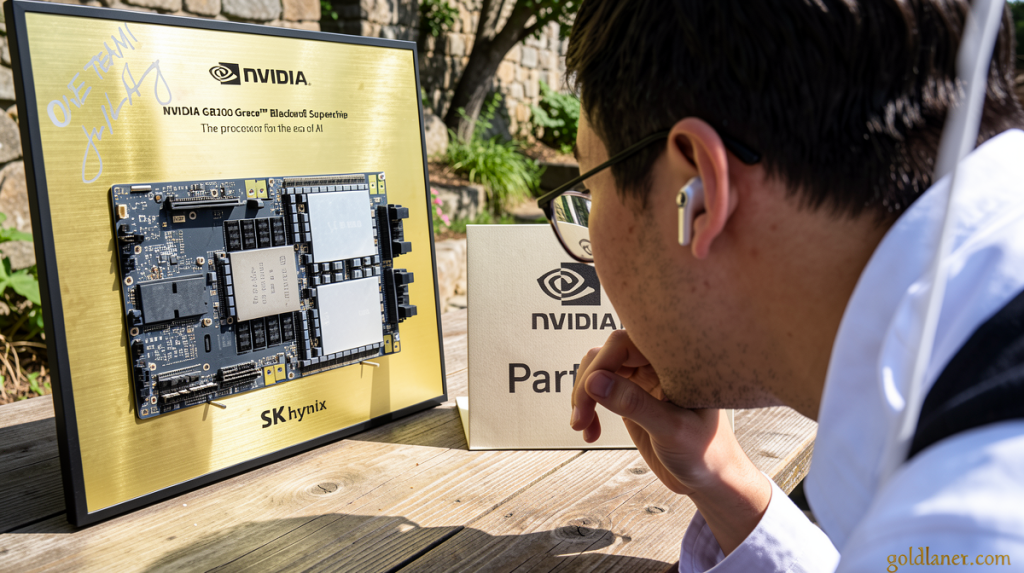
Strip away the marketing language and a single Nvidia accelerator card reveals a supply chain that threads through both nations with almost no slack. The logic die is fabricated by TSMC in Hsinchu. The high-bandwidth memory stacks come from SK Hynix or Samsung in South Korea. Specialized packaging and assembly technologies fuse those elements into a functional accelerator. Taiwanese contract manufacturers then slot the finished cards into rack-scale server cabinets fitted with liquid-cooling loops before the racks ship to hyperscale data centers. Remove either node and the chain snaps.
That interdependence has become so acute that Nvidia chief executive Jensen Huang felt compelled to write a handwritten note on a memory wafer supplied by SK Hynix during Taipei’s annual computer exhibition in June 2026. The message, scrawled in marker on the thin silicon disc, read:
“Please make more.”
The gesture underscored a reality no single supplier can escape: the pace of frontier-model training has outstripped the manufacturing capacity of any one country, let alone any one firm.
A Rivalry Written in Export Ledgers
The cooperation now unfolding between Seoul and Taipei was not born of warmth. Both territories emerged from Japanese colonial administration in the mid-1940s and followed nearly identical industrial recipes: state-directed investment, export-oriented growth, and a gradual pivot from labor-intensive textiles in the 1960s to consumer electronics in the 1970s and 1980s. Both also completed the rare transition from authoritarian rule to competitive democracy within a single generation.
Yet the shared blueprint produced shared markets, and shared markets produced collisions. As Asia became the world’s factory for electronic components, Korean and Taiwanese firms clashed across every product category. Acer and Asus battled Samsung and LG in personal computers; HTC took on Samsung in smartphones; panel makers on both sides of the strait fought over television and monitor display glass. In most of those contests, South Korea emerged ahead, propelled by conglomerates like Samsung that vertically integrate design, fabrication, packaging, and retail under one corporate roof.
The intensity of the rivalry occasionally spilled into legend. In 2013, Business Today magazine ran a piece by veteran technology journalist Owen Lin describing a 2008 internal Samsung meeting where executives allegedly debated a “Kill Taiwan” strategy aimed at dominating every sector where Taiwanese firms competed. Samsung told CNN at the time that no such formal strategy existed and declined further comment when approached again. Lin himself, author of Chip Champion: The Triumph of TSMC and Taiwan, has noted that cooperation between the two economies was historically rare while competition was the default mode.
“Cooperation was actually very rare,” Lin said. “Competition was much more common.”
Sung Soo Eric Kim, a distinguished guest professor at Keio University in Tokyo, urged readers not to over-read the anecdote. Every large corporation formulates market strategies against rivals across multiple geographies, he argued, and Samsung’s global footprint means it competes with firms in Japan, the United States, and elsewhere as readily as with those in Taipei.
“All companies compete with each other,” Kim said. “They would, of course, have market strategies competing with not just Taiwan, Japan, and the United States – they’re a global company.”
When Necessity Outpaces History
Even in the contract-manufacturing segment that TSMC now commands, Samsung once held the upper hand. The explosive growth of Apple’s iPhone line in the late 2000s reshaped the competitive map, pulling advanced-node capacity toward foundry partners willing to scale at unprecedented volumes. That shift, combined with South Korea’s dominance in DRAM and NAND flash, left the two economies occupying complementary rather than overlapping positions in the AI hardware stack.
The result is a partnership driven less by goodwill than by arithmetic. Demand for accelerators designed by Nvidia and AMD has grown so steeply that neither Taipei nor Seoul can meet it alone. SK Hynix has told CNN it is accelerating construction of new fabrication facilities to close the gap.
“In the AI era, technological competitiveness alone is not enough and the ability to supply the required volume at the exact moment customers need it is the ultimate competitive advantage,” an SK Hynix spokesperson said.
Kim framed the shift in blunt operational terms:
“We don’t have time to get into this old-fashioned conflict,” he said. “There’s so much demand; we have to cooperate and supply first.”
What Comes Next
The alliance carries obvious geopolitical sensitivities. Taiwan’s semiconductor capacity is a strategic asset that Washington has repeatedly flagged as a national-security concern, while South Korea’s memory-chip dominance gives Seoul leverage in trade negotiations with both the United States and China. A supply chain that depends on seamless coordination between the two may prove fragile if diplomatic tensions flare or if export-control regimes tighten further.
Yet the physics of the problem does not care about politics. Every additional frontier model trained, every additional data-center campus breaking ground in the American Midwest or the German Ruhr, pulls another thousand accelerators through the same narrow corridor of TSMC fabs, Korean memory lines, and Taiwanese assembly plants. Until alternative architectures mature or demand plateaus, the two economies will keep shipping silicon to each other’s customers – not because the old rivalry has vanished, but because the bill for compute power is too large for either to pay alone.
Related Reading
Frequently Asked Questions
What is From heated rivalry to frenemies?
From heated rivalry to frenemies is the main topic of this guide. The article explains the context, practical details, and next steps readers should understand.
Why does From heated rivalry to frenemies matter?
From heated rivalry to frenemies matters because readers are looking for a useful answer, not just a short summary. Good content should match search intent and help them decide what to do next.