
Tear your eyes away from the ballroom. This courthouse is the real face of Trump-era architecture
Tear your eyes away from the ballroom. This courthouse is the real face of Trump-era architecture
A New Benchmark for Trump’s Architectural Vision
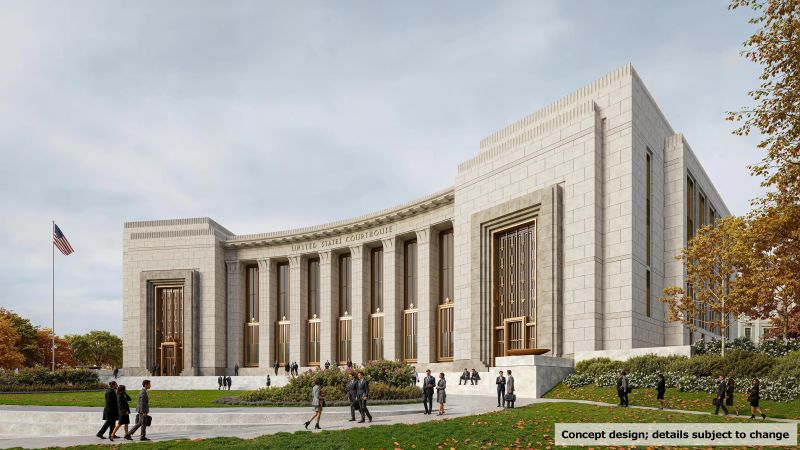
Tear your eyes away from the ballroom – In the shadow of President Donald Trump’s opulent $400 million White House ballroom and his proposed triumphal arch, a quieter but equally significant architectural statement has emerged in Chattanooga, Tennessee. This week, officials revealed plans for a new federal courthouse set to open in 2030, a design that stands as a tangible representation of the administration’s push to redefine the aesthetic of federal buildings. While the ballroom and arch captured headlines for their grandeur, the Chattanooga courthouse—over 500 miles away from Washington, D.C.—offers a more deliberate reflection of Trump’s ideological priorities.
The project, described as a muscular Art Deco Greek temple, marks the first major federal design announcement since Trump’s executive order, “Making Federal Architecture Beautiful Again,” which was enacted last year. The order explicitly mandated that federal structures prioritize “classical and traditional” styles, steering away from modernism, postmodernism, and brutalism. This new courthouse in Chattanooga is a direct outcome of that directive, serving as a case study in how architects are adapting to the president’s vision.
The Greco-Deco Interpretation
Designed by the otherwise contemporary firm HOK, the building blends elements of classical symmetry with the angularity of Art Deco. Its structure features a row of square columns flanked by two bulky, mausoleum-like volumes, creating an imposing facade that critics have likened to “architectural shoulders” of power. The design has been dubbed “Greco-Deco” by the National Civic Art Society (NCAS), which praised it as a “showpiece” of Trump’s aesthetic agenda. The organization, incidentally, played a role in drafting the executive order, underscoring its alignment with the administration’s goals.
NCAS president Justin Shubow, a vocal proponent of classical design, emphasized the project’s significance in a video call. “Classicism is still alive, can be done well, and can be both traditional and original,” he stated, highlighting the balance between heritage and innovation. However, Shubow also cautioned architects against becoming entangled in a “culture war,” noting that many judges, regardless of their political appointments, seek a courthouse that embodies institutional dignity. “The architecture should not be a battleground for ideological trends,” he added, suggesting the design’s primary purpose is to reflect a sense of stability and authority.
“Classicism is still alive, can be done well, and can be both traditional and original,” said Justin Shubow, NCAS president. “I think architecture firms should be very wary of having their work enlisted in this sort of culture war.”
While the courthouse’s design may align with Trump’s preferences, its roots are deeply tied to the 1930s, echoing the grandeur of the Joel W. Solomon Federal Building and US Courthouse it replaces. The building’s blocky, rectangular form is a nod to the classical revival that dominated public architecture in the early 20th century. Yet, some observers argue that this nod to the past carries a more deliberate political weight.
Critics’ Perspectives: Beauty or Bureaucratic Symbolism?
Kevin D. Murphy, a professor and chair of the history of art at Vanderbilt University, offered a more skeptical view. He suggested that the design evokes a version of 1930s classicism “associated with fascist states,” drawing parallels between the courthouse’s stoic facade and the authoritarian aesthetics of the era. “To me it isn’t at all transparent,” Murphy said, questioning whether the building’s formidable appearance reflects a desire to intimidate rather than inspire trust in the judiciary.
“Is that the message you want to send about the judiciary? That it’s intimidating?” Murphy asked, critiquing the design’s symbolism. “The building is very formidable and very solid, in a very conventional way.”
Christopher Hawthorne, a former architecture critic for the Los Angeles Times now writing for the Punch List newsletter, took a more nuanced stance. While acknowledging the courthouse’s “handsome design” and potential for competence, he argued that its true purpose lies in reflecting the current occupant of the White House. “Architecture has a responsibility to say something fundamental about contemporary society,” Hawthorne said. “This design doesn’t say much beyond the current administration’s taste.”
The debate over the courthouse’s significance extends beyond aesthetics. For some, it represents a return to timeless architectural values, while for others, it symbolizes a narrowing of design possibilities. The project’s completion in 2030 will mark a pivotal moment in the evolution of federal architecture, as it becomes the first concrete example of Trump’s directive in action.
Public Sentiment: Traditional Preference in a Changing Landscape
Despite the ideological divide among architects, public opinion appears to favor the traditional approach. A Harris Poll conducted in 2020 for the National Civic Art Society found that 70% of Americans, regardless of political affiliation, preferred traditional designs over modern ones for courthouses and federal offices. This statistic suggests a broader cultural appetite for classicism, even as critics warn against its potential to stifle innovation.
The FBI’s recent decision to vacate the J. Edgar Hoover Building—its iconic, brutalist structure—has further fueled discussions about the merits of classical architecture. Similarly, reports of the Dallas City Hall’s angular design facing potential demolition have not sparked widespread public outcry. These developments indicate that, while traditionalists may celebrate the shift, the public’s tolerance for innovation in federal architecture remains mixed.
Yet, the Chattanooga courthouse’s unveiling has already sparked a new round of debate. For many, it embodies a vision of strength and permanence, qualities they associate with the Trump administration’s broader agenda. For others, it serves as a reminder of how political ideologies can shape even the most neutral of spaces. As the building nears completion, its impact will be measured not just in its visual appeal, but in its ability to redefine the role of architecture in public life.
With the National Civic Art Society lauding the design as a triumph and critics like Kevin Murphy questioning its implications, the Chattanooga courthouse stands as a microcosm of the cultural and political discourse surrounding Trump-era architecture. Whether it is seen as a beacon of tradition or a symbol of ideological control, its presence in the public sphere will undoubtedly influence perceptions of federal design for years to come.
