
Explaining the World Cup’s newest rules
Explaining the World Cup’s Newest Rulebook Changes
Unexpected Penalties and Rulebook Reforms
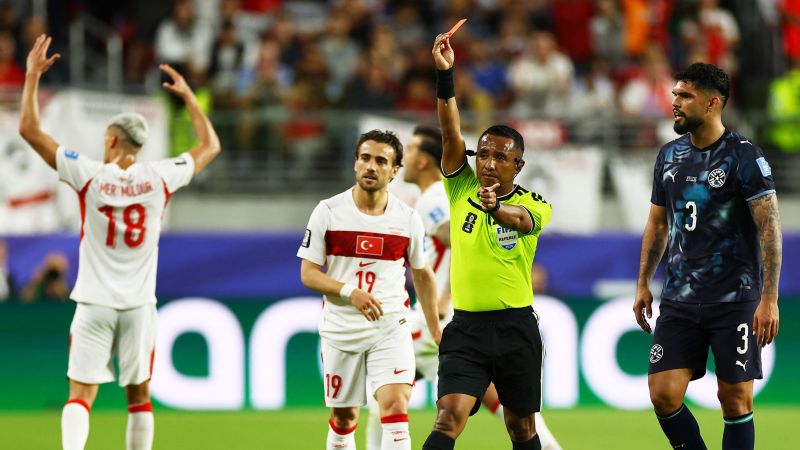
Explaining the World Cup s newest – The FIFA World Cup has always been a stage for dramatic moments, but this year’s tournament introduces a fresh set of regulations that have already sparked debate among fans and players alike. One of the most talked-about changes involves a seemingly minor action: covering one’s mouth during a confrontation. This rule, which took effect in the 2026 edition, allows referees to issue red cards to players who do so in a “confrontational situation.” While the idea may appear odd, it reflects FIFA’s broader effort to enhance transparency and accountability in the game.
At the heart of this new law is a specific incident that occurred during the opening match of the tournament. In a game between Paraguay and Turkey, midfielder Miguel Almiron was shown a red card for what initially seemed like a harmless gesture. Replays revealed that Almiron had placed his hand over his mouth while exchanging words with Turkey’s Mert Mulder. Although there was no evidence he used racial language, the act of concealing his mouth during a heated exchange was deemed enough to warrant a penalty. This moment highlighted how quickly a subtle action can escalate into a major consequence under the revised rules.
“Holding 74% possession and generating 27 shots on goal is impressive, but it’s the defense’s resilience that stole the match,”
The incident is not an isolated case. The rule was inspired by a Champions League match in February 2026, where Real Madrid’s Vinícius Júnior accused Benfica’s Gianluca Prestianni of using racial slurs. Replays showed Prestianni speaking to the player but covering his mouth, making it impossible to determine the exact nature of the insult. FIFA’s decision to implement the new rule was aimed at preventing such ambiguity, ensuring that players cannot hide their intent behind a simple hand movement.
Other Rule Adjustments for the Tournament
Alongside the mouth-covering rule, several other changes have been introduced to streamline gameplay and reduce disputes. One notable adjustment involves the handling of goal kicks and throw-ins. Teams now face a five-second countdown to complete these restarts, penalizing delays that waste time. If a player fails to execute a throw-in within the allotted time, possession shifts to the opposing team. Similarly, a goal kick that exceeds the five-second limit results in a corner kick for the other side.
These changes are part of FIFA’s initiative to make the game faster and more efficient. The five-second rule for throw-ins, for instance, has been a long-standing topic of discussion in football circles. Critics argue it could penalize players who take extra time to set up a precise delivery, while supporters claim it eliminates unnecessary delays. The implementation of this rule in the World Cup underscores FIFA’s commitment to modernizing the sport’s mechanics.
The Role of Technology in Referee Decisions
Another significant update comes from the Video Assistant Referee (VAR) system. This year, VAR has been granted additional authority, including the power to overturn incorrectly awarded corner kicks. This change is particularly relevant given the high-stakes nature of the tournament, where even a single mistake can alter the outcome of a match. By empowering VAR to review such decisions, FIFA aims to reduce human error and ensure fairness across all competitions.
The expanded VAR role has already had an impact. In a recent match, the system successfully corrected a controversial corner call, demonstrating its potential to resolve disputes more accurately. However, some purists worry that the increased use of technology could diminish the human element of refereeing. Despite these concerns, the rule changes are expected to streamline decision-making and provide greater clarity for fans and players alike.
Spain and the USA: Key Matches to Watch
While the rulebook updates are shaping the tournament’s dynamics, the excitement on the field remains equally compelling. Spain, the defending champions, faces a crucial test against Cape Verde, a team making its World Cup debut. The Spanish squad, led by coach Luis de la Fuente, will be eager to bounce back from a 0-0 draw that left many questioning their ability to control the game. Cape Verde’s resilient defense and veteran goalkeeper Vozinha proved to be formidable opponents, even as Spain dominated possession with an astonishing 74% of the ball and 27 shots on goal.
Meanwhile, the USA’s upcoming matches have drawn significant attention. Fans are still buzzing about the team’s potential to claim the title, but the path ahead is anything but straightforward. The Americans’ next group game will be a key opportunity to showcase their progress, with the team hoping to build momentum after a mixed start to the tournament. For those following the action, the clash between Spain and Cape Verde will offer a glimpse into the tournament’s evolving challenges, as well as the talents of young stars like Lamine Yamal, who will be under pressure to make an impression.
Additionally, the Norway squad adds a personal touch to the tournament. With Father’s Day coinciding with the event, the team’s new father figure, a player who recently welcomed a child, is being celebrated for his contribution to the national team. This highlights the human stories that intertwine with the global spectacle of the World Cup, reminding fans that every match is not just about strategy and skill, but also about the individuals behind the jerseys.
Looking Ahead: The Road to the Final
As the tournament progresses, the new rules will continue to test players and referees in unexpected ways. From the controversial red card for Almiron to the VAR’s expanded powers, these changes are reshaping how matches are played and judged. For newcomers to the sport, the rulebook’s additions may feel overwhelming, but they are designed to address long-standing issues in the game.
FIFA’s focus on clarity and fairness is evident in the updates, which aim to reduce confusion and ensure that every action on the field is accounted for. Whether it’s the five-second countdowns for restarts or the new mouth-covering penalty, these rules are part of a larger effort to modernize football. As teams prepare for their next encounters, the interplay between strategy, skill, and these new regulations will be a defining feature of the 2026 World Cup. With so many games to come, there’s no shortage of drama, and the rulebook will undoubtedly play a role in shaping the tournament’s narrative.
For those who missed the initial rulebook announcement, the details are as follows: players can be sent off for covering their mouths during confrontations, five-second limits apply to goal kicks and throw-ins, and VAR has greater authority in reviewing decisions. These adjustments, though seemingly small, have the potential to influence the flow of matches and the outcome of games. As the World Cup unfolds, fans will be watching closely to see how these rules impact the beautiful game.
With the competition in full swing, the 2026 World Cup promises to be as thrilling as ever. From the tactical nuances of the new rules to the underdog stories emerging on the field, there is something for every type of fan. Whether it’s the fiery exchanges between players or the quiet determination of a team like Cape Verde, the tournament is a testament to football’s ability to adapt and evolve. As the games continue, the rulebook will remain a constant reminder of FIFA’s ongoing efforts to refine the sport for the next generation of players and spectators.
