
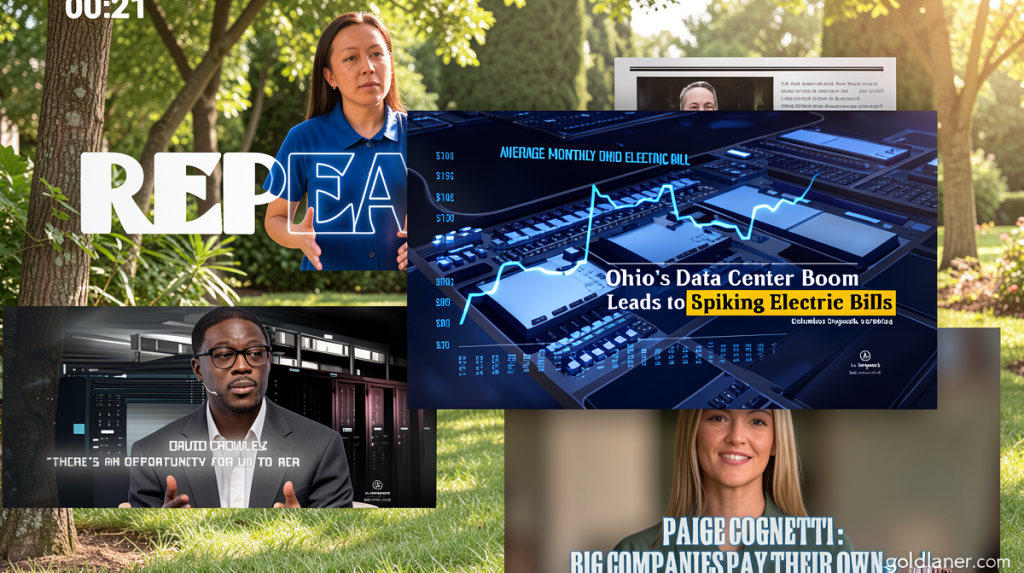
The Data Center Backlash Has Become a Bipartisan Campaign Weapon
Goldlaner.com – Americans are telling politicians, in no uncertain terms, that they do not want another server farm built down the road. Polling released over the past several months paints a consistent picture: a Fox News survey conducted in July showed 70% of voters opposed to new data center construction in their own communities to support artificial intelligence. A separate Reuters/Ipsos poll from June found that 59% of adults would resist a facility being erected within ten miles of their residence. Pew Research, publishing findings this month, reported that 52% of Americans now feel more anxious than enthusiastic about AI’s expanding role in everyday life — a figure that had sat at just 37% in 2021 — while a large majority anticipated the technology would shrink available employment.
That wave of public frustration has not gone unnoticed in campaign offices. Candidates across the ideological spectrum are now leaning hard into anti-data-center messaging, reshaping contests from county commissions to Senate races ahead of this year’s midterm elections. The shift represents a genuine tectonic realignment in voter sentiment, fueled by skepticism toward the tech industry, anxieties over property rights, environmental externalities, and above all the prospect of sharply higher utility costs.
Ad Spending Explodes Around a Single Issue
The numbers behind the messaging are striking. Tracking firm AdImpact tallied more than $31 million in political advertising that referenced data centers during the current year. Last month alone, over 8% of all broadcast-TV campaign dollars flowed to spots touching data centers or AI infrastructure — a dramatic jump from less than 1% the prior year. Nearly every dollar of that spending, more than 99%, was deployed against proposed AI infrastructure projects rather than in support of them.
The contrast with recent history is stark. AdImpact’s database shows that in 2024, not a single broadcast-TV election ad mentioned data centers. Through most of 2025, only a small handful did, and those appeared almost exclusively in lower-profile state-level races. Within roughly twelve months, the issue has leapt to the center of national political discourse.
Local Races, National Resonance
The backlash plays out with particular intensity at the local level, where a proposed facility can sit directly between a candidate’s district and a developer’s blueprint. In Michigan, a congressional candidate recorded a commercial standing in a working farm field, warning viewers that the land stood at risk of being swallowed by “a massive data center that’ll jack up our energy bills and ruin our home values.” In a suburban Missouri county, both leading Republican contenders for the executive seat devoted their entire television advertising budgets to pledging opposition to data centers, each accusing the other of being in the pocket of developers. In Wisconsin and California, two candidates who happen to share a first name have both been branded “Data Center David” by their rivals in recent attack spots.
“Data centers have picked up a unique bipartisan opposition in large part because they are so local as an issue,” said Daniel King, a research fellow at the Foundation for American Innovation. “Regardless of where party lines fall at the national level or on larger issues, both sides have been able to really pick up the spike.”
The Industry’s Quiet Counterplay
Interest groups tied to the AI sector have responded by funneling millions of dollars into pivotal races, federal election filings indicate. Yet a review of their broadcast placements reveals a conspicuous absence of the very topic dominating the political conversation. One major super PAC, funded in part by an OpenAI executive, purchased millions of dollars worth of television advertising this year without once referencing AI or data centers in any of its spots. The strategy appears designed to bankroll allied candidates while sidestepping the issue voters have made most salient.
Why the Issue Cuts Across Party Lines
Analysts note that data centers resist easy sorting into left-versus-right categories. The concern is fundamentally geographic and economic: a facility’s proximity to a neighborhood, its draw on the local grid, its effect on surrounding property values. That specificity makes it a potent tool for candidates regardless of their broader platform.
“It isn’t intrinsically a right or left issue,” said Clifford Young, chair of research firm Ipsos Public Affairs. “It’s a boogeyman for everyone. It plays into this underlying belief that the system is broken.”
The Scale of the Buildout
The infrastructure push behind the political controversy is enormous. Tracking firm Cleanview counts more than 2,000 data centers currently in various planning stages across the United States, part of a broader capital program in which major technology companies are committing hundreds of billions of dollars to new computing capacity. The chips that power modern AI workloads consume substantially more electricity than earlier-generation processors. Goldman Sachs projects that this demand could drive a 6% increase in national electricity bills over the coming year, with the steepest increases concentrated in communities situated near new facilities.
Even senior lawmakers who face no immediate electoral challenge have begun advocating tighter permitting rules or outright moratoriums on new construction, signaling that the issue has moved beyond a campaign talking point into the realm of proposed legislation. With Congress up for grabs in November, both parties are racing to define their position on what has become, in the words of one pollster, the defining local-infrastructure fight of the decade.
Related Reading
Frequently Asked Questions
What is Voters hate data centers Candidates?
Voters hate data centers Candidates is the main topic of this guide. The article explains the context, practical details, and next steps readers should understand.
Why does Voters hate data centers Candidates matter?
Voters hate data centers Candidates matters because readers are looking for a useful answer, not just a short summary. Good content should match search intent and help them decide what to do next.