
MIT unveils a robot that flies and swims. Now it wants to put it into action
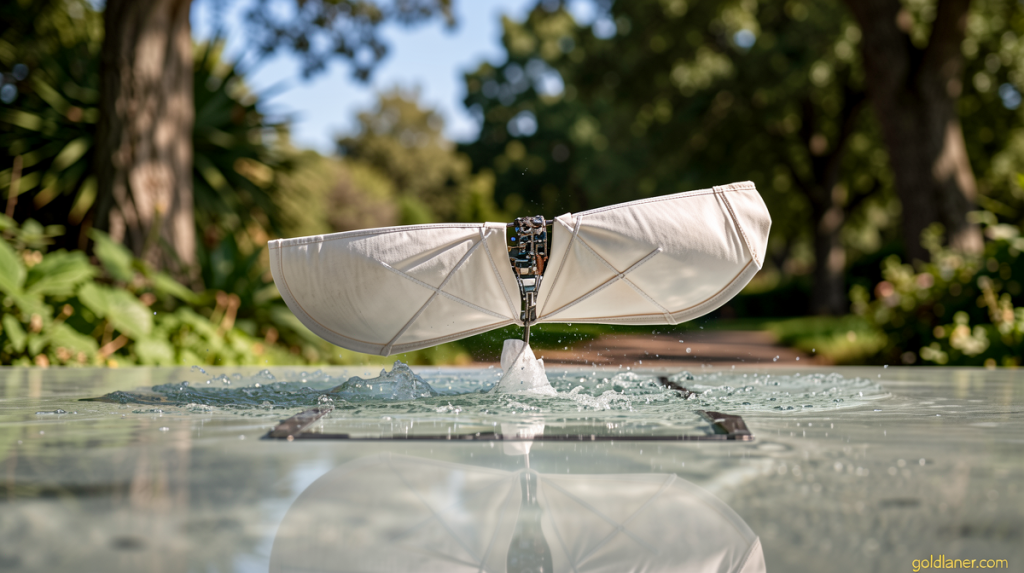
MIT Engineers Create Dual-Domain Robot for Ocean Exploration
Goldlaner.com – A research team at the Massachusetts Institute of Technology has developed an innovative robotic platform capable of navigating both atmospheric and aquatic environments. The device, which costs approximately $300 to produce, represents a significant advancement in autonomous marine and aerial monitoring technology. Its lightweight construction and dual-mode propulsion system suggest potential applications ranging from environmental sampling to wildlife surveillance in challenging locations.
Bird-Inspired Engineering Breakthrough
The concept emerged from extensive observation of seabirds such as petrels and puffins, species that utilize wing movements for both flight and underwater swimming. Researchers examined how these creatures transition between mediums and analyzed the mechanical principles governing their movement patterns. Raphael Zufferey, who serves as an assistant professor of mechanical engineering at MIT and led the study, noted that while scientific literature covered diving bird anatomy, no comprehensive solution had been developed for robotic implementation.
“No one had ever figured out how to transform that into a fully moving robot,” Zufferey explained regarding the gap in existing research.
The team conducted a comprehensive review of ornithological studies, documenting wing flap frequencies across various bird species and correlating these measurements with wingspan dimensions. Larger birds demonstrated lower flap rates, a relationship that informed the robot’s programming parameters. The resulting vehicle weighs 250 grams, equivalent to nine ounces, and operates using a battery-powered motor connected to nylon wings. A tail section receives treatment with water-repellent nanoparticles to enhance performance during aquatic transitions.
Engineering Beyond Simple Biomimicry
While the design draws inspiration from nature, the engineers deliberately avoided straightforward biomimetic replication. Water density varies considerably from air depending on temperature, pressure, and humidity levels. Diving birds partially fold their wings underwater to reduce movement amplitude and minimize drag forces. Replicating this mechanism in a robot would necessitate four additional joints, increased mechanical complexity, and greater overall mass.
Instead, the MIT team engineered a wing structure that remains rigid in form but possesses enhanced flexibility compared to avian counterparts. This approach reduces amplitude without requiring folding mechanisms. The robot operates without sensing its medium directly; rather, it follows programmed frequency targets for wingbeats per second regardless of whether it traverses air or water.
Performance metrics indicate the vehicle achieves flight speeds exceeding six meters per second, approximately 13.4 miles per hour. Aquatic movement reaches nearly one meter per second, or 2.2 miles per hour. Theoretical range estimates suggest six kilometers of flight or two kilometers of swimming on a single charge, though these figures await empirical validation through extended testing protocols.
Testing and Technical Validation
Researchers conducted comprehensive evaluations spanning one year within a controlled water facility in Massachusetts before relocating experiments to Lake Geneva in Switzerland. A critical development phase focused on optimizing the entry angle for water immersion, ultimately settling on seventy degrees as the ideal trajectory. The current iteration functions reliably under moderate wind and wave conditions, though rougher environments present challenges requiring future engineering refinements.
“Developing a vehicle capable of operating effectively in both air and water is a significant technical challenge, and successfully integrating these two modes of operation is a notable engineering achievement,” said Maaten Furlong, director of engineering science at the National Oceanography Centre, who provided external assessment of the project.
Future Applications in Oceanography
The research team now pursues funding opportunities to advance the platform toward autonomous mission capabilities. While individual functions—flight, swimming, diving, and medium transitions—have been demonstrated separately, combining these operations into a single continuous mission remains an objective. Zufferey emphasized that understanding avian navigation patterns continues to inform the development process.
Marine scientific sampling currently involves substantial financial investment, creating opportunities for cost-effective alternatives. The FAAV could deploy from either terrestrial or maritime launch points, following predetermined aerial routes before submerging to collect water samples. Potential deployment scenarios include monitoring toxic algal concentrations, investigating volcanic lake environments, and conducting research near iceberg formations where human access proves difficult or hazardous.
“I like the idea of bringing these robots into more dangerous scenarios,” Zufferey stated, highlighting applications in extreme environments.
Additional instrumentation options include camera systems for wildlife observation, further expanding the platform’s utility across multiple scientific disciplines. As ocean monitoring demands grow alongside increasing environmental pressures, such versatile robotic tools may become essential components of future research infrastructure.
Related Reading
Frequently Asked Questions
What is MIT unveils a robot that flies?
MIT unveils a robot that flies is the main topic of this guide. The article explains the context, practical details, and next steps readers should understand.
Why does MIT unveils a robot that flies matter?
MIT unveils a robot that flies matters because readers are looking for a useful answer, not just a short summary. Good content should match search intent and help them decide what to do next.
