
China loves historic sites. Tourists don’t mind if they’re not the originals
China’s Modern-Day Historical Revivals: Where Authenticity Takes a Backseat to Experience
Goldlaner.com – Nationwide, China has embraced a unique phenomenon known as fanggu, or “historical imitation.” These attractions represent a creative solution to a persistent challenge: much of China’s rich heritage has been lost over centuries to fires, wars, looting, and revolutions. Rather than mourning what was lost, the country has chosen to recreate it. Entire villages that appear ancient have been constructed from scratch, complete with glistening palaces and majestic boulevards. Every element is carefully curated, from vines transplanted in bulk to tiles mechanically crumbled to achieve an aged appearance. The outcome is a grand, occasionally peculiar fusion of dynastic history, architectural styles, and geographical elements.
The Emotional Economy of Tourism
Modern travelers are increasingly seeking more than just sightseeing. Yang Jinsong, director of the International Institute at the China Tourism Academy, explained to state media outlet People’s Daily in June that contemporary consumers are “increasingly willing to pay for emotional value, seeking deeper engagement and cultural meaning through immersive experiences.” For many domestic visitors navigating a stagnant economy, these fanggu villages provide an ideal retreat.
The financial barrier to entry is remarkably low. Once inside, travelers can select from hundreds of traditional Hanfu costumes for an average of just $15. Adding another $10 unlocks the complete experience: professional makeup, accessories, photography sessions, and post-production editing. Aiming for the classic pale-faced, red-lipped aesthetic, these photoshoots have transformed into viral sensations on Xiaohongshu, also known as RedNote. Foreign visitors are now participating as well, drawn by Chinamaxxing—a social media-driven movement that has popularized Chinese practices and aesthetics among young people worldwide.
Gubei: A Northern Water Town That Never Was
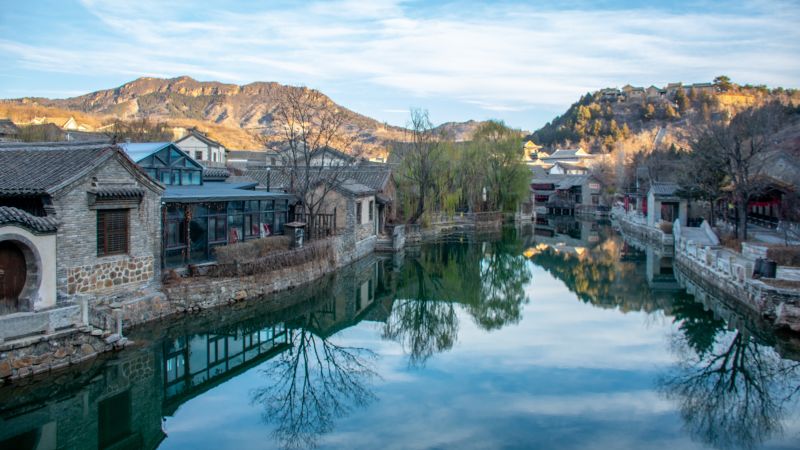
Forget Venice when thinking about Gubei. This destination features canals, cobblestone roads, lantern-lit teahouses, and gray-tiled homes. Positioned at the foot of the Simatai section of the Great Wall, it serves as an ideal sanctuary following a steamy hike. Visitors can enjoy boat rides where century-old willows line the banks or wander through the central square, where splintered plaques peek through vines. As guides often remark, isn’t Qing Dynasty “river life” romantic?
Gubei is marketed as a classic Jiangnan water village. The catch? Jiangnan water villages never existed in northern China—Jiangnan literally means “south of the Yangtze River,” approximately 800 miles away. Gubei is not an ancient relic. Built in 2014 by a state-backed enterprise, this $600 million investment merged two of China’s most treasured attractions: the Great Wall in the north and water towns in the south. What once required a two-hour flight from Beijing is now accessible via a two-hour drive.
In recent years, Gubei has captured both the hearts and wallets of exhausted Beijingers and curious international tourists. Travel platforms like Klook now package the Great Wall and water town into day tours, advertising a “getaway from the hustle and bustle of the city with a trip to an ancient village.” By July 2026, the platform recorded over 10,000 bookings and 2,200 reviews, yielding an average rating of 4.9.
For those wishing to extend their stay, state enterprises oversee all accommodations within the complex, ranging from modest guest houses to premium resorts. Some properties charge up to $500 per night. After climbing the Great Wall, lounging in a lantern-lit villa offers the perfect way to unwind.
Transparency Concerns and Global Appeal
For most tourists, Gubei’s lack of genuine history is not a dealbreaker. However, some visitors desire greater transparency. Minyada “Minnie” Chotichaicharin, a Thai exchange student, visited Gubei in April. Her two-hour tour included crafts, archery, hot springs, and a traditional boat ride. Upon learning that Gubei was far from ancient, she admitted to feeling disappointed. “I wouldn’t mind that it’s rebuilt,” she says, “but it’s hard to not feel tricked.”
Xi’an’s Neon-Powered Revival
Around 750 A.D., Xi’an stood as the world’s largest and most cosmopolitan city. As a crucial Silk Road gateway, it teemed with merchants from across Asia, Europe, and the Middle East. Today, Xi’an remains faithfully Chinese. Along its pedestrian street, tourists pose beside statues of famous Tang Dynasty poets, while a high-end bakery displays a dragon sculpted entirely from baguettes.
Xi’an, which served as China’s capital for over a millennium, has now constructed its own “city that never sleeps.” Datang Everbright City blazes with red pagodas and throbs to Chinese EDM, creating a frenetic revival of the Golden Age of the Tang Dynasty. Conveniently overlooking the curfews of ancient China, the 2,100-meter pedestrian street attracts nearly 75 million visitors annually. While some come seeking historical connection, most are captivated by the neon-soaked nightlife.
“I wouldn’t mind that it’s rebuilt,” she says, “but it’s hard to not feel tricked.”
“increasingly willing to pay for emotional value, seeking deeper engagement and cultural meaning through immersive experiences”
Related Reading
Frequently Asked Questions
What is China loves historic sites Tourists don t?
China loves historic sites Tourists don t is the main topic of this guide. The article explains the context, practical details, and next steps readers should understand.
Why does China loves historic sites Tourists don t matter?
China loves historic sites Tourists don t matters because readers are looking for a useful answer, not just a short summary. Good content should match search intent and help them decide what to do next.
