
John Roberts is trying to send a message on Trump. His court’s decisions send another
John Roberts Sends a Message on Trump Through Court Decisions
A Toast with Deeper Meaning
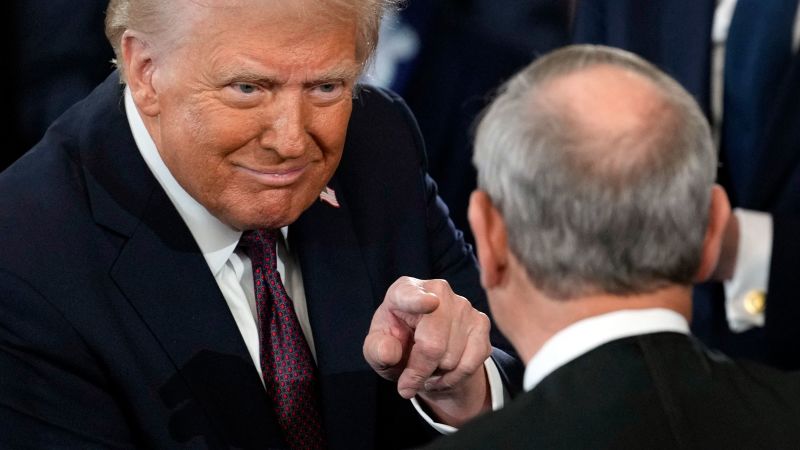
Goldlaner.com – John Roberts is trying to send a clear signal about the Supreme Court’s independence during the Trump era. At the June gathering hosted by the Supreme Court Historical Society, the Chief Justice followed tradition by offering his customary toast honoring the nation’s leader. Previously, this ceremony within the marble-pillared Great Hall proceeded without any preamble. This time, however, the organization’s executive director took the floor first to clarify that the toast represented a longstanding custom extending across generations and administrations. Only after this explanation did Roberts lift his glass and proclaim, “To the president of the United States.”
Since Donald Trump’s initial election victory ten years ago, tensions between the judiciary and the executive branch have intensified considerably. Simultaneously, the Supreme Court has dismantled numerous constraints on presidential authority, creating substantial advantages for Trump’s agenda. Under the guidance of a conservative majority, the Court granted Trump considerable protection against criminal charges. It also restricted lower court judges from issuing broad injunctions targeting questionable policies nationwide.
Recent Rulings Favor Executive Power
Additionally, the Court permitted Trump to exclude foreign nationals from entering the country, whether his reasoning stemmed from religious bias during his first presidency or racial concerns more recently. Just weeks ago, justices delivered another decision empowering Trump to dismiss leaders of independent regulatory bodies responsible for workers’ rights, consumer safeguards, and nuclear oversight.
Roberts has consistently emphasized that the Court strengthens the institution of the presidency rather than elevating one specific individual. He has worked diligently to counter suggestions that the bench operates under Trump’s influence. According to available records, at least seventy-seven rulings involving Trump’s second term featured pointed criticism from various judges.
“The entry suspension at issue here is an act that could have been taken by any other president,” Roberts declared from the bench in 2018 when upholding Trump’s travel ban targeting predominantly Muslim nations, despite the president’s vocal opposition to Muslims.
Simultaneous Opinions Send a Clear Message
Last month presented an unusual scenario when Roberts authored the opinion expanding presidential firing authority while simultaneously issuing a separate ruling preventing Trump from immediately removing Lisa Cook, a Federal Reserve governor. These contrasting decisions appeared together on the Court’s official website, breaking from standard procedure. In the press room, reporters observed the opinions bound together with a rubber band—a deliberate gesture ensuring neither would be interpreted in isolation.
This pairing extended beyond protecting the central bank, which financial markets closely monitored. The initial opinion granting the president new dismissal powers over most independent agencies already indicated the Fed would remain exempt due to its “distinct historical tradition.” A related 2025 case concerning independent-agency removals similarly described the Federal Reserve as “uniquely structured, quasi-private.”
Roberts’ Vision of Judicial Independence
The coordinated publication served as a vehicle for Roberts to communicate his message of institutional autonomy. This theme has permeated his public statements as well. “The people on the court were appointed by five different presidents,” Roberts remarked during a March appearance at Rice University. “The notion that we carry forward the views of the people that appointed us is absurd.”
Illustrating the boundary between branches of government, Roberts recalled his 2005 appointment by President George W. Bush: “Secret Service people had protected me during the nomination. Once I had been confirmed and taken the oath, it’s in the White House, you walk out the door, it’s the Supreme Court police, right there, no more Secret Service. …. The idea that I’m carrying out, or that they’re carrying out, some different agendas, is really fallacious.”
A Broader Pattern Emerges
Evaluating the Supreme Court solely through individual annual terms provides an incomplete perspective. Examining the Court’s trajectory through its Trump-related jurisprudence reveals a comprehensive transformation reshaping American governance. The conservative majority has predominantly sided with Trump to strengthen executive authority and alter social policy while advancing the Court’s own objectives.
The Roberts Court has consistently pursued expanding executive power and eliminating racial remedies for discrimination in voting and employment. John Roberts is trying to send a message that these decisions reflect institutional evolution rather than political alignment.
Frequently Asked Questions
What is the significance of Roberts’ toast at the Supreme Court Historical Society event?
The toast gained attention because the executive director provided context beforehand, clarifying it as a longstanding tradition rather than a political statement. This timing helped distinguish the ceremonial gesture from the Court’s recent decisions favoring Trump.
How many Trump-related rulings have featured judicial criticism?
According to available records, at least seventy-seven rulings involving Trump’s second term included pointed criticism from various judges, demonstrating that the Court maintains independent perspectives even while supporting executive authority.
What makes the Lisa Cook decision notable?
Roberts simultaneously issued two contrasting opinions—one expanding presidential firing authority and another protecting Cook from immediate removal. The opinions were bound together with a rubber band in the press room, signaling they should be read as complementary rather than contradictory.
Why does Roberts emphasize the Court’s institutional independence?
Roberts has worked to counter suggestions that the bench operates under Trump’s influence. He points out that justices were appointed by five different presidents and that the Court’s role is to strengthen the presidency as an institution, not to elevate one specific individual.
