
Explosion near Macron’s Damascus hotel as French president meets Syrian counterpart
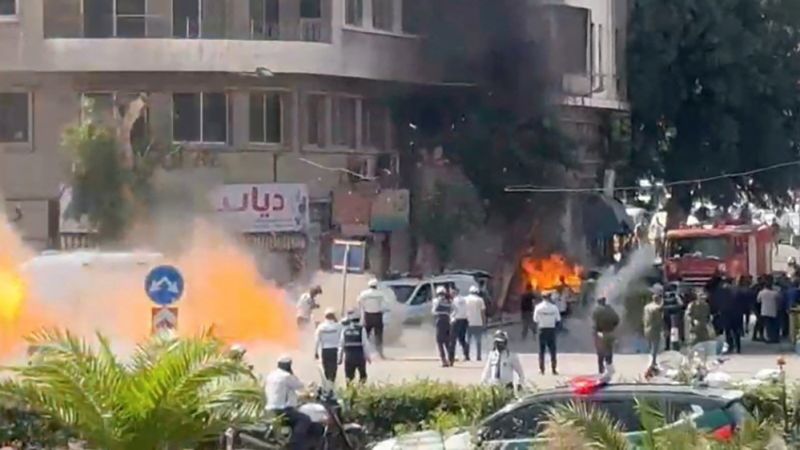
Explosion near Macron’s Damascus Hotel as French President Meets Syrian Counterpart
Explosion near Macron s Damascus hotel – On Tuesday, a significant explosion occurred near the Four Seasons Hotel in Damascus, a location where French President Emmanuel Macron had stayed the night prior to his meeting with Syrian President Ahmed al-Sharaa. The incident, reported by French and Syrian media, sent shockwaves through the capital and raised concerns about security during the high-profile diplomatic engagement. According to the Élysée Palace, Macron arrived at the Presidential Palace shortly before the blasts, remaining unscathed despite the proximity of the attack.
The French news outlet BFMTV, a CNN affiliate, confirmed that Macron had been residing at the Four Seasons Hotel, a well-known accommodation for international visitors. The hotel’s strategic position in the heart of Damascus makes it a common choice for diplomats, non-governmental organization (NGO) representatives, and journalists. However, the twin explosions on Tuesday marked a stark disruption to its usual role as a neutral hub.
“Both explosive devices were made in a primitive way,” stated the Syrian Arab News Agency (SANA). The first device was placed inside a vehicle parked along a major road, while the second was hidden within a garbage container near the Ministry of Tourism, as revealed by an unnamed Syrian official speaking to CNN.
The attack resulted in at least 18 injuries, with four of the victims being police officers, according to SANA. The second blast, occurring adjacent to the Ministry of Tourism, added to the chaos. While the exact cause of the explosions remains under investigation, SANA noted that authorities are working to determine the attackers’ motives and identify those responsible. The method used—simple and makeshift—suggests a potential lack of sophisticated planning, though the target of the attack is still being analyzed.
Macron’s visit to Syria represents a historic milestone, as it is the first official trip by a Western leader to the country since the Assad regime’s fall in December 2024. The French president’s arrival on Monday evening local time underscored the shifting dynamics in the region, with Syria now under a new administration. This meeting between Macron and al-Sharaa is expected to address key issues such as economic cooperation, regional stability, and the ongoing recovery efforts in the aftermath of years of conflict.
The timing of the explosions has sparked speculation about the intent behind the attack. With the Syrian capital still recovering from previous conflicts, the blasts may be seen as an attempt to undermine diplomatic progress or test security measures. The Ministry of Health reported that a separate attack just a week earlier had killed nine individuals and wounded 22 others, highlighting the persistent threat to public spaces in Damascus. Analysts suggest that the attackers might be targeting both the symbolic presence of a Western leader and the symbolic resilience of the Syrian government.
SANA emphasized that the investigation into the explosions is ongoing, with officials scrutinizing all possible leads. The primitive nature of the devices has led some to question whether they were deployed by a local group or a broader network seeking to destabilize the region. The hotel’s location, near government buildings and tourist areas, makes it a high-value target for those aiming to create political or social disruption.
France has expressed its commitment to maintaining diplomatic ties with Syria, despite the challenges posed by the conflict. The Élysée Palace’s statement about Macron’s safety reflects the urgency of ensuring his protection during the visit. While the attack did not derail the meeting, it has undoubtedly cast a shadow over the discussions, prompting a review of security protocols and a reevaluation of the risks associated with such engagements.
As the Syrian government continues to consolidate power in the post-Assad era, the presence of Western leaders like Macron signifies a new chapter in international relations. The Four Seasons Hotel, often a focal point for high-level delegations, now stands as a reminder of the fragile balance between progress and peril. The twin blasts, though not fatal to Macron, have rekindled debates about the safety of diplomatic missions and the evolving security landscape in Syria.
SANA’s report also highlighted the swift response from local authorities, who swiftly cordoned off the area and provided emergency services to the injured. The coordination between Syrian and French teams during the crisis has been praised as a model of cooperation, even in the face of potential threats. Meanwhile, the broader international community is monitoring the situation closely, with concerns about the implications of such attacks on Syria’s diplomatic standing and regional alliances.
The explosion near Macron’s hotel has been described as a coordinated but low-tech operation, with both devices targeting high-traffic zones. The first blast, located on a main thoroughfare, likely aimed to draw attention to the area, while the second, near the Ministry of Tourism, may have targeted a specific group or symbol. The simplicity of the devices has led some to speculate that they were designed for maximum impact with minimal resources, possibly executed by a local insurgent group or sympathizers.
As the investigation unfolds, questions remain about who orchestrated the attack and why. The timing, just days before a major diplomatic event, suggests a deliberate attempt to create tension. However, the fact that Macron remained unharmed has bolstered confidence in the security arrangements. The Syrian government, now navigating a complex political environment, is determined to present a stable image to its international partners, even in the wake of such incidents.
With the region still in transition, the explosion serves as a reminder of the ongoing challenges. While the immediate focus is on the safety of Macron and the injured, the broader implications for Syria’s future are being discussed. The French president’s visit, a symbolic gesture of reconciliation, has now become intertwined with the reality of security threats. As the investigation continues, the world watches to see how this event will shape the trajectory of Syrian-French relations and the stability of the country’s new leadership.
In conclusion, the twin explosions near Macron’s hotel in Damascus have underscored the persistent risks in the region. Despite the attack, the French president’s presence in Syria remains a testament to the country’s diplomatic aspirations. The simplicity of the devices and the timing of the blasts raise questions about the motivations of the attackers, but the successful protection of Macron highlights the effectiveness of security measures. As Syria moves forward in its post-Assad era, the events of Tuesday will be a critical point of reflection for both the government and its international counterparts.
