
Strong explosions rock Kyiv hours after Zelensky warned of ‘massive’ Russian attack
Kyiv Shaken by Explosions Following Zelensky’s Warning of Russian Assault
Strong explosions rock Kyiv hours after – Hours after Ukrainian President Volodymyr Zelensky issued a stark warning about an impending “massive” Russian attack, Kyiv was rocked by a series of powerful explosions that spread fear across the city. The strikes, which began during the early hours of Thursday, targeted residential areas, causing significant damage and raising concerns about civilian casualties. According to Kyiv officials, the attacks involved a combination of ballistic missiles and drones, which penetrated the city’s skyline and left a trail of destruction.
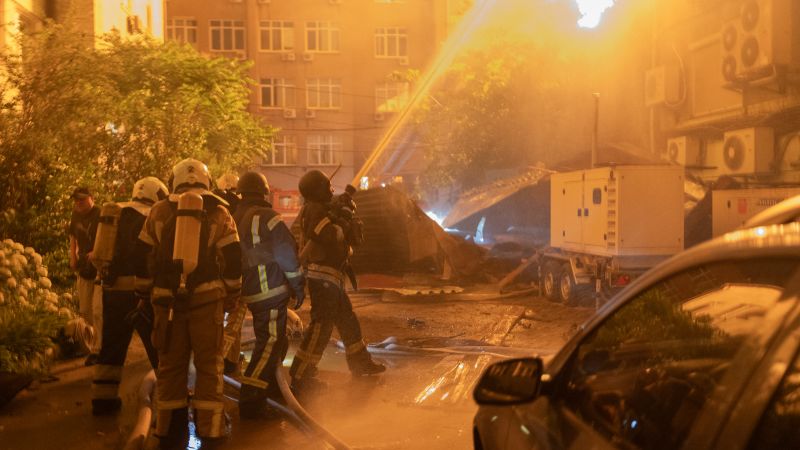
The first reports of the explosions came shortly after midnight, with initial shockwaves shaking buildings across central Kyiv. Emergency crews quickly mobilized to address the aftermath, including fires that erupted in several residential complexes. Kyiv Mayor Vitali Klitschko confirmed that at least one person had died in the attacks, while 11 others were hospitalized with injuries. The city’s infrastructure, already strained by months of conflict, faced further challenges as rescue teams worked to evacuate those trapped inside a collapsed nine-story building.
Zelensky’s warning had been issued the previous day, urging citizens to take immediate precautions. In a post to X, he emphasized the urgency of the situation, stating, “That is exactly the threat we are facing tonight.” His remarks followed intelligence reports indicating that Russian President Vladimir Putin had been preparing for a large-scale strike against Ukraine for weeks. The president’s message was backed by a call for residents to “be especially careful” and to respond promptly to air-raid sirens, which began blaring around 8 p.m. local time as the attacks unfolded.
“That is exactly the threat we are facing tonight,” Zelensky said in a post to X.
Residents scrambled to find shelter, with many heading to metro stations to seek refuge from the escalating violence. The sounds of explosions and the wail of sirens echoed through the city, creating a tense atmosphere that mirrored earlier nights of bombardment. In one incident, an ambulance substation was hit, leaving medical workers injured and complicating efforts to transport the wounded. Photos and videos shared by Reuters news agency captured the chaos, showing flames consuming crumbling structures and rescuers sifting through piles of rubble in search of survivors.
The attacks marked a continuation of Russia’s strategic shift toward targeting Ukrainian cities with precision strikes. This month, Kyiv has seen an uptick in such incidents, with the city’s residential neighborhoods becoming prime objectives. The strikes not only caused physical damage but also disrupted daily life, forcing evacuations and leaving families in disarray. Kyiv’s historic core, which has become a frequent target, now bears the scars of yet another assault.
Ukraine’s military has increasingly relied on drones as a key element of its defense strategy. Over the past month, the country has intensified its drone campaign, launching long-range attacks on Russian energy infrastructure. Zelensky has framed this initiative as a crucial tool to weaken Moscow’s war effort and force a strategic shift in the conflict. However, the latest strikes suggest that Russia is countering this approach with its own aggressive tactics. On a single night last week, Russian authorities reported intercepting 660 drones across 12 regions, indicating the scale of Ukraine’s aerial operations.
While Kyiv has been the primary focus of recent Russian strikes, the city’s vulnerability is part of a broader pattern of attacks on Ukraine’s urban centers. This follows a major assault in June that targeted the Kyiv Pechersk Lavra, a UNESCO-listed monastery complex in the heart of the capital. The attack damaged the historic site, highlighting the deliberate targeting of cultural landmarks in the war effort. Such incidents have drawn international condemnation and underscored the intensity of the conflict.
As the situation in Kyiv worsened, officials and civilians alike braced for a prolonged period of bombardment. The city’s resilience has been tested repeatedly, but its residents remain determined. Zelensky’s warnings, though alarming, have become a familiar part of the conflict narrative, signaling the constant threat of Russian aggression. The combination of missile strikes and drone attacks has created a dual-layered assault, challenging Ukraine’s ability to defend its territory and protect its citizens.
Analysts suggest that the timing of the attacks coincided with Russia’s broader military operations, which aim to disrupt Ukraine’s supply lines and morale. The destruction of residential buildings has forced many families to relocate, while the damage to infrastructure has hampered the city’s recovery efforts. Despite these challenges, Kyiv’s leadership has continued to emphasize preparedness, ensuring that emergency services and civilians are equipped to respond to further threats.
Meanwhile, the global community watches closely as the war in Ukraine enters a new phase. The escalating attacks on Kyiv have reignited discussions about the potential for a large-scale offensive, with concerns growing about the humanitarian impact. Zelensky’s warning, coupled with the recent strikes, has once again highlighted the precarious balance between military strategy and civilian safety in the conflict.
As the night wore on, the city’s emergency response teams worked tirelessly to mitigate the damage. The coordination between local authorities and international aid organizations has become critical in the face of sustained attacks. Kyiv’s mayor, Vitali Klitschko, described the situation as “dire,” but also noted the city’s resolve to endure. “We will not back down,” he stated, “even as the enemy seeks to break our spirit.”
The incident in Kyiv serves as a reminder of the ongoing battle for control of the region. While Russia aims to inflict maximum damage through its attacks, Ukraine’s ability to adapt and respond has been a defining feature of the conflict. The combination of Zelensky’s warnings and the reality of the strikes has kept the city on high alert, with citizens preparing for the next wave of assaults. As the battle for Kyiv continues, the world remains focused on the unfolding drama in the heart of Eastern Europe.
