
Tricycle ambulances are saving lives in Ghana
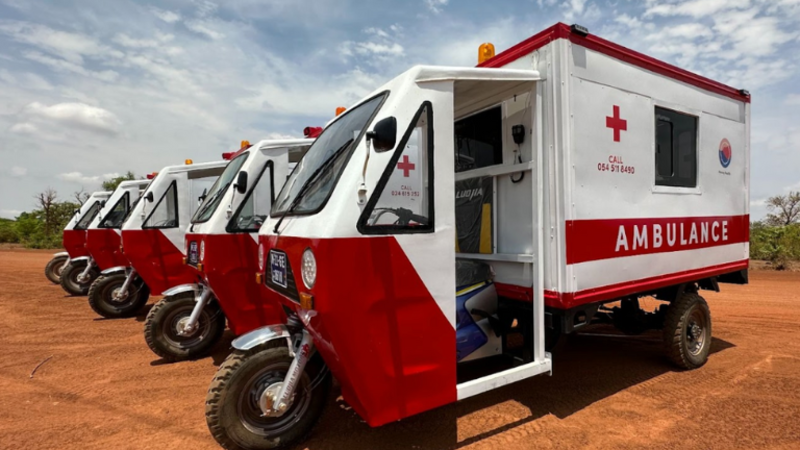
Tricycle Ambulances Are Transforming Healthcare in Ghana
A Life on the Line: The Tricycle Ambulance Revolution
Tricycle ambulances are saving lives in Ghana – In a remote farming community nestled in Northern Ghana, Billeh Rosemount faced a harrowing medical emergency in October 2024. At 24 years old, she was experiencing a miscarriage and feared for her life. “I was bleeding heavily, and the midwife couldn’t stop the blood,” she recalled. The situation demanded urgent action, yet the conventional ambulance service was nowhere to be found. Instead, Rosemount was transported by a tricycle ambulance—a compact, motorized vehicle tailored to navigate Ghana’s challenging terrain. Designed by Moving Health, a nonprofit organization dedicated to reducing maternal mortality, these tricycles serve as lifelines in regions where traditional ambulances are either too few or impractical.
“You have to go and beg for somebody to get the vehicle… It was very, very, very difficult for us,” Rosemount said, emphasizing the community’s struggle to access emergency transport. She added that without this innovative solution, pregnant women often had to rely on neighbors for motorbike rides, leaving them vulnerable in critical moments.
These tricycle ambulances are engineered to overcome the obstacles of rural Ghana’s infrastructure. Unlike standard ambulances, which may struggle with potholes and narrow roads, the tricycles are equipped with a motorcycle engine, allowing them to traverse difficult paths swiftly. Each vehicle includes a full-length stretcher, space for a companion, and a midwife or community health worker. Essential medical equipment such as oxygen concentrators and emergency birthing kits are also onboard, ensuring that life-threatening conditions can be addressed en route to larger hospitals.
The Innovation Behind the Tricycle Ambulance
Moving Health’s journey began at the Massachusetts Institute of Technology (MIT) in 2016, where co-founder Emily Young and a group of mechanical engineering students envisioned a mobile healthcare solution for underserved regions. The idea took shape after observing the lack of reliable emergency transport in Ghana’s rural areas. By 2019, the initiative had transitioned from a prototype to a fully operational program, with its first tricycle ambulances deployed in the Upper West Region of Northern Ghana.
One of the organization’s key achievements is manufacturing these vehicles at a fraction of the cost of conventional ambulances—roughly one-tenth the price. This affordability allows the nonprofit to scale its impact across multiple districts. As of 2024, Moving Health has introduced a fleet of 31 tricycle ambulances, covering more than 230,000 people in regions not served by the National Ambulance Service. The vehicles are stationed at community clinics, accessible via a dedicated hotline or bike messengers in areas with limited cellular connectivity.
“Sometimes the biggest barrier to surviving a medical emergency isn’t the lack of hospitals,” said Emily Young, CEO and co-founder of Moving Health. “It’s being able to get there in time.”
Isaac Quansah, Moving Health’s chief technology officer and country director, has witnessed the urgency of this issue firsthand. After his wife experienced postnatal complications following the birth of their first child, Quansah was unable to find an ambulance and had to drive her to the hospital in a small car. The journey was agonizing, as his wife endured excruciating pain while seated upright. “When I design an ambulance, I know that I have a reason,” Quansah told CNN. “A life-fulfilling purpose for me to help other mothers not go through what my wife went through.”
The tricycle ambulance’s design is a testament to the community’s needs. Health workers initially highlighted a common challenge: women often give birth midway through their trip to the hospital, especially at night. In response, Moving Health incorporated features that allow for immediate care during transit, such as adjustable seating and space for a midwife to assist. The vehicles are upgraded annually based on feedback from users, ensuring they remain effective in evolving conditions.
Global Context and Local Impact
Moving Health’s work aligns with broader global efforts to improve maternal health. According to the World Health Organization, Sub-Saharan Africa accounted for approximately 70% of maternal deaths worldwide in 2023. In Ghana, maternal mortality remains a pressing issue, with 234 deaths per 100,000 live births recorded in that year—14 times higher than in the United States. Despite progress, rural areas continue to bear the brunt of these preventable deaths, where distance and unreliable transport systems create critical delays.
The tricycle ambulance initiative has significantly reduced these delays. A 2024 study revealed that Ghana’s National Ambulance Service grew from 55 units in 2020 to 356 by 2024, serving a population of around 35 million. However, the tricycle ambulances have gone even further, cutting transport time for rural communities by 64% since their introduction. This improvement has allowed countless mothers to receive timely care, preventing complications that could lead to fatal outcomes.
Quansah oversees local manufacturing in Northern Ghana, where the nonprofit employs and trains engineers to sustain the initiative. This approach not only ensures the vehicles are built to local standards but also fosters economic opportunities within the community. By empowering local workers, Moving Health reinforces the idea that healthcare solutions must be rooted in the regions they serve. The tricycle ambulances are not just a tool for emergency response—they are a symbol of resilience and adaptability in the face of logistical challenges.
Empowering Communities Through Innovation
The success of Moving Health’s tricycle ambulances lies in their ability to bridge the gap between rural communities and essential medical services. By leveraging the existing infrastructure of motorbikes, the organization has created a system that is both cost-effective and scalable. The vehicles can cover distances up to 100 kilometers (62 miles), transporting patients to district, regional, or national hospitals for specialized care. This flexibility has proven vital in a country where access to healthcare facilities is unevenly distributed.
Rosemount’s experience underscores the transformative potential of these ambulances. After receiving emergency care on the tricycle, she recovered, but the alternative was grim. Without this service, the journey might have taken two hours, or worse, required her to rely on a neighbor’s motorbike. “You can lose one of the lives, the mother or the child,” she said, reflecting on the risks of delayed treatment. The tricycle ambulance’s presence has not only saved lives but also instilled a sense of security in communities where maternal health once felt precarious.
As Moving Health expands its operations, the focus remains on addressing the root causes of maternal mortality. By improving access to emergency transport, the organization is tackling a critical factor in reducing preventable deaths. The tricycle ambulances exemplify how simple, innovative solutions can make a profound difference in healthcare delivery. Their impact is a reminder that in regions with limited resources, creativity and community collaboration can overcome even the most daunting challenges.
Looking ahead, Moving Health aims to replicate its model across other African nations, where similar transportation hurdles exist. The organization’s commitment to affordability, adaptability, and local empowerment ensures that its tricycle ambulances will continue to play a pivotal role in saving lives. For Ghana’s rural communities, these vehicles are more than just machines—they are a lifeline, a beacon of hope, and a step toward a healthier future.
