
In a visit to farm country, Trump extols ‘beautiful fountains’ back in Washington
In a Visit to Farm Country, Trump Highlights “Beautiful Fountains” in Washington
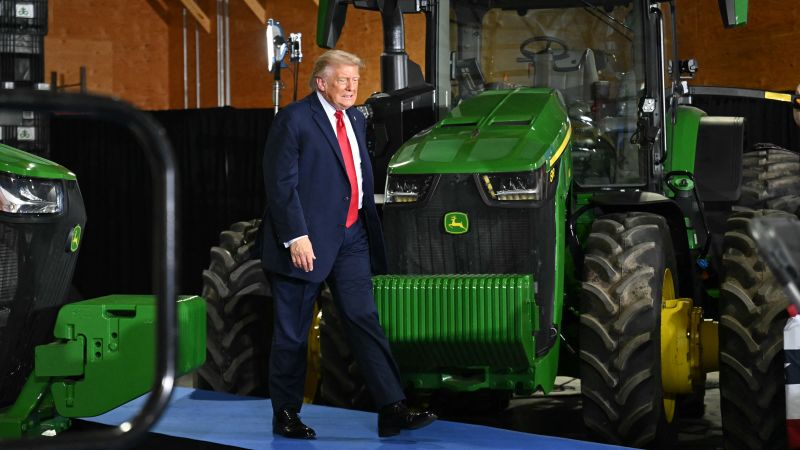
In a visit to farm country – President Donald Trump returned to the political spotlight this week during a roundtable event in Wisconsin, where he engaged with local farmers and emphasized his support for agricultural interests. The gathering, held at Custer Farms in Chippewa Falls, took place under a green banner bearing the slogan “Fighting for American Farmers,” a visual reminder of the administration’s focus on rural communities. However, Trump’s remarks quickly shifted to a topic that seemed unrelated to the immediate concerns of his audience: the state of public fountains in Washington, D.C.
“We’re very proud of Washington,” Trump declared, addressing the group. His statement came after he pointed out a peculiar detail about the nation’s capital: “We had 22 fountains that didn’t work – all of the fountains, not one in Washington worked – and now they’re clean and beautiful.” This remark, though seemingly off-topic, drew a brief chuckle from the crowd. The fountains, part of a grand public space in the heart of the city, became a metaphor for Trump’s broader narrative about government efficiency and infrastructure.
“We’re very proud of Washington. We had 22 fountains that didn’t work – all of the fountains, not one in Washington worked – and now they’re clean and beautiful.”
The event took place roughly 1,025 miles from the White House, underscoring the logistical effort required for Trump’s return to the campaign trail. It marked his first visit to Wisconsin since securing the state’s electoral victory in 2024, a move that positioned him squarely in one of the most critical battlegrounds of the upcoming midterm elections. Republican Representative Derrick Van Orden, who represents western Wisconsin’s dairy region and chairs the House Agriculture Committee, is vying for re-election in a race that could determine the GOP’s hold on the House majority.
Despite the enthusiasm of Trump’s supporters, who had waited for hours in the face of unpredictable weather—a baking sun that gave way to a driving rainstorm—the audience’s reaction to his remarks was subdued. Trump, ever the showman, took the opportunity to showcase images of the reflecting pool and other projects he has championed in Washington. Yet, the piece of paper he held up was so small that it barely registered in the crowd’s view. Noticing the difficulty, he chuckled and remarked: “I’m too cheap to put up a projector.”
Trump’s Return to the Campaign Trail
For Trump, the trip to Wisconsin represented a rare return to the campaign trail, where he sought to reinvigorate his political base ahead of the midterms. While his supporters greeted him with excitement, the president’s own eagerness to be there remained evident in his tone. “I don’t need this,” he said with a laugh. “I got elected.” This line, delivered in a casual manner, hinted at his belief in his own popularity and the ongoing relevance of his leadership in the political arena.
During the discussion, Trump contrasted the struggles of farmers with his own personal challenges, asserting that their lives were “much better than my life.” He described their existence as “nice, safe, beautiful,” a sentiment that contrasted sharply with the economic anxieties his administration had sparked. While farmers grappled with rising costs of diesel and fertilizer—linked to the Iran war—Trump framed his policies as a solution, claiming that the issues were “artificial” and temporary.
“Your life is much better than my life. You have a nice, safe beautiful life.”
Trump’s attempt to address the agricultural sector was met with a mix of reactions. Some in the audience appeared receptive, while others remained skeptical. One of the few moments of warmth came when he recounted a story about a farmer who told him that fair trade was more important than government subsidies. “We’d rather have fair trade than the subsidies,” Brad Peterson, a farmer and roundtable participant, later stated, reflecting the sentiment of many in the room.
Van Orden, who has long represented this region, acknowledged the economic pressures facing farmers. “If anybody – anybody – you hear says that Donald Trump and this administration doesn’t care about the farmers,” he said, “you can look them straight in the eye and tell them that’s a pile of manure.” This defense of the president’s policies highlighted the tension within the Republican Party, as lawmakers sought to balance support for Trump with the needs of their constituents.
The $12 Billion Aid Package
Trump’s speech also touched on his proposed $12 billion aid package for farmers, a measure he promised would alleviate the financial strain caused by rising commodity prices. While the package was presented as a tangible solution, its details were met with cautious silence. The president insisted that the cost increases were a result of external factors, such as the ongoing Iran conflict, and that his administration would soon reverse them.
“We’ll take care of fertilizer. What happened here is artificial with the energy and the fertilizer, so we’re looking at something.”
The aid package, however, seemed to overshadow the broader narrative of farmers’ economic struggles. Critics argue that the focus on government handouts neglects the need for long-term market stability. Rebecca Cooke, a Democratic congressional candidate challenging Van Orden, expressed frustration with Trump’s approach. “He’s sort of coming into the lion’s den,” she told CNN. “Farmers just want stable marketplaces to be able to feed the world, they’re not looking for government handouts.”
Cooke, who grew up on a farm just a few miles from the site of the roundtable, described the local voters as feeling “betrayed” by Trump’s policies. “I feel like it’s sort of a slap in the face to come here to talk about all the things that these coastal elites have passed that have actually been really a detriment to family farmers,” she added. Her comments underscored the divide between Trump’s messaging and the realities faced by rural communities.
As the discussion progressed, Trump’s rhetoric about the nation’s capital and its infrastructure served as a reminder of his broader political strategy. By highlighting the “beautiful fountains” of Washington, he subtly positioned himself as a savior of American institutions, even as his policies continued to fuel debate over their impact on the agricultural sector. The event in Wisconsin, while focused on farming, became a platform for Trump to reinforce his image as a leader who prioritizes American interests, whether through public works or economic relief.
With the midterms fast approaching, Trump’s presence in the state carries both symbolic and practical weight. His visit to Custer Farms, a hub of rural economic activity, was designed to connect with voters who have historically supported his brand of populist politics. Yet, the stark contrast between his promises and the challenges facing farmers raises questions about the depth of his commitment to the sector. For many in the audience, the event was a chance to reaffirm their allegiance to the president, even as they voiced concerns about the direction of his policies.
As the sun set over the Wisconsin fields, the roundtable concluded with a sense of anticipation. Trump’s remarks, though laced with humor and self-deprecation, left the audience grappling with the complexities of their role in the national political landscape. The $12 billion aid package and the promise of “beautiful fountains” in Washington may have been central to his message, but the true test of his leadership would come in the weeks ahead as the midterms unfolded and the stakes for the agricultural community grew ever higher.
