
Man charged with murder in killings of 3 on Hawaii’s Big Island
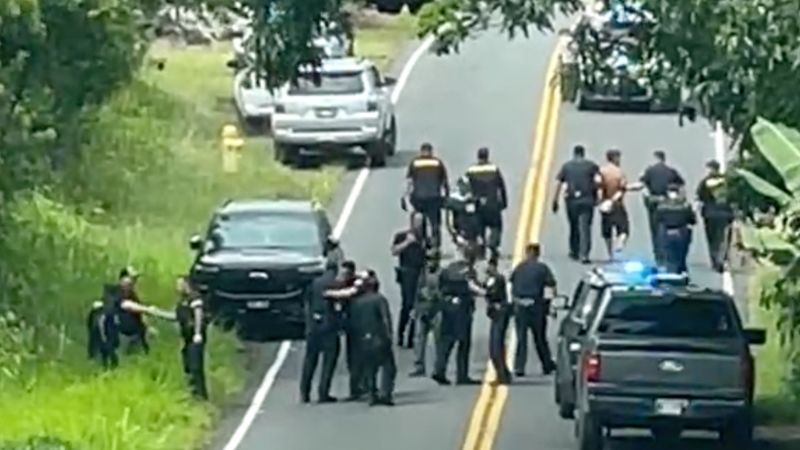
Man Charged with Murder in Killings of 3 on Hawaii’s Big Island
Man charged with murder in killings – On the remote Big Island of Hawaii, a 36-year-old man has been formally charged with murder in the deaths of three individuals, marking a significant development in a case that has shaken the local community. The Hawaii Police Department confirmed the charges against Jacob Daniel Baker on Saturday, citing first- and second-degree murder counts. As of Sunday, Baker remained in custody without bail, and his initial court appearance is set for Monday. Authorities have not yet disclosed whether he has legal representation, leaving his defense team’s potential involvement uncertain.
Manhunt Ends with Arrest in Rural Community
Baker’s apprehension followed a multi-day search that brought law enforcement to a secluded area of the Big Island. The three victims were discovered in the Puna district, a rural region known for its lush tropical scenery and tight-knit, off-grid lifestyle. Police reported that Robert Shine, 69, was found partially submerged in a cement pond, while the second victim, Chitta Morse, 79, was discovered a short distance away. The third body, that of John Carse, 69, was located nearly 19 miles from the other two, according to officials.
Details about the victims’ identities and the circumstances of their deaths have begun to emerge. Shine, a local resident, was identified by friends as the first to be found, with his body discovered in a state of partial submersion. Morse, known for his community involvement, was located by search teams a few hundred feet from Shine’s site. Carse, another long-time Puna resident, was identified by authorities at a property further removed from the initial crime scene. The police have not yet shared a motive for the killings, though investigators are examining potential connections among the victims.
Suspect’s Background and Community Ties
Baker’s ties to the Puna community were highlighted by Stephen Shaffer, a local resident who had employed him to work on his ex-wife’s land. Shaffer described Baker’s role as climbing coconut trees in exchange for lodging, a common arrangement in the off-grid community. However, tensions arose when Shaffer’s ex-wife sought a restraining order against Baker, claiming he had become a threat. Friends of the ex-wife, including Donald Hyatt, noted that Baker had vacated the cabin where he lived for months before recently returning to the area.
Hyatt stated, “Baker came back with squatter’s rights and started making threats against Shaffer’s ex-wife again.”
This return to the community sparked concern, particularly as Baker had previously been involved in legal disputes. Court records reveal he has been named in 20 cases over the past two decades, many related to traffic violations. In most instances, Baker represented himself, indicating a pattern of handling minor offenses without legal counsel.
The recent incidents, however, have escalated. Just days before the killings, two women had applied for temporary restraining orders against Baker, alleging he had harassed and threatened them. A judge reviewed the applications but denied them, citing insufficient evidence of harassment. This decision has since been scrutinized as the community grapples with the possibility of a targeted attack.
Community Impact and Investigation Progress
The Puna community, which blends serene natural landscapes with a culture of communal living, has been left in a state of unease. Residents now describe a sense of vigilance, with some recalling how the area’s off-grid nature had fostered a close-knit atmosphere. “People here trust each other, but now there’s fear,” said one local. The discovery of the victims has prompted questions about how someone with a history of minor legal issues could carry out such a violent act.
Hawaii Police Chief Reed Mahuna emphasized that investigators have yet to find a clear link between the victims beyond their proximity in the community. “The three individuals had no known connection beyond their shared location,” Mahuna stated in a recent press briefing. This lack of obvious motive has added to the mystery, though the police are continuing to examine evidence for any overlooked patterns.
As the investigation unfolds, attention has focused on Baker’s recent behavior. Hyatt, who had known the victims personally, noted that Baker had returned to the area with a sense of entitlement, claiming his right to occupy the property. “He started acting like he was the owner,” Hyatt explained. This shift in demeanor may have contributed to the escalating conflict. While the exact sequence of events remains unclear, the timing of the crimes suggests a deliberate plan.
Broader Context and Legal Implications
The case has also drawn attention to the legal system’s role in addressing domestic tensions. Baker’s history of self-representation in minor cases raises questions about his familiarity with the law and how that might have influenced his actions. “He knew the system well enough to maneuver through it,” said a legal analyst. However, his ability to navigate minor offenses does not necessarily predict his capacity for premeditated violence.
Residents have expressed concern over the suspect’s access to the area and the community’s vulnerability. “Puna is a place where people know each other, but it’s also hard to track someone who’s not in the spotlight,” one resident remarked. The three victims’ deaths have underscored the potential for conflict to escalate quickly in such a setting. Police have not ruled out the possibility of a broader criminal pattern, though the focus remains on the immediate incident.
With the arrest of Baker, the community now awaits the next phase of the case. The charges of burglary, auto theft, and property damage alongside the murder counts suggest a complex legal proceeding. As the suspect faces potential life imprisonment, the residents of Puna remain on edge, reflecting on the events that led to the tragic outcome. “We’re trying to understand how someone we trusted could do this,” said Shaffer, whose ex-wife’s fears may have played a role in the sequence of events.
The case has become a focal point for discussions about safety in off-grid communities. While such areas often promote a sense of independence and self-sufficiency, they also present unique challenges in terms of oversight and accountability. As the investigation continues, the police are working to piece together the full story, ensuring that no detail is overlooked. The arrests and charges against Baker represent a critical step in addressing the violence that has gripped the region.
Authorities have also emphasized the importance of the community’s role in the investigation. Local residents provided key information during the manhunt, including details about Baker’s movements and interactions. This collaborative effort highlights the close-knit nature of Puna and its residents’ commitment to uncovering the truth. As the case progresses, the community remains hopeful that justice will be served for the three lives lost.
Legacy of the Tragedy
Though the immediate focus is on the suspect, the tragedy has left a lasting impact on Puna. The serene environment, once a symbol of peace, now carries an undercurrent of tension. “It’s hard to imagine someone walking through the jungle and then taking a life,” said a local who had lived in the area for over two decades. The killings have prompted a reevaluation of safety measures in off-grid communities, with some calling for stricter oversight of residents who have claimed land without formal agreements.
As the legal proceedings begin, the community watches closely. The charges against Baker reflect the severity of the crime and the police’s determination to hold him accountable. While the motive remains elusive, the circumstances surrounding the killings suggest a calculated act of violence. The case will likely serve as a reminder of the complexities of life in remote, communal settings—and the potential for personal disputes to escalate into tragic outcomes.
