
Once home to the CIA, this tiny Southeast Asia runway was considered ‘the most secret place on Earth’
Once home to the CIA, this tiny Southeast Asia runway was considered ‘the most secret place on Earth’
Once home to the CIA this – Hidden deep within the humid embrace of central Laos’ dense jungles lies a 4,500-foot stretch of weathered concrete that slices through the foliage like a scar. This strip of land, once a vital hub of Cold War activity, now serves as a quiet gathering spot for locals, a stark contrast to its former role as a clandestine stronghold. The village of Long Tieng, with its modest population of a few thousand, has long relied on agriculture for survival. Its small shops, lined with rice and farming tools forged from salvaged bombshell metal, speak to both its rural heritage and its wartime legacy. Yet beneath the surface of this unassuming settlement lies a story of covert operations that shaped the region’s history.
A Forgotten Bastion of the Cold War
At the heart of Long Tieng is the airstrip, a relic of the U.S. military’s secret efforts to counter communist expansion. Today, it hosts children zipping on scooters and elderly villagers enjoying morning walks, but its past was far more intense. During the 1960s to early 1970s, this remote location became a critical nerve center in the American campaign to thwart the spread of communism across Southeast Asia. It was here that the Hmong-led anti-communist forces, backed by the CIA, orchestrated some of the most covert operations of the era.
The airstrip, known under the codenames Lima Site 98 and Lima Site 20A, was a cornerstone of the largest paramilitary operation ever run by the Central Intelligence Agency. At its peak, it handled over 900 daily takeoffs and landings, surpassing the traffic of many major airports. Supply planes delivered essential cargo, including weapons and food, which were then transferred to smaller aircraft for distribution to other isolated bases in the country. This intricate logistics network enabled the Hmong fighters to disrupt North Vietnamese supply lines and launch guerrilla strikes against communist forces.
“The war in Laos was so compartmentalized,” explains Paul Carter, an expert on the Secret War in Laos. “Even those fighting in other regions were unaware of Long Tieng’s existence until the late 1960s, when they finally allowed journalists to visit.”
Long Tieng was not just a military base; it was a microcosm of the broader conflict. General Vang Pao, a charismatic leader of the Hmong forces, commanded operations from this strategic vantage point. The CIA’s involvement was pivotal, with a small team of operatives and pilots—nicknamed “Ravens”—working in tandem with Hmong soldiers and Thai allies. This collaboration, though intense, remained largely invisible to the world, hidden from public view and international scrutiny.
Despite its importance, the airstrip’s secrecy was unmatched. The U.S. military’s campaign in Laos, known as Operation Menu, involved relentless bombing that rivaled the scale of Vietnam’s aerial warfare. Since direct involvement was prohibited by international agreements, the CIA operated as the unseen hand, directing missions from the shadows. The airstrip, once a lifeline for the Hmong resistance, became a symbol of this clandestine struggle, a place where the lines between war and espionage blurred.
A Journey Through Time
Fifty years after the end of the Cold War in Laos, I found myself drawn to this forgotten outpost. The book “A Great Place to Have a War” by Joshua Kurlantzick had ignited my curiosity, revealing the hidden battles that unfolded far from the main theaters of conflict. As I watched grainy footage of reporters navigating the base in the 1970s, I felt a compelling need to witness Long Tieng firsthand.
My journey began in Vientiane, the capital, where I joined an old college friend and a local driver named Mr. Pao. A former miner, he was intimately familiar with the terrain, though he had only visited the village once before. Together, we traversed rugged roads, the motorbike ride offering a glimpse into a land where history and modern life coexist. The trip, organized by a handful of tour companies, remains a niche attraction. Chris Corbett, owner of Laos Adv Tours and Rentals, notes that his business runs about ten motorbike tours annually, welcoming roughly forty visitors to the site. “It’s a unique experience,” he says, “but the number of people who come here is still a fraction of those visiting Luang Prabang or Vang Vieng.”
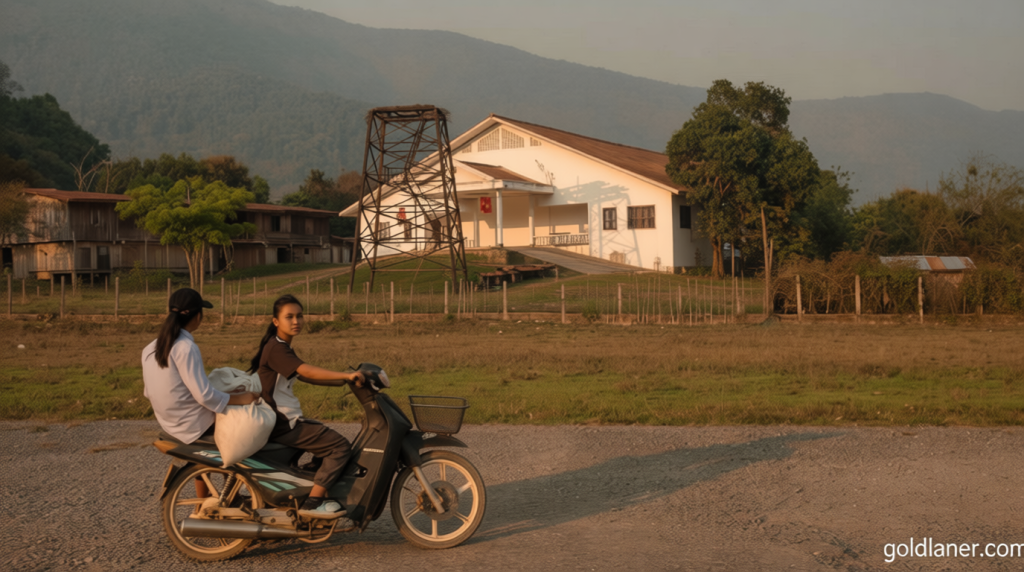
Arriving at Long Tieng, the contrast between past and present was striking. The control tower, once a hub of military activity, now stood as a crumbling structure surrounded by the natural world. The runway, pockmarked by bomb craters, had transformed into a communal space, where the echoes of war are replaced by the laughter of children and the chatter of villagers. Yet, remnants of the Cold War linger—scattered remnants of military equipment, faded signs of once-bustling operations, and the quiet determination of a people who endured decades of conflict.
Today, Long Tieng is a living museum of the U.S. involvement in the region. The airstrip, though no longer operational, remains a testament to the ingenuity and secrecy of the CIA’s efforts. It was a place where the war was fought not with open battlefronts, but through covert strategies and hidden bases. The Hmong soldiers, whose bravery and loyalty were instrumental, often spoke of the airstrip as their lifeline, a point of contact between the mountains and the world beyond. For them, it was a place of both danger and hope, where survival hinged on the ability to remain unseen.
As I stood on the edge of the runway, the weight of history pressed upon me. The site once dubbed “the most secret place on Earth” now hums with the quiet rhythm of daily life, a reminder of the invisible battles fought in the shadows. Long Tieng, with its humble beginnings and monumental role in the Cold War, stands as a poignant symbol of resilience and the enduring impact of covert operations. The journey to this remote village is not just an exploration of the past, but a glimpse into the complexities of war and the stories that remain untold in the corners of the world.
