
Guns on the television and in Iran’s streets as Trump renews war threats
Guns on the Television and in Iran’s Streets as Trump Renews War Threats
State-Sponsored Rallies and Rising Tensions
Guns on the television and in Iran – As the sun sets over Tehran, the capital of Iran, and the Alborz mountains vanish into the shadows, citizens have been converging in public spaces for state-organized demonstrations. These gatherings, held nightly for the past three months, serve as a platform for collective expression against the United States. In the upscale Tajrish neighborhood, the air vibrates with the resonance of “Death to America,” echoing across crowds waving Iranian flags. Nearby, vendors sell tea and merchandise, including baseball caps and patches emblazoned with national symbols, to participants who appear energized by the cause.
“I am so ready to sacrifice my life for my country and for my people,” said Tiana, a young woman in glasses that mirror the colors of Iran’s flag, her voice rising above the cacophony of chants. “All the people, the whole army, all commanders that we have, they’re ready to sacrifice their lives too, and ready to fight with their whole heart and soul.”
Trump’s recent social media post has intensified the atmosphere. The former president’s message, posted on his Truth Social platform, warned that “the clock is ticking, and they better get moving, fast, or there won’t be anything left of them.” This declaration, directed at Iran, has fueled anxieties about an impending military escalation, especially as peace negotiations appear to be stalled. The rhetoric reflects a broader strategy to provoke public sentiment, with his words serving as a rallying cry for hardline factions.
Gun Kiosks and Civilian Preparedness
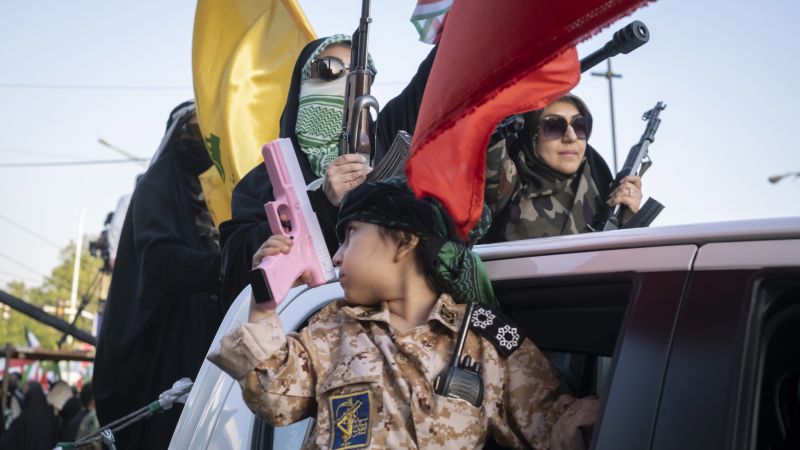
Amid the fervor, a new element has emerged: public gun kiosks. These booths, spread across cities, offer basic firearm training to civilians, signaling a growing readiness for conflict. In Vanak Square, a woman in a black chador practiced handling an AK-47 with the guidance of a masked soldier from the Islamic Revolutionary Guard Corps. Nearby, a young girl played with an unloaded Kalashnikov, firing it into the air as her instructor smiled, his presence a stark reminder of the militarized environment.
“Nuclear and missile technology is as important as our borders, so we will protect them,” read a handwritten sign carried by an older man. “We need nuclear power, clean energy, not a bomb,” he explained, emphasizing Iran’s stance on its nuclear program. “Trump knows we don’t have a bomb, but he is attacking us anyway.”
State television has also amplified the message of readiness. Channels like Ofogh and Channel 3 feature anchors brandishing assault rifles, blending entertainment with propaganda. On Ofogh, Hossein Hosseini, a male host, fired a rifle into the studio ceiling after a lesson from a masked IRGC member, his actions underscoring the nation’s militaristic resolve. Similarly, Mobina Nasiri, a female presenter on Channel 3, held an assault rifle while addressing viewers, declaring, “They sent me a weapon from Vanak Square so that I too, like all of you people, can learn how to use it.”
Contrasting Voices in a Divided Nation
Yet not all Iranians share the same sentiment. In a nearby park, close to the Cinema Museum of Iran, a different scene unfolds. Locals relax at an open-air book stall, sipping tea and chatting, while couples stroll hand in hand. A young man passing by muttered, “No to war,” his words a quiet defiance against the prevailing tide of militarism.
“We just want to live in a normal country, where our children can have a future,” whispered a university professor, who requested anonymity. “We want peace.”
This professor, along with others in the park, represents a segment of the population yearning for stability. Fatima, a 23-year-old who grew up in London and Dubai, shared her perspective: “We know this war isn’t over. We know Trump is not really going to negotiate. He’s just going to be, like, ‘You do what I tell you or I’m going to kill you.’ And then he’s going to attack us even if we do as he says.” Her statement highlights the perception that Trump’s threats are more about intimidation than genuine diplomacy.
The juxtaposition of these scenes underscores the complexity of public opinion in Iran. While state media and rallies push a narrative of unyielding resistance, everyday citizens like the professor and Fatima express a desire for peace. Their voices, however, are often drowned out by the relentless drumbeat of war propaganda, which dominates the nation’s discourse.
A Nation on the Brink
The presence of firearms in public spaces and the militarization of media suggest that Iran is preparing for a new phase of conflict. The government’s emphasis on readiness has turned streets into battlegrounds of ideology, where the call to arms resonates with both the young and the old. Yet, the nation’s heart shows signs of fracture, with some fearing the consequences of renewed hostilities and others resolute in their commitment to resist.
As rumors swirl about imminent US-Israeli strikes, a sense of inevitability has gripped many Iranians. The fear of escalation is palpable, with citizens bracing for the worst. However, the contrast between the jubilant rallies and the calm of the park reveals a broader spectrum of views. While the government mobilizes support through public demonstrations, it also faces internal dissent from those who prioritize diplomacy over confrontation.
Iran’s nuclear program remains a central issue in the conflict, with Trump framing it as a key leverage point in his demands for a ceasefire. The refusal to abandon the program has been portrayed as a defiance of American influence, yet it also symbolizes Iran’s determination to assert its sovereignty. The training of civilians in weapon use and the integration of military imagery into daily life indicate that the country is not only preparing for war but also embedding it into its cultural fabric.
Editor’s Note
CNN operates in Iran with the permission of the government, allowing for in-depth coverage of the nation’s political and social dynamics. The report reflects the voices of Iranians across the ideological spectrum, capturing both the fervor of resistance and the longing for peace. As tensions mount, the nation stands at a crossroads, its streets echoing with the clash of opposing narratives.
The interplay of state-sponsored rallies, militarized media, and civilian preparedness paints a vivid picture of a country on high alert. Yet, the diversity of opinion remains a critical factor in shaping Iran’s response to external pressures. With Trump’s threats looming and the ceasefire hanging by a thread, the people of Iran are left to navigate a path fraught with uncertainty, their hopes and fears intertwined with the fate of their nation.
