
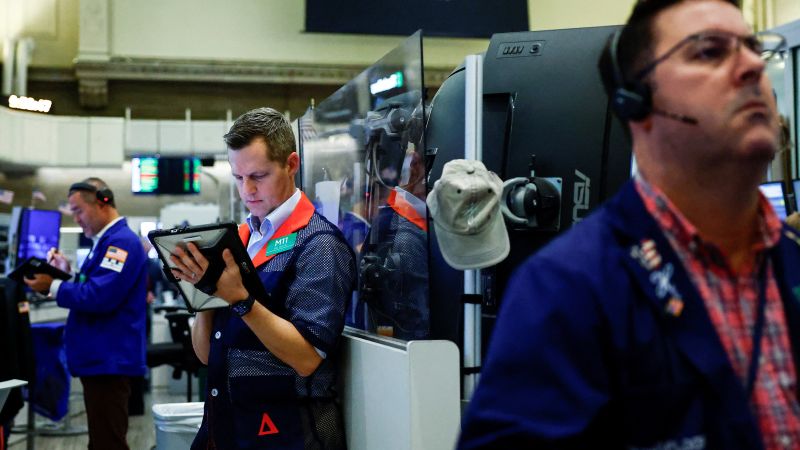
AI Spending Fears Trigger Broad Wall Street Retreat
Goldlaner.com – US markets closed out the month under sharp pressure Friday as fresh technology earnings revived doubts about whether the enormous sums being committed to artificial intelligence will produce the profits investors have priced in.
The Nasdaq Composite slid more than 3.6%, putting it on course for its steepest one-day decline since June. The S&P 500 fell 2.4%, also its worst session since June, while the Dow dropped 740 points, or 1.4%, heading for its biggest daily loss since July.
The sell-off reflected a growing divide among investors: enthusiasm remains high for AI’s long-term potential, but markets are becoming far less willing to reward spending plans without clearer signs of near-term financial returns.
Chip stocks lead the decline
Intel was among Friday’s biggest losers, tumbling more than 30% after issuing fourth-quarter guidance that disappointed investors. The company pointed to a weaker personal-computer market and manufacturing constraints.
The outlook also weighed on the broader semiconductor sector. Nvidia shares fell 5.6%, and a widely tracked chipmaker index dropped 9%. Expectations for the industry have climbed sharply after a strong year, making it increasingly difficult for companies to exceed Wall Street’s forecasts.
Even after Friday’s steep decline, Intel stock remained up about 70% for the year. Mike Dickson, head of research and quantitative strategies at Horizon Investments, said the sharp reaction also reflected investors taking profits after strong gains.
“A lot of these names, Intel is no exception, they just had a phenomenal year already. So there’s definitely some some profit taking as a result,” said Mike Dickson.
Big Tech faces tougher questions
Amazon shares fell 2% after its earnings report pointed to another increase in AI-related investment. Alphabet declined another 1.5% Friday, extending a drop of more than 12% from Thursday that erased roughly $500 billion from the value of the fourth-largest US company.
Alphabet’s results brought attention to two linked concerns: slower growth in Google’s search advertising business and a faster buildup in spending on AI infrastructure. Investors are watching closely as consumers increasingly use AI chatbots alongside, and potentially instead of, traditional search tools.
Alphabet, Microsoft, Meta and Amazon are collectively devoting hundreds of billions of dollars to data centers and the computing capacity needed to support AI products. The scale of that expansion has transformed capital spending into one of the most important questions for technology investors.
Matt Maley, chief strategist at Miller Tabak + Co., said Alphabet’s earnings suggested that the expected benefits from AI could take longer to materialize.
“It raises the question as to whether the payout will be as big as they have been promising,” Maley wrote.
Free cash flow becomes a key measure
Markets are increasingly focused not just on revenue growth but on what remains after companies pay for equipment, data centers and other investments. The pressure is particularly visible in free cash flow, a measure investors often use to judge how much cash a company can generate after capital expenditures.
Google has recorded two consecutive quarters of negative free cash flow for the first time, as AI investment accelerates while revenue growth has not kept pace with expectations. Meta disclosed negative free cash flow for a quarter last week, its first such quarter since 2012. Amazon said Thursday that its free cash flow was negative $42.4 billion over the previous 12 months while it expands AI spending.
Microsoft offered a contrast. It generated $18.6 billion in positive free cash flow in the latest quarter, and its shares were down only 5% from the record high reached earlier this month.
“Investors don’t just want capex, they want to see the returns already,” said Neil Wilson, a strategist at Saxo Markets. “For the wider AI trade, we are starting to see a more critical evaluation of the return on investment from this monster AI splurge.”
A more selective market for AI
The retreat does not necessarily signal that investors have abandoned AI altogether. Instead, it suggests the market is moving into a more demanding phase, in which companies may be judged more closely on financing, cash generation and evidence that AI tools can support durable earnings.
Google and Meta have both entered bear-market territory, falling more than 20% from peaks reached in May and August 2025, respectively. Higher interest rates have added pressure to riskier parts of the AI buildout, especially projects that depend heavily on debt or outside capital.
Paul Stanley, managing director at Arca, argued that volatility should be expected while the technology remains in an early stage of development.
“The AI trade is down, but not out,” Stanley said. “This is not the first tech and AI correction, and it won’t be the last. We are still in the very early stages of AI development, and pullbacks are par for the course.”
Stanley also identified the midterm elections as the next major market test, writing that uncertainty could lessen once they are over regardless of the result.
As investors sold technology shares, money moved toward more defensive areas of the market, including consumer staples. That rotation underscored the broader message from Friday’s trading: AI remains a powerful growth story, but companies pursuing it now face greater pressure to show that unprecedented investment can eventually be converted into meaningful returns.
Related Reading
Frequently Asked Questions
What is Wall Street sell off deepens as investors?
Wall Street sell off deepens as investors is the main topic of this guide. The article explains the context, practical details, and next steps readers should understand.
Why does Wall Street sell off deepens as investors matter?
Wall Street sell off deepens as investors matters because readers are looking for a useful answer, not just a short summary. Good content should match search intent and help them decide what to do next.