
Masked Men in Black Take to British Roads as Anti-Migration Tensions Escalate
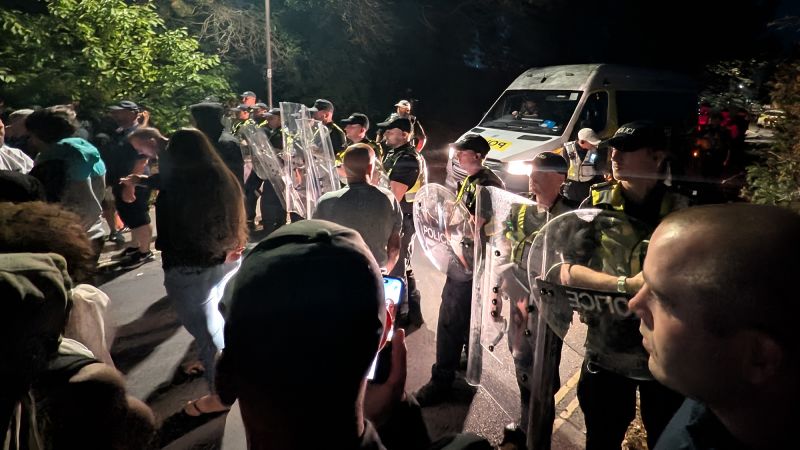
Goldlaner.com – Two separate incidents within a single weekend have thrust the question of small-boat migration into sharp focus across southern England, as groups of men wearing balaclavas and dressed in dark clothing seized roads near major ports and clashed with officers trying to maintain order. The episodes — one in the Hampshire coastal city of Portsmouth on Sunday night into Monday, the other in the Kent port town of Dover on Saturday — represent the most visible flare-up of street-level anti-migration agitation in Britain in recent months, arriving at a moment when the political debate over Channel crossings has grown increasingly polarized.
The Portsmouth Standoff
In Portsmouth, a small vessel carrying migrants made landfall on the coast early Sunday. Before lifeboats could complete their work of bringing passengers ashore, a cohort of masked men moved to obstruct the operation. When that effort failed, the group shifted tactics, setting up a road blockade aimed at preventing buses from transporting the asylum seekers to a nearby processing centre. Police and the demonstrators faced each other for hours, with the confrontation dragging on until the early hours of Monday morning.
Video captured at the scene showed the men, clad almost entirely in black, chanting slogans including “stop the boats” and “I’m England ’til I die.” Hampshire and Isle of Wight Constabulary confirmed that no arrests were made, though an investigation was opened to identify those responsible for any assaults on officers, criminal damage to vehicles, or other offences committed during the standoff.
Dover: A Second Front
The Dover episode unfolded the day before. Social media footage from the busy ferry terminal — the principal crossing point between England and France — captured clusters of masked men in black linking arms across a main thoroughfare and repeating the same “stop the boats” chant. Routes leading into the port were blocked, and the National Highways agency recorded a four-mile traffic jam building up on Saturday morning. Kent Police stated that no arrests were made in that incident either.
The geographic proximity of the two events — Portsmouth roughly 80 miles west of Dover along the south coast — gave the impression of a coordinated campaign, though organizers have not publicly confirmed any joint planning between the two sites.
Who Is Behind the Protests?
The Portsmouth demonstration appears to have been organized by a group calling itself the Patriot Platform, headed by Daniel Thomas, a former associate of Tommy Robinson, the far-right political activist known for his anti-Islamic campaigning. Thomas, also known by the nickname Danny Tommo, describes the organization as a Christian “army of patriots.” He frames the action as motivated by
“a love for our children, country and most importantly the future that we are leaving for our children.”
British media have noted that Thomas served a prison sentence after pleading guilty to attempted kidnapping in 2016. The advocacy organization HOPE Not Hate, which monitors far-right extremism across the UK, has been tracking the Patriot Platform and its affiliated smaller groups. In a statement following the Portsmouth incident, the group characterized the episode as evidence of
“the growing trend of anti-migrant vigilantism coming to a head in the public eye.”
HOPE Not Hate went further, arguing that the organization promotes its ideology on the premise of providing a public safety service in what it portrays as an increasingly dangerous Britain. The group added that Thomas has little prospect of convincing the wider public that the Patriot Platform functions as a safety-first community organization
“when its members march through the streets wearing balaclavas and have been exposed for their violent criminal records.”
Official and Political Reactions
The UK Home Office issued a statement condemning
“the intimidating and thuggish behaviour”
in Portsmouth, while affirming that the right to peaceful protest is fundamental to British democracy but must
“never cross a line into disorder.”
In Westminster, reactions split along familiar partisan lines. Nigel Farage, leader of the hard-right Reform UK party, which saw a significant surge in support during England’s local elections in May, had spent the preceding days rallying his base around the small-boat issue. On Friday he branded the asylum seekers
“an invasion”
in a public speech. Yet on Saturday, speaking to GB News, he drew a clear distinction between his political stance and the weekend’s street tactics, saying
“nobody feels more strongly about stopping the boats than me,”
while condemning what he called the
“disgusting”
methods employed over the weekend.
“Turning up in balaclavas is not the way to do it,”
he added.
Mike Tapp, the Labour MP representing the Dover constituency, took a sharper tone in a Facebook post on Saturday, calling the demonstrators
“idiots coming to Dover to cause disruption.”
He went on to note that small-boat crossings have fallen by roughly 40 per cent and that his party was working to address the underlying problems, before closing with the blunt instruction:
“Go home, enjoy your weekend/get a job.”
The Wider Political Context
The weekend’s events land against a backdrop in which migration remains one of Britain’s most combustible political topics, even as the actual number of people crossing the English Channel in small boats has declined to its lowest level since 2020, per Home Office data. That statistical reality sits in tension with the intensity of public and parliamentary debate, a gap that commentators say fuels both mainstream political campaigning and fringe street activism. Reform UK’s electoral gains in May have sharpened the competition over who owns the anti-migration narrative, while the visible presence of organized groups willing to occupy roads and confront police introduces a new variable into an already volatile landscape. Whether the Patriot Platform and similar outfits will continue to stage such actions — and whether authorities will adopt a tougher enforcement posture in response — will likely shape the tone of Britain’s migration debate through the autumn.
Related Reading
Frequently Asked Questions
What is Why are far right masked men protesting?
Why are far right masked men protesting is the main topic of this guide. The article explains the context, practical details, and next steps readers should understand.
Why does Why are far right masked men protesting matter?
Why are far right masked men protesting matters because readers are looking for a useful answer, not just a short summary. Good content should match search intent and help them decide what to do next.