
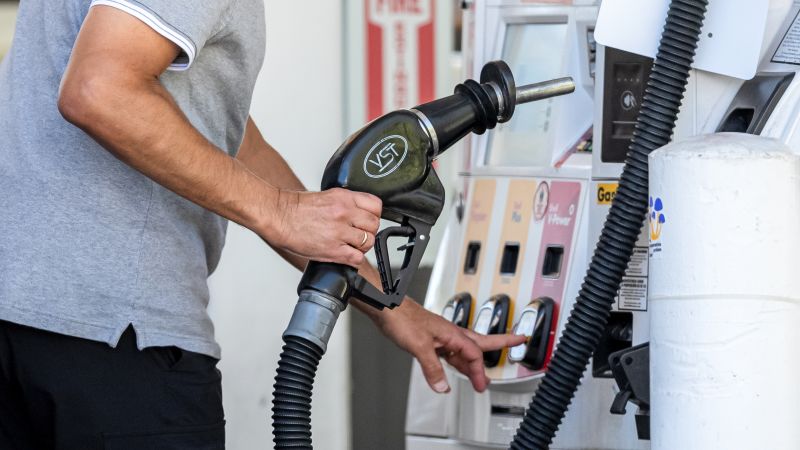
Record-Breaking Pump Prices Are Reshaping American Life Through the Fall
Goldlaner.com – National gasoline prices have climbed to levels never before seen for this time of year, and the strain is showing up in households across the country in ways that go well beyond a slightly fuller wallet at the pump. With crude oil trading near $80 a barrel and the Strait of Hormuz still largely shut to tanker traffic, the average gallon of regular unleaded hit $4.15 on Sunday — a figure that shatters every prior Labor Day benchmark. August’s monthly average of $4.07 per gallon set the highest mark ever recorded for that month, according to AAA data shared by spokesperson Aixa Diaz. For context, the same gallon cost $2.98 in late February, just before the US-Iran conflict erupted and sent energy markets into sustained turbulence.
A Grandmother’s Summer of Missed Hugs
For Linda French, 78, a retired schoolteacher in Jonesborough, Tennessee, the numbers translate into something far more personal. She had planned a summer visit to New York to see her elderly brother, still recovering from hip surgery, and to spend time with her young great-nieces and nephews. The drive spans hundreds of miles, and at current pump prices the trip simply could not fit her fixed income. Airfare offered no escape either: the ticket she purchased in March more than doubled in cost within a few months.
French now relies on FaceTime to stay connected, though she insists the screen cannot replicate the physical closeness she craves.
“You can’t hug your family,” she said. “We’re all getting older. It’s hard not to see them.”
She has already scrapped plans to travel to Washington, DC, for Thanksgiving and to New York again for Christmas. The cancellations are not a matter of preference but of arithmetic.
What the Data Shows — and What It Doesn’t
The current price environment sits roughly a dime above the August 2022 average, the last time fuel costs spiked sharply after Russia launched its full-scale invasion of Ukraine. That parallel is instructive but incomplete. In 2022, prices peaked at a record $5.02 per gallon in June before retreating to $3.79 by Labor Day. This year, the trajectory has been different: prices have held above $4 since early summer, with no comparable pullback in sight.
Travel behavior has absorbed the shock without collapsing. AAA projected that trips over the Memorial Day and July 4th weekends would land essentially flat against last year’s record highs. Americans kept driving, but the multi-year pattern of surging holiday travel volumes has stalled. The willingness to get on the road has not vanished; it has simply been capped by cost.
The Commuter Squeezed Between Two Debts
Colton Comstock, 28, made a deliberate financial choice after college: move back home in Johnsburg, Illinois, and funnel savings toward a house down payment while accelerating repayment of $60,000 in student loans. His plan assumed a manageable fuel budget. His reality is a daily 75-mile round-trip commute to a door and dock service company, where he works as a financial analyst. He recently filled his tank at $4.55 per gallon.
“Rising gas prices is negating the fact that I’m living at home to save money,” Comstock said.
To keep his roughly $500 monthly down-payment contribution intact, he has trimmed the extra payments he was routing to his student loan account. He has visited his family’s lake house in Wisconsin — about 100 miles away, where he enjoys stargazing and long conversations with his brothers on the pier — only once this summer, instead of the several trips he had planned.
“I’m just trying to do nothing because you can’t afford anything. So I just try to sit at home and chill.”
If prices persist into early next year, Comstock says he may sell his 2023 Dodge Charger and trade down to a more fuel-efficient vehicle — a concession he had not anticipated when he bought the car.
Cutting Back on Small Joys
In New Paris, Ohio, Linda Cook — a former business consultant now receiving disability benefits — has swapped an hour-long drive to a lake for a small inflatable pool in her backyard. The decision is not recreational preference. It is the intersection of elevated gasoline costs, climbing electric bills, and rising Medicare premiums compressing her monthly budget to the point where groceries have been trimmed and the thermostat stays high enough to disrupt her sleep.
Pedicures and a new swimsuit, small pleasures that once fit comfortably into her summer, have been eliminated entirely.
“When you don’t have a lot of”
— a sentence she leaves unfinished, as though the rest of the thought is too obvious to complete.
Outlook: The Geopolitical Ceiling
Analysts see no near-term relief valve. Patrick De Haan, petroleum analyst at GasBuddy, framed the outlook bluntly: consumers should expect the most expensive September, October, and November on record unless the geopolitical landscape shifts.
“We’ll probably see our most expensive September, October and November, until something shifts with these geopolitical tensions,” De Haan said.
He added that the latest round of strikes between US forces and Iran makes such a shift “less and less likely.” Without a de-escalation in the Persian Gulf and a parallel wind-down of the Russia-Ukraine war, the structural drivers keeping crude in the $80 range — and retail fuel above $4 — remain firmly in place.
For French, Comstock, and Cook, the question is no longer whether prices will normalize before the holidays. It is how many small freedoms — a hug, a lake afternoon, a new swimsuit — they will have to surrender before the calendar turns.
Related Reading
Frequently Asked Questions
What is Americans are still struggling with high?
Americans are still struggling with high is the main topic of this guide. The article explains the context, practical details, and next steps readers should understand.
Why does Americans are still struggling with high matter?
Americans are still struggling with high matters because readers are looking for a useful answer, not just a short summary. Good content should match search intent and help them decide what to do next.