
Belgrade Turns Out for a War Criminal’s Final Journey as Brussels Looks On in Alarm
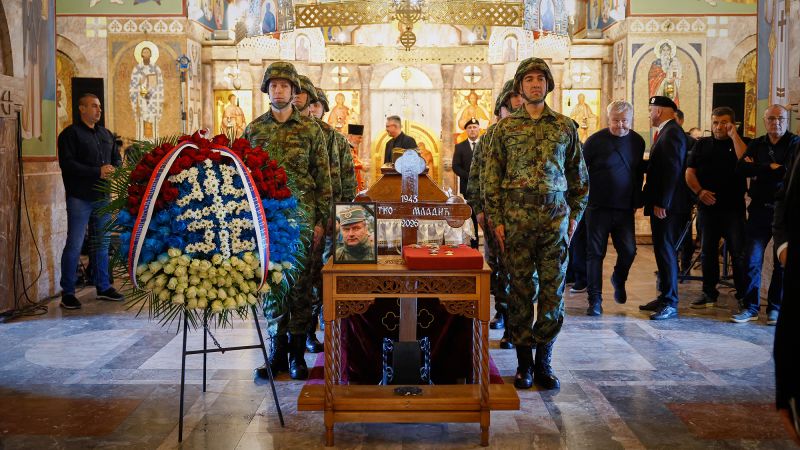
Goldlaner.com – Thousands of grieving Serbs packed the narrow nave of the Church of St. Luke in Belgrade on Monday morning, arriving hours before the ceremony began to pay their respects to Ratko Mladić — the Bosnian Serb general whose coffin, draped in the national flag, sat beneath his military cap and saber while uniformed soldiers stood guard at either end. The scene marked the culmination of a state-organized farewell that has drawn sharp rebuke from the European Union, which had urged Belgrade not to grant the convicted genocidaire a public spectacle of mourning.
Mladić, who passed away at age 84 on August 27 while incarcerated in The Hague, Netherlands, had been serving a life sentence handed down for genocide, war crimes, and crimes against humanity committed by his forces during the Bosnian war of 1992 to 1995. Yet in the eyes of a substantial portion of Serbia’s population, he remains a figure of national pride rather than international shame.
A Funeral Wrapped in Military Protocol
Although the family formally arranged the funeral, the Serbian state inserted itself at every visible stage. A government aircraft ferried his remains back to Belgrade the previous week. Soldiers bore the flag-wrapped coffin through the streets. A military commemoration took place Saturday at an official army installation. Pro-government outlets confirmed that full military honors would accompany the burial, and that Patriarch Porfirije, head of the Serbian Orthodox Church, would officiate the liturgical service.
Among the early arrivals was Milan Dobric, who had traveled from Kosovo to stand beside the casket. Speaking to reporters outside the church, he offered a sentiment echoed by many in the crowd:
“Mladić was a man who gave everything in his life for the Serbian people. I am glad that this morning people are coming to pay special respect.”
The Conviction Behind the Coffin
The International Criminal Tribunal sentenced Mladić in 2017 after finding him responsible for orchestrating the 1995 massacre at Srebrenica, in which more than 8,000 Bosnian Muslim men and boys were killed. The tribunal also held him accountable for the yearslong siege of Sarajevo, the Bosnian capital, and for establishing detention camps where non-Serb civilians and captured enemy soldiers were held under brutal conditions. The broader conflict, which erupted following the dissolution of the former Yugoslavia as ethnic Serbs in Bosnia seized territory to carve out a separate state aligned with Belgrade, ultimately killed more than 100,000 people and displaced over 1 million before a United States-brokered peace accord halted the fighting in 1995.
Srebrenica itself had been designated a UN “safe haven” for Bosniaks. Serbian forces overran the enclave, compelled men and boys to strip, executed them, and bulldozed their bodies into mass graves — a sequence of events that Serbia to this day refuses to label genocide, preferring the term “horrific crime.”
Brussels Pulls Back; Belgrade Pushes Forward
The EU, of which Serbia is a candidate member, reacted with visible displeasure. Enlargement Commissioner Marta Kos canceled a planned visit to Serbia, stating that the public glorification surrounding Mladić’s death stood at odds with the values underpinning the bloc’s enlargement path. Other European officials, regional leaders, and families of wartime victims joined the chorus of criticism.
President Aleksandar Vucic, a populist who had backed Serbia’s expansionist agenda during the war itself, dismissed the diplomatic friction. He characterized the funeral as an “emotional outpouring” that “has nothing to do with whether Vucic allowed something or not.” He also leveled a personal jab at Kos, accusing her of “lying” — a remark consistent with a pattern of increasingly strident anti-Western rhetoric he has adopted in the run-up to an early parliamentary election anticipated next month.
“We (Serbs) have been persecuted and harassed for 30, 40 years … always guilty whatever happens. People just won’t take it any more.”
Vucic was not present at the church service itself, a detail that observers noted as consistent with his preference for managing public perception from a distance.
A Pattern of Defiance
The Mladić funeral did not emerge in isolation. Last year, Serbia interred Nebojsa Pavkovic, the former army chief of staff also convicted of war crimes, with full military honors at a cemetery reserved for distinguished individuals. Since Mladić’s death, nationalist supporters have held candlelit vigils, painted murals bearing his likeness across Belgrade’s streets, and lit flares in his name. On Sunday evening, soccer fans unfurled a massive banner of his image at a match in the capital and chanted his name through the stands.
For the EU, these gestures compound an already fragile enlargement process. Serbia’s bid has effectively stalled amid democratic backsliding and Vucic’s refusal to align with international sanctions imposed on Russia following its invasion of Ukraine. The state burial of a man convicted of Europe’s first post-World War II genocide thus functions not merely as a funeral but as a political statement — one that deepens the rift between Belgrade’s nationalist establishment and the Western institutions whose membership it nominally pursues.
Related Reading
Frequently Asked Questions
What is Body of war criminal Mladić lies?
Body of war criminal Mladić lies is the main topic of this guide. The article explains the context, practical details, and next steps readers should understand.
Why does Body of war criminal Mladić lies matter?
Body of war criminal Mladić lies matters because readers are looking for a useful answer, not just a short summary. Good content should match search intent and help them decide what to do next.