
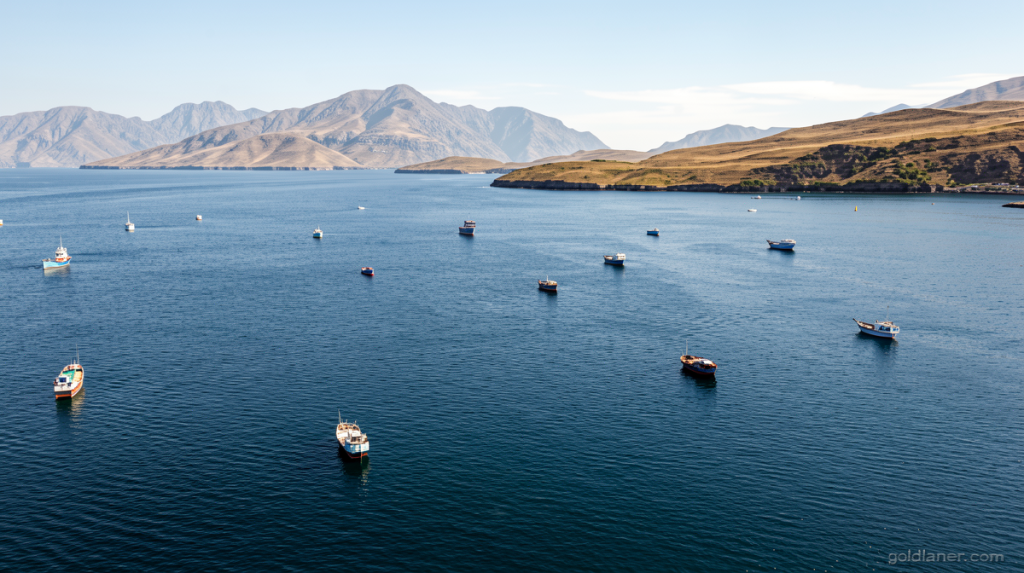
US Bombs Iranian Rocket Launchers on Larak Island in First Strike Since Late July
Goldlaner.com – After more than a month of relative military quiet, American forces returned to the skies above Iranian territory on Sunday, dropping ordnance on two rocket launchers stationed on Larak Island. The island sits just off Iran’s southern coast, overlooking the narrow waterway known as the Strait of Hormuz — the artery through which roughly one-fifth of the world’s traded oil passes each day. The attack, confirmed by a senior US official, represented the first direct American strike on Iranian soil since a large-scale bombing campaign concluded on July 29.
Capt. Tim Hawkins, the public-voice of US Central Command, stated that American aircraft hit two launcher platforms on the island. According to the account given, Iranian personnel had been observed in the act of preparing to fire rockets loaded with naval mines into the strait’s shipping lanes. Residents in the vicinity reported hearing a loud explosion near the island that same Sunday, as relayed through Iran’s semi-official Fars News Agency.
Tehran Demands Retaliation
The Iranian response was swift and pointed. The Islamic Revolutionary Guard Corps, the armed wing that has long served as the backbone of Iran’s military posture, issued a statement on Sunday vowing retaliation. The IRGC characterized the strike as an act by what it called a “US-Zionist enemy,” claiming the bombardment produced casualties among both military personnel and civilians on the island.
In a brief remark broadcast through state television via IRIB, an IRGC spokesperson labeled the American action
“a strategic and deadly mistake” by the Trump administration.
The language was deliberately escalatory, framing a limited kinetic event as a broader strategic miscalculation rather than a tactical response to a specific threat. Whether Tehran will follow through with a proportional or disproportionate counter-strike remains to be seen, but the rhetoric signals that the leadership intends to preserve domestic momentum by portraying the episode as an unprovoked aggression.
The Strait at the Center of Everything
Understanding why Larak Island matters requires understanding the geography. The Strait of Hormuz is only about 33 kilometers wide at its narrowest point, yet it funnels the energy exports of Saudi Arabia, Iraq, Kuwait, Qatar, and the United Arab Emirates toward global markets. Any disruption — whether by mines, missiles, or blockade — sends shockwaves through oil prices, shipping insurance rates, and the economies of every nation dependent on Middle Eastern hydrocarbons.
The timing of Sunday’s strike is not accidental. US Central Command announced last week that it had completed a mine-clearing operation across the strait’s international shipping corridors, removing sea mines that had been laid in prior weeks. The Trump administration framed the clearance as a prerequisite for restoring normal commercial transit. President Donald Trump reinforced that posture on Tuesday, declaring
“Iran has been notified that any ship or boat placing new mines will be immediately and systematically destroyed.”
A US official added that American forces are watching the waterway closely and stand ready to safeguard the free flow of commerce through what was described as “this essential waterway.” The White House, when pressed for additional comment, directed inquiries back to Central Command.
Meanwhile, a quieter diplomatic track continues. Iran and Oman are engaged in talks over a proposed framework to normalize maritime traffic through the strait. Regional mediators, notably Qatar, have lent their weight to those discussions. Iranian officials have repeatedly tied the question of safe navigation to wider negotiations with Washington and to the broader regional security architecture, suggesting that a purely technical shipping agreement may be inseparable from larger political settlements.
Economic Pressure Replaces Bombs
The broader strategic picture has shifted in recent weeks. Rather than sustaining a tempo of airstrikes, the Trump administration has pivoted toward what it frames as economic coercion. The White House stated on Thursday that no active negotiations are underway between Washington and Tehran over the six-month conflict that has defined the region’s geopolitics since early in the year.
Trump himself has spoken in recent days about leveraging American financial dominance to push Iran “toward a very big victory,” a phrase that signals a preference for attrition through sanctions and trade restrictions over further kinetic operations. The Treasury Department has threatened a new round of punitive measures aimed at third countries that continue doing business with Tehran, branding the initiative an “economic D-Day” — a deliberate echo of the 1944 Normandy landings to convey the scale of the intended pressure.
This posture explains why the July 29 bombing wave, launched in response to an attempted Iranian attack on American military positions the previous day, was described as a “heavy wave” and then followed by weeks of restraint. The administration appears to be treating limited strikes as calibration tools — enough to demonstrate capability and deterrence, but not so frequent as to invite a full-scale exchange.
What Comes Next
Sunday’s bombardment complicates that calculus. By striking again so soon after the mine-clearing operation and amid ongoing Oman-mediated talks, Washington has signaled that it will not tolerate perceived threats to shipping even while diplomatic channels remain nominally open. For Tehran, the episode offers a ready-made narrative of American bad faith that can be deployed domestically and across the region.
For the shipping industry, insurers, and energy traders watching the strait’s daily transit counts, the message is equally clear: the waterway remains contested, and the cost of doing business through it will carry a premium of uncertainty until a durable arrangement — military, economic, or diplomatic — takes hold. Until then, the launchers on Larak Island, now reduced to wreckage, will be replaced, and the question of who controls the narrowest chokepoint on the planet will keep demanding answers.
Related Reading
Frequently Asked Questions
What is US strikes Iranian rocket launchers marking?
US strikes Iranian rocket launchers marking is the main topic of this guide. The article explains the context, practical details, and next steps readers should understand.
Why does US strikes Iranian rocket launchers marking matter?
US strikes Iranian rocket launchers marking matters because readers are looking for a useful answer, not just a short summary. Good content should match search intent and help them decide what to do next.