
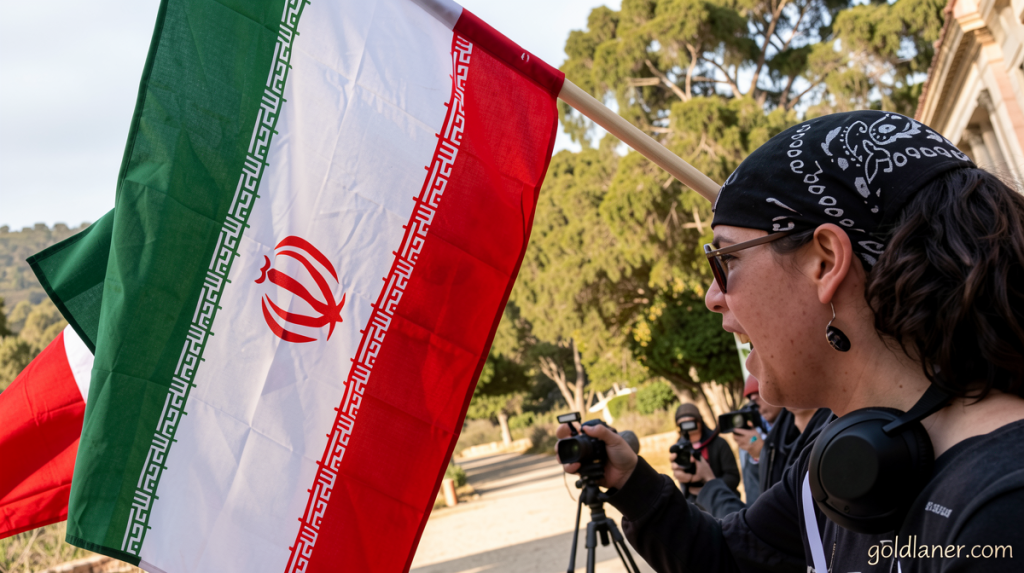
Six Months Into the Iran War: Diaspora Divided
Goldlaner.com – Six months into the Iran war, the communities of Iranian Americans scattered across the Western Hemisphere have found themselves fractured along lines that no one predicted when the first coordinated strikes fell in late February 2026. What started as a military campaign involving the United States, Israel, and Tehran has rippled outward into university campuses, suburban kitchens, and workplace break rooms, turning a diaspora already shaped by decades of exile into a battleground of competing loyalties and memories. Families who once argued about politics now argue about whether the bombs were liberation or catastrophe — and whether the Islamic Republic’s rule is ending or merely pausing.
Four Decades of Departure, One Fractured Community
The Iranian-American population was not born in a single moment. It accumulated across roughly forty years of successive exoduses: revolutionaries and dissidents who fled after 1979 with little more than a suitcase and a grievance; families displaced by the Iran-Iraq war and its long aftermath through the 1980s and ’90s; and more recent arrivals who left after the 2009 Green Movement crackdowns, the 2019 fuel-price uprisings, and the mass demonstrations of January 2026. Each wave carries its own memory of what Iran was, what it became, and what it might yet become. Those memories now collide in American living rooms and online forums with an intensity that surprises even veteran community organizers.
At one pole sit activists who greeted the opening strikes as long-overdue intervention — a slim chance, perhaps, to break the back of a theocratic state that has governed by decree and surveillance for nearly half a century. At the other pole stand those who watched the first explosions and saw only the predictable arithmetic of civilian casualties, displaced populations, and a regional powder keg ignited once again. Between those extremes lies a vast, anxious middle that simply wants the fighting to stop.
From Cautious Hope to Exhausted Frustration
Arezo Rashidian, a longtime monarchist organizer in the Los Angeles area who has coordinated protest activity alongside Reza Pahlavi — the exiled son of Iran’s last shah — was among those who welcomed the first strikes with guarded optimism. In the days after the war began, she told interviewers she hoped American and Israeli forces would carry out “targeted attacks on bases to bring down that regime.” Regime change, not mere containment, was the stated objective.
Half a year later, that optimism has curdled into something closer to exhaustion. Rashidian describes a community mood she characterizes as frustration layered over uncertainty.
“We really wanted regime change … it’s been six months now, and it didn’t get to that point.”
Relatives and acquaintances still inside Iran have relayed a picture of a society tightening its grip. In the quieter weeks following the peak of aerial bombardment, Rashidian says, a renewed atmosphere of dread has settled over cities and towns. Conversations about politics — or about participation in the January protest wave — have grown hushed. Neighbors watch neighbors. Phones are checked. The secret police, she reports, are reactivating their networks.
“Now that the war is a little bit quieter, now the secret police are starting to mobilize.”
That account aligns with observable developments: renewed public enforcement of Iran’s mandatory hijab statutes, with video circulating of women publicly reprimanded for clothing choices and of shops fined or shuttered over alleged dress-code infractions. Rashidian also relays reports of arrests, executions, and broader security sweeps — details that remain difficult to confirm independently from outside the country.
Even so, she has not abandoned the pressure campaign. She continues to advocate for tougher economic sanctions against Tehran, hoping they will, in her words, “tighten the rope” around the regime’s finances. This week, Washington signaled further measures. Treasury Secretary Scott Bessent described a plan aimed at a sprawling network of Iranian entities that have built structures to route around existing sanctions. Yet the long-anticipated unveiling of what had been floated as Trump’s “economic D-Day” package disappointed many observers. Rather than imposing sweeping new restrictions, the administration opted to expand and intensify enforcement of measures already on the books — a distinction that left some in the diaspora feeling the moment had been squandered.
Tehran’s Counter-Card and the Economic Dimension
Iran, for its part, has signaled that it can inflict reciprocal economic pain on its adversaries. The question now facing policymakers — and the diaspora watching from American suburbs — is whether six months into the Iran war will mark the beginning of a longer economic siege or the end of a brief, inconclusive campaign.
Frequently Asked Questions
When did the Iran war begin, and who is involved? The coordinated military strikes began in late February 2026 and involve the United States, Israel, and Iran. Six months into the Iran war, the conflict has shifted from active bombardment to a quieter phase of enforcement and economic pressure.
How has the war affected Iranian Americans in the United States? The diaspora, built over four decades of successive migration waves, is deeply divided. Some view the strikes as a chance to end theocratic rule; others see them as predictable catastrophe. Most simply want the fighting to stop. Community organizers report heightened tension in families and online spaces.
What sanctions measures have been announced in recent weeks? Treasury Secretary Scott Bessent outlined a plan targeting Iranian entities that have structured transactions to evade existing sanctions. The administration chose to intensify enforcement of current measures rather than impose the sweeping new restrictions some had expected under what was floated as an “economic D-Day” package.
What is happening inside Iran during the quieter weeks? Reports from within the country describe renewed enforcement of hijab statutes, public reprimands, shop closures, arrests, and reactivation of secret-police networks. Independent verification of these reports remains difficult.