
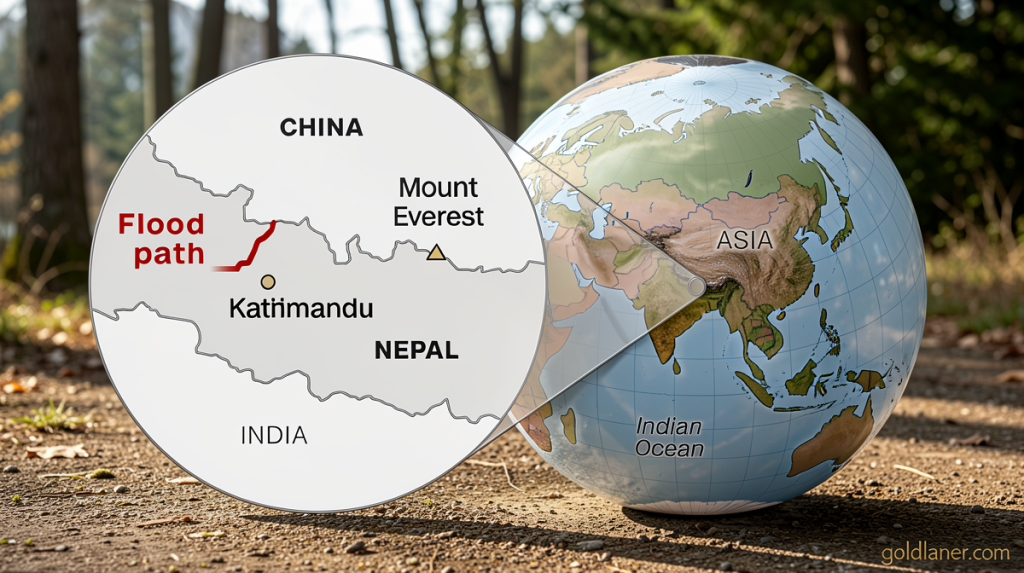
Death Toll Climbs Past 675 as Monsoon Deluge Buries Nepal-China Border Region
Goldlaner.com – The Himalayan corridor along the Nepal-China frontier has been shattered by a cascade of landslides and flash floods that began on August 26, leaving at least 675 confirmed dead and roughly 3,000 residents unaccounted for across both sides of the international boundary. Homes have been flattened, critical bridges spanning mountain valleys have been swept away, and entire settlements now sit beneath meters of mud, rock, and debris. The disaster, unfolding during the peak of the South Asian monsoon, represents one of the most severe compound geological events recorded along this stretch of the border in recent decades.
A Cascade of Destruction
The initial landslide triggered on August 26 did not act in isolation. Within hours, torrential rainfall saturated surrounding slopes, converting a single slope failure into a chain reaction of secondary slides and debris flows that raced downhill at speed. Flash floods followed, channeling water and sediment through narrow valleys and overwhelming communities with little warning. Structures built on unstable hillside terrain were the first to collapse; bridges that served as the only links between isolated villages were next. The combined effect has severed transportation routes that residents depended on for daily movement, medical access, and supply delivery.
Authorities on both the Nepali and Chinese sides of the border have confirmed that approximately 3,000 people remain missing. In terrain this remote and this heavily buried, the distinction between “missing” and “presumed dead” grows narrower with each passing hour, yet rescue teams continue to comb through debris fields with hand tools and light machinery where heavy equipment cannot reach.
Two New Lakes, Two New Threats
Perhaps the most urgent secondary danger now facing the affected valleys is the formation of two lakes created when landslide debris dammed natural watercourses. These so-called debris lakes hold enormous volumes of water behind walls of unconsolidated rock and soil. If either dam fails—whether through overtopping, internal erosion, or a triggering tremor—a wall of water could release downstream with little advance notice, inundating settlements that have already been devastated.
Officials on both sides of the border are monitoring the lakes closely, tracking water levels, dam stability, and inflow rates. The prospect of additional rainfall this weekend has intensified the urgency of those observations. Meteorological forecasts call for renewed heavy precipitation over the flood-affected catchments, which would raise lake levels and increase hydraulic pressure on the debris dams simultaneously.
Why This Region Is So Exposed
The Nepal-China border runs through some of the most geologically active and topographically extreme terrain on Earth. Steep gradients, deeply fractured rock, and thick layers of glacial and colluvial debris make slopes inherently unstable. When the monsoon—typically peaking between July and September—delivers weeks of sustained rainfall, the combination of saturated soils, undercutting of stream banks, and seismic micro-tremors creates conditions ripe for large-scale slope failure.
Flash floods in such terrain are not merely “heavy rain.” Water moving through a confined valley at high velocity picks up boulders, uproots trees, and exerts forces capable of tearing apart reinforced concrete. Communities situated in valley floors or on lower benchlands have historically been the most vulnerable, and the current death toll reflects that pattern.
Rescue, Recovery, and the Road Ahead
Relief operations face formidable logistical obstacles. Many affected settlements are accessible only by footpaths or single-lane mountain roads, several of which have been destroyed. Helicopter lifts are constrained by low cloud cover, wind shear, and limited landing zones. On the Chinese side, the remoteness of the border sector compounds the challenge; on the Nepali side, thinning of local administrative capacity after years of outmigration means that village-level coordination must be rebuilt from scratch.
Bridge replacement, road clearing, and the re-establishment of telecommunications will take weeks to months. Until those lifelines are restored, displaced populations will depend on temporary shelters, aid convoys, and whatever infrastructure survives. The two debris lakes, if they persist, will require engineered solutions—controlled drawdown, spillway construction, or, in worst-case scenarios, managed breaching—to prevent a second wave of catastrophe.
The Scale Made Visible
Satellite imagery captured in the days following the initial event, together with ground-level video recorded by survivors and responders, reveals the sheer magnitude of the destruction. Valleys that once held terraced fields and clustered dwellings now appear as broad channels of grey-brown sediment. The contrast between intact forest on upper slopes and the obliterated valley floor below underscores how quickly a single monsoon episode can erase generations of settlement.
For the families of the missing, the coming weekend’s rain represents both a renewed threat and a grim arithmetic: every additional millimeter of rainfall over the debris dams narrows the window in which a buried person might still be alive. The border region, already reeling from the August 26 event, now waits under a sky that may deliver its next blow within days.
Related Reading
Frequently Asked Questions
What is Landslides and floods have wreaked havoc?
Landslides and floods have wreaked havoc is the main topic of this guide. The article explains the context, practical details, and next steps readers should understand.
Why does Landslides and floods have wreaked havoc matter?
Landslides and floods have wreaked havoc matters because readers are looking for a useful answer, not just a short summary. Good content should match search intent and help them decide what to do next.