
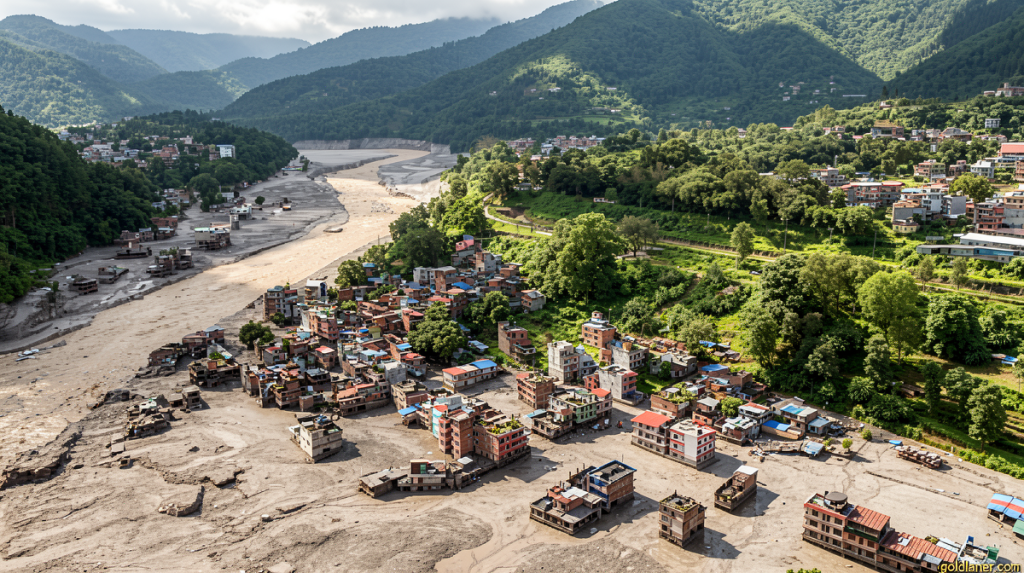
A Glacier’s Collapse on the China-Nepal Border Exposes the Himalaya’s Growing Infrastructure Gamble
Goldlaner.com – When a section of glacier sheared away from a mountainside on Wednesday morning, the resulting cascade of rock, ice, and water did not merely destroy a stretch of border terrain. It swallowed entire villages, obliterated roads and bridges, and knocked out hydropower stations on both sides of the China-Nepal frontier. More than 600 people have been confirmed dead, and roughly 3,000 remain unaccounted for. The event has forced an uncomfortable reckoning: nations are pouring unprecedented capital into high-altitude construction in one of the planet’s most geologically volatile corridors, and the mountain is answering back.
The Mountain’s Inherent Volatility
The Himalayan range sits atop a tangle of active fault lines where the Indian and Eurasian plates continue to grind together. Glacial melt feeds the great river systems that carve through the range, and millions of residents across the Indian subcontinent’s floodplains depend on that downstream flow for agriculture, drinking water, and industry. The combination of seismic instability, glacial dynamics, and monsoon-driven precipitation makes the region extraordinarily sensitive to even modest triggers. A single ice fracture can spawn a debris dam, which can burst hours later, sending a wall of water through valleys where communities and infrastructure have been concentrated.
Rescue operations in the days following the collapse have been hampered by precisely this chain reaction. Barrier lakes formed from landslide debris threaten secondary flooding and further slope failures, turning every approach route into a potential hazard. Variable weather compounds the difficulty, limiting aerial access and slowing ground teams on both sides of the border.
A Construction Surge Across the Range
The disaster lands amid an extraordinary acceleration of high-altitude engineering. China’s government has designated Tibet and its Himalayan borderlands as pillars of national energy security, and Beijing is pushing to convert the plateau into a green-energy engine. At the center of that ambition sits a $168 billion megadam now under construction — a project whose scale and altitude push the boundaries of what civil engineering has previously attempted. Alongside it, ultra-high-voltage transmission corridors are being laid to ferry clean electricity from Tibetan hydropower plants and vast solar and wind installations eastward to the energy-hungry coastal provinces.
India has followed with its own wave of dam, tunnel, highway, and railway projects in the eastern Himalaya, while Nepal, though smaller in scale, has also accelerated development in its river valleys. Collectively, hundreds of millions of dollars have flowed into infrastructure in terrain that is acutely exposed to earthquakes, landslides, and shifting climate patterns.
Climate Is Rewriting the Risk Calculus
The frequency and intensity of extreme hydrological events in the region are climbing. Design standards calibrated to historical return periods are being outpaced by observed reality. Austin Lord, a senior fellow in the Energy, Water, and Sustainability Program at the Stimson Center in Washington, puts the problem in blunt terms:
“We’re getting ‘100 year floods’ every five to 10 years… the climate risks are evolving faster than our ability to shift the margins on what we think are the horizons of safety.”
Lord argues that the unknowns are too large for any single state to absorb alone. “With so many unknowns, if we don’t start working on them together then we won’t make any progress, and we’ll just be overwhelmed again next time,” he said. The implication is a push toward shared glacial-monitoring networks, joint early-warning protocols, and coordinated emergency-response frameworks spanning the border states.
Reframing the Mountains as a Resource
The geopolitical logic behind the buildout extends beyond electricity. Ruth Gamble, an environmental, cultural, and climate historian of Tibet at La Trobe University in Australia, traces a shift in how the states have conceptualized the high country:
“The mountains got reframed from being what (the states) saw as a backwater or a place of potential ethnic instability… into being a resource.”
For Gamble, the calculus is layered. “It’s about hydropower but there’s also minerals and tourism,” she noted, adding that “there’s (also) a military-industrial complex happening… and there’s a lot of infrastructure associated with that as well.” Roads and tunnels that double as strategic corridors, power lines that anchor remote garrisons, and dams that control seasonal flow all serve dual civilian-military purposes in a region where the China-India border dispute remains unresolved and periodically flares into standoff.
Political Signals and Open Questions
On Friday, a meeting of China’s ruling Communist Party leadership, chaired by Xi Jinping, acknowledged the scale of the emergency. The communiqué cited “enormous challenges to rescue and emergency response efforts” attributable to “numerous glaciers, glacial lakes, and potential geological hazards” alongside erratic weather. Whether that acknowledgment translates into a recalibration of project siting, design margins, and scale remains to be seen.
Experts caution that the severity of this event, compounded by its location squarely on an international boundary, should prompt planners in every Himalayan state to revisit assumptions embedded in existing and proposed projects. It should also catalyze regional dialogue on shared risk-monitoring infrastructure — a conversation that, until now, has been stymied by the very border tensions the infrastructure is meant to project power across. The mountain, indifferent to national boundaries, has just delivered its reminder.
Related Reading
Frequently Asked Questions
What is The Himalayas are unpredictable But countries?
The Himalayas are unpredictable But countries is the main topic of this guide. The article explains the context, practical details, and next steps readers should understand.
Why does The Himalayas are unpredictable But countries matter?
The Himalayas are unpredictable But countries matters because readers are looking for a useful answer, not just a short summary. Good content should match search intent and help them decide what to do next.