
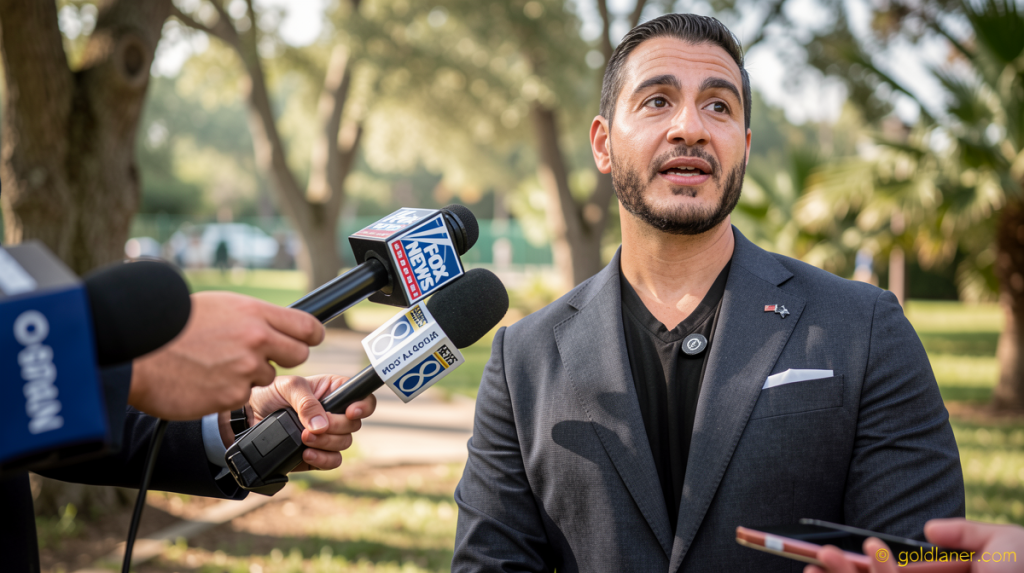
Michigan Senate Race: El-Sayed Seeks Reconciliation with Jewish Democrats After Primary Rifts
Goldlaner.com – With weeks separating the Michigan electorate from a decisive November contest, Abdul El-Sayed has spent the weekend in a frantic effort to mend relationships with Jewish Democrats who grew uneasy during his primary campaign. The progressive Senate nominee met individually and in small groups with Jewish party leaders across the state, offering apologies for remarks he made in the aftermath of a synagogue attack earlier this year. His stated goal: stitch together a fractured Democratic coalition before facing Republican former Representative Mike Rogers in the general election.
The Piker Question
One thorny issue El-Sayed chose to sidestep was his campaign association with Hasan Piker, the far-left Twitch streamer who traveled alongside him during the primary. Earlier in the month, Piker told his online audience that Israel had grown so toxic in American political life that Jews who voiced support for the country might encounter physical violence. El-Sayed declined to engage with that framing directly.
“I don’t ever want my comments to hurt anybody’s feelings. It’s important to me that people understand that I take seriously the pain of all communities in this state,” El-Sayed said. “But I don’t want to have a conversation about a Twitch streamer in California. It’s just not a serious conversation.”
The dismissal drew mixed reactions. Supporters saw a candidate prioritizing statewide unity over internet drama; critics saw a nominee minimizing remarks that many in the Jewish community found alarming.
Primary Aftermath and the AIPAC Shadow
El-Sayed’s path to the general-election ballot was anything but smooth. He unseated moderate Representative Haley Stevens in a bitterly contested primary earlier this month. Stevens had been backed by tens of millions of dollars in spending tied to the American Israel Public Affairs Committee, one of the most influential pro-Israel lobbying organizations in Washington. The campaign’s final weeks were marked by sharp ideological clashes over Israel’s war in Gaza and the role of Jewish institutional power in American politics.
At the state party convention held Saturday in Lansing, El-Sayed referenced more than $60 million in anti-El-Sayed spending from the primary but stopped short of naming AIPAC by name. That deliberate omission was read by observers as another conciliatory gesture toward the party’s most organized Jewish constituencies.
A Quieter Convention
The Saturday gathering in Lansing drew several hundred delegates and carried a markedly calmer tone than the Michigan Democratic Party’s spring convention, where progressive pro-Palestinian activists had booed Democrats they considered insufficiently critical of Israel’s military campaign against Hamas. State Attorney General Dana Nessel, who had been among the most vocal Democratic critics of El-Sayed’s post-attack remarks, skipped the convention entirely, citing fear of being harassed or booed off the stage.
For those who did attend, the mood leaned toward reconciliation. Norma McDaniel, a 79-year-old delegate from Inkster employed by the Detroit Department of Elections, had opposed El-Sayed in the primary and arrived Saturday carrying what she described as serious doubts about his candidacy. After his nine-minute address, which included pointed jabs at Rogers and President Donald Trump, she said her reservations had dissolved.
“He’s very articulate, he knows what points to hit, and he knows how to hit people’s hearts. He reached my heart today,” McDaniel said. “We have to unify the Democrats against what’s going on in Washington.”
The Synagogue Attack and the Words That Followed
The controversy at the center of El-Sayed’s weekend outreach traces back to March, when Ayman Ghazali, a naturalized U.S. citizen originally from Lebanon, drove a vehicle packed with explosives into the Temple Israel synagogue in West Bloomfield Township, a suburb north of Detroit. The building caught fire. Ghazali killed himself at the scene. According to officials, he had lost family members in an Israeli airstrike in Lebanon roughly one week before the Michigan attack.
In the days following, El-Sayed condemned the killing and spoke broadly against antisemitism. But he also offered the observations that “violence is a cycle” and that “hurt people hurt people.” Some members of the Jewish community interpreted those phrases as a form of contextual justification for the attack, a reading El-Sayed now says was unintended.
On Saturday, he addressed the Michigan Democratic Jewish Caucus directly.
“My comments might have been misconstrued to be justifying something I did not intend to justify,” he told reporters afterward. “To anybody who feels like my comments might have been hurtful, I’m really sorry. That was not my intention.”
He elaborated further, acknowledging the timing problem in his original remarks.
“We condemned that terrorist attack. We condemned it outright. What I was trying to do is offer context for why it happened, but it wasn’t the time for context. And you don’t ever want to trample somebody’s pain,” El-Sayed said.
Rogers Presses the Attack
Rogers, the Republican nominee, wasted no time countering the reconciliation narrative. On Saturday he accused El-Sayed of attempting to make Michiganders believe his beliefs had shifted since the primary.
“Let me be clear: they have not,” Rogers said. “Abdul has had six months to apologize for his incredibly horrific rema[rks].”
Why Michigan Matters to the Senate Tally
The stakes extend well beyond one state. Democrats require a net gain of four Senate seats to reclaim the chamber’s majority in November. Losing the seat vacated by retiring Michigan Senator Gary Peters would make that arithmetic considerably harder. El-Sayed’s ability to hold together both the progressive base that carried him through the primary and the Jewish institutional voters who bankrolled Stevens’ campaign will determine whether the state’s electoral college votes and Senate ballot line up for the party heading into the general election.
The weekend’s meetings, the convention speech, and the public apologies represent El-Sayed’s most visible attempt yet to answer that question before the electorate does.
Related Reading
Frequently Asked Questions
What is El Sayed apologizes to Jewish Democrats?
El Sayed apologizes to Jewish Democrats is the main topic of this guide. The article explains the context, practical details, and next steps readers should understand.
Why does El Sayed apologizes to Jewish Democrats matter?
El Sayed apologizes to Jewish Democrats matters because readers are looking for a useful answer, not just a short summary. Good content should match search intent and help them decide what to do next.