
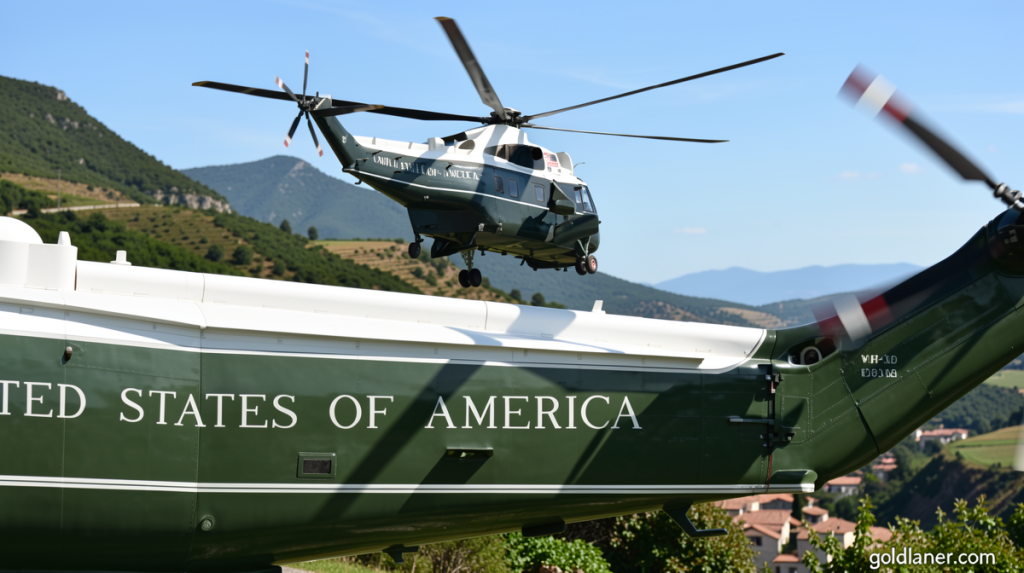
NTSB Preliminary Report Details Radio Blackout That Left Marine One’s Takeoff Unmonitored
Goldlaner.com – A seven-page preliminary report from the National Transportation Safety Board, released Thursday, laid out the sequence of radio failures that left the helicopter carrying President Donald Trump effectively invisible to air traffic control moments before an American Airlines regional jet drifted into the protective airspace surrounding Marine One on August 4. The findings arrive on a day when controllers again struggled to reach the presidential helicopter and had to depend on other aircraft already aloft to relay messages — a reminder that the underlying problem had not yet been fully resolved.
The Ellipse: A Temporary Pad Born of Construction
Under normal circumstances, Marine One lifts off from the South Lawn or the North Portico of the White House, with flights out of Ronald Reagan Washington National Airport suspended until the helicopter clears the immediate airspace. But ongoing construction at the White House forced the presidential helicopter unit to relocate temporarily to The Ellipse, the large oval lawn just south of the mansion. That shift, the report notes, created a geometry problem: the existing radio transmitter and receiver sight at the airport could not maintain adequate line-of-sight to the new operating position.
The FAA’s own Spectrum Engineering technicians conducted a coverage analysis after the incident and confirmed the gap. Their written conclusion, quoted in the NTSB document, stated that “there was not adequate line-of-sight to ensure communications between the radio transmitter/receiver sight and The Ellipse,” where Marine One had been staging during the construction period.
Two Failed Calls, One Near Miss
On the morning of August 4, Marine One made two attempts to contact the Reagan Washington National Airport control tower before lifting off. The first transmission, per the report, was “not received at all.” The second came through “broken and completely unreadable.” Investigators subsequently questioned the helicopter control frequencies to determine whether equipment malfunction was at play.
While the helicopter was climbing, planes continued departing from the nearby airport. An American Airlines regional jet entered the protective bubble that surrounds Marine One during presidential movements. The Federal Aviation Administration described the event as a “momentary loss of separation after which the aircraft continued to move away from one another,” and reaffirmed that the president was never in danger.
Audio recordings of the air traffic control frequency, previously obtained by journalists, captured the Marine One pilots repeating that they would be taking off soon. The tower, however, apparently could not hear the transmission. The NTSB noted that the frequency had been functioning normally on the day of the incident, with no known outages or degradation reports on file.
White House Response and Ongoing Fixes
White House spokesperson Kush Desai issued a statement on Thursday addressing the episode directly:
“Marine One flights are piloted by the finest aviators in the world, and the White House maintains the utmost confidence in these patriots and other security officials who are responsible for ensuring the President’s safety.”
Desai added that although the president “was at no point in harm’s way during the August 4th momentary loss of separation,” the administration “continues to work with relevant military, FAA, and other security personnel to ensure the President’s continued safety.”
Transportation Secretary Sean Duffy confirmed the root cause to reporters at a news conference this month at Newark Liberty International Airport. Speaking at a staff level, he acknowledged that “between the Marine One team and the FAA, there had been some telecom issues,” and added, “We are resolving that, and our teams are working very well together.”
Immediate Corrective Steps and Broader Implications
The FAA told investigators it “took immediate action” following the August 4 event. Among the measures: relocating an antenna to improve signal reach between DCA controllers and Marine One pilots, and reviewing the procedural steps involved in presidential lift notifications. The agency also convened a dedicated safety review panel and arranged for agency leadership to meet with the White House Military Office helicopter unit. According to the FAA, that group would work to “enhance coordination on three-minute lift notification and boost signal frequencies.”
Technicians interviewed after the incident reported no documented history of problems with the frequency in question. Radio checks performed with two separate Marine Helicopter Squadron One aircraft — one positioned at The Ellipse and another in the same general area — turned up no deficiencies. Communication with other helicopters in contact with DCA’s tower also showed no gaps.
The episode underscores a broader operational tension: when a president’s helicopter operates from a non-standard pad, the layered assumptions built into airport departure procedures — including the automatic suspension of outbound flights — can be disrupted. The three-minute lift notification, a standard protocol giving controllers advance warning of a presidential departure, becomes harder to execute reliably when the signal path itself is compromised by terrain, temporary structures, or construction activity.
The NTSB investigation remains ongoing. The preliminary report represents only the first tranche of findings, and the board has not yet issued final recommendations. Until those are published, the full scope of procedural, technical, and coordination failures — and the steps needed to prevent a recurrence — will remain partially obscured.
Related Reading
Frequently Asked Questions
What is Report reveals communication issues before jet got?
Report reveals communication issues before jet got is the main topic of this guide. The article explains the context, practical details, and next steps readers should understand.
Why does Report reveals communication issues before jet got matter?
Report reveals communication issues before jet got matters because readers are looking for a useful answer, not just a short summary. Good content should match search intent and help them decide what to do next.