
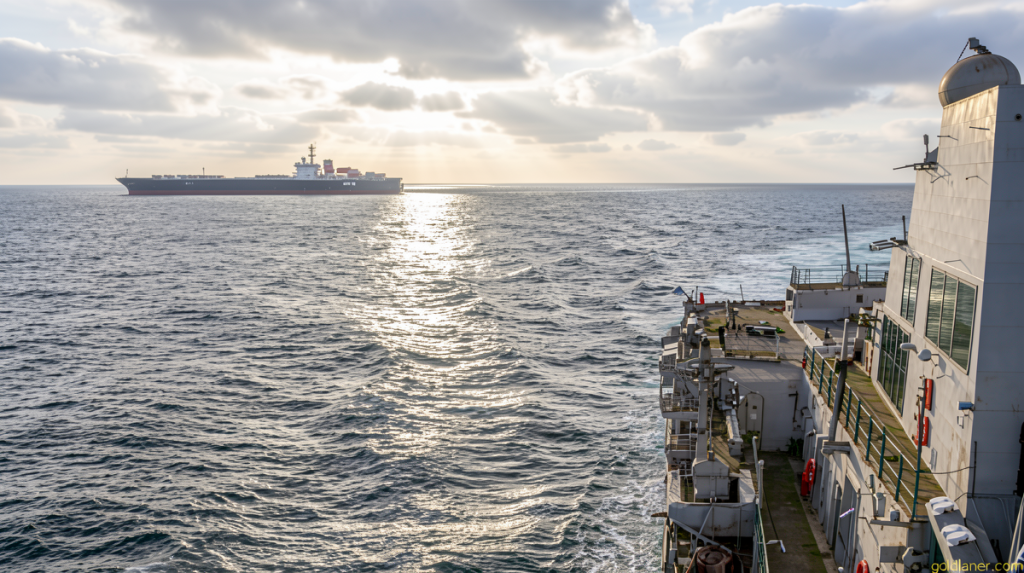
Senators Demand Review of Warship Conditions
Goldlaner.com – Democratic senators demand review of conditions aboard three Navy vessels currently locked into a prolonged maritime standoff with Iran. In a letter delivered Monday to Defense Secretary Pete Hegseth and acting Navy Secretary Hung Cao, two senior lawmakers on the Senate Appropriations Committee formally requested an independent, strategic investigation into crew welfare, operational readiness, and shipboard quality of life. The move signals a sharp escalation in congressional oversight of how the fleet is being sustained through what has become one of the longest continuous deployments in recent memory.
The inquiry targets the aircraft carriers USS Abraham Lincoln and USS Gerald R. Ford, together with the destroyer USS Benfold. Each ship has accumulated operational stresses that have drawn sustained attention from service members’ families, lawmakers, and defense analysts alike.
Who Wrote the Letter and Why It Carries Weight
The authors are Patty Murray of Washington, vice chair of the Appropriations Committee, and Chris Coons of Delaware, ranking Democrat on the committee’s defense subcommittee. Their position is consequential: the Appropriations Committee drafts the federal budget bills that fund every branch of the armed forces, effectively controlling decisions about crewing levels, maintenance schedules, and deployment ceilings. A request coming from those chairs lands differently than one from a junior member.
The senators asked for what the letter calls “an immediate independent strategic review” of the three vessels’ recent deployments. Scope, as spelled out in the correspondence, covers:
“readiness issues related to operations, manning, quality of life, including mental health, and culture on the ships as well as communications with the crews’ families.”
Any findings, they added, should yield concrete recommendations aimed at “improving future extended deployments for sailors and Marines.”
What Happened Aboard Each Ship
The USS Benfold, a guided-mine-layer destroyer, suffered an engineering failure last month that cut all electrical power for four consecutive days while the ship was operating in the South China Sea. Crews were forced onto manual systems and backup generators, testing both equipment redundancy and human endurance under sustained stress.
The USS Gerald R. Ford, the Navy’s newest carrier, recently concluded a record-length deployment that included active combat missions directed against both Venezuela and Iran. During that tour, a major fire broke out in the laundry department and took roughly 30 hours to bring under control. Approximately 600 sailors lost access to their bunks while firefighting and damage-control operations continued, sleeping in common areas or on deck for extended periods.
The USS Abraham Lincoln is now transiting home to San Diego to close out a deployment of comparable length. Since a brief stopover in Guam in December 2025, sailors aboard have had virtually no opportunity to go ashore. Earlier this month, reports surfaced of disruptions to the ship’s mail system and intermittent shortages of basic supplies, including hygiene products and fresh food. Those reports placed the Lincoln’s crew welfare squarely in the public eye and prompted the senators’ formal intervention.
A Broader Pattern of Stretching Deployments
The letter does not exist in isolation. Extended deployments that exceed the Navy’s own internal benchmark of seven months have become increasingly routine. The median length of U.S.-based carrier deployments has climbed steadily since 2020, driven by fleet-size constraints, competing operational demands across multiple theaters, and shipbuilding and maintenance cycles that have not kept pace with operational tempo.
When carriers and their escort groups remain at sea well beyond the planned window, cumulative effects compound: fatigue deepens, family separation stretches into years, and the ship’s internal logistics system—designed for a finite rotation—begins to strain. The senators’ call for an independent review is, in effect, an acknowledgment that current operational tempo may be outpacing the Navy’s capacity to sustain its people at acceptable welfare standards.
Navy’s Public Response
As of publication, the Department of Defense had not issued a formal statement confirming or declining the requested review. Acting Navy Secretary Hung Cao’s office acknowledged receipt of the letter and indicated that the matter would be reviewed through standard channels. No timeline for a decision was announced.
Frequently Asked Questions
What exactly are the senators asking for?
An independent, strategic review of the recent deployments of the USS Abraham Lincoln, USS Gerald R. Ford, and USS Benfold. The review would examine operations, manning, quality of life, mental health, shipboard culture, and family communications, then produce recommendations for future extended deployments.
Why does the Appropriations Committee have leverage here?
The committee drafts the budget bills that fund the Department of Defense. It sets ceilings on personnel, controls maintenance funding, and can attach conditions to appropriations. A formal request from its leadership therefore carries budgetary teeth that a simple letter of inquiry would not.
How long have these ships been deployed?
The Navy’s internal benchmark for a carrier deployment is seven months. All three vessels named in the letter have exceeded that window. The Ford’s deployment included active combat missions; the Lincoln’s transit home from Guam began in December 2025; the Benfold’s power failure occurred during operations in the South China Sea last month.
Has the Pentagon agreed to conduct the review?
No formal agreement has been announced. The Navy acknowledged receipt of the letter and said the matter would be reviewed through standard channels. A decision timeline has not been published.