
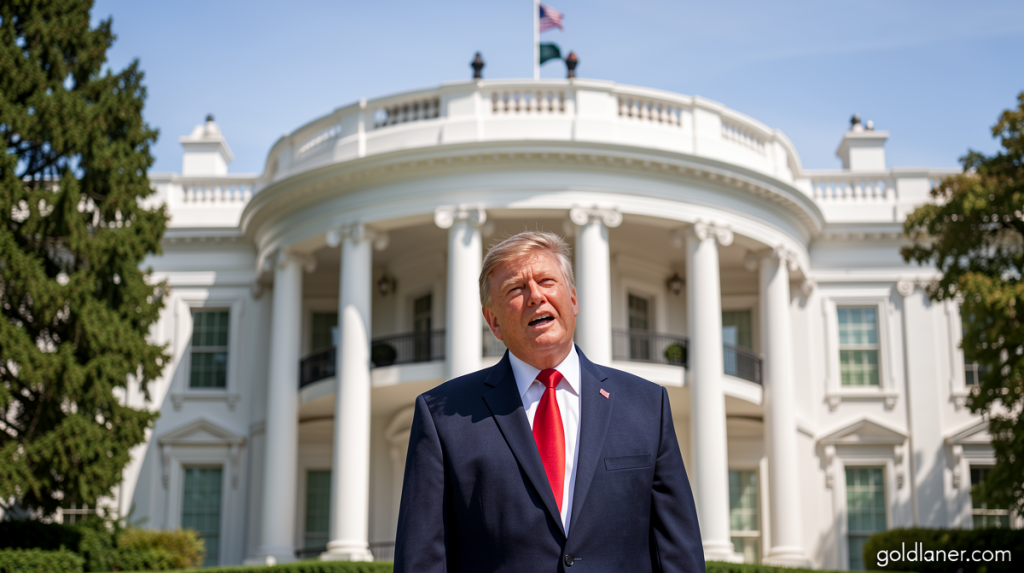
Trump’s Economic Gambles Collide With GOP’s Midterm Survival Strategy
Goldlaner.com – With fewer than 72 days separating Americans from the ballot box, the Republican Party faces an increasingly uncomfortable contradiction at the heart of its campaign messaging. The party’s default answer to voter anxiety over stubborn inflation and weak employment data remains a three-word formula: name a noun, attach a verb, and land on “Joe Biden.” Yet President Donald Trump keeps issuing executive actions that tether the economy’s current condition directly to his own administration, complicating the blame narrative and injecting fresh volatility into races the GOP desperately needs to hold.
The tension is not hypothetical. Three distinct policy moves in recent weeks — an escalated economic siege against Iran, a sudden intervention in the domestic beef supply chain, and a sharp tariff escalation aimed at Canada — have collectively raised alarms among lawmakers who must defend their seats in November. Each move carries the potential to spike consumer prices or destabilize agricultural markets precisely when Republican candidates in swing states need calm, predictable economic conditions.
The Iran “Economic D-Day” Drags Into Election Season
The most consequential of the three is the administration’s all-out economic pressure campaign against Iran, a strategy that launched in late February with the explicit prediction it would conclude within four to six weeks. That timeline has evaporated. The operation now threatens to extend into the final weeks before voters head to the polls, and its domestic footprint is already visible at the pump: gasoline prices have climbed toward four dollars per gallon.
Whether the strategy is sound or merely the fallback option after earlier military strikes failed to compel Iranian capitulation is a question Republicans are asking privately. What is less debatable is the political arithmetic. A prolonged conflict that keeps energy prices elevated and markets unsettled during the closing stretch of a midterm campaign is precisely the scenario the party hoped to avoid. Grumbling among House and Senate members about the war’s duration and its economic spillover has grown audible in recent days.
Beef Tariff Pause Upsets Cattle States With Senate Races
Trump’s second recent intervention targets the beef market. To ease elevated retail prices, the administration temporarily suspended tariffs on imported beef and opened the door to roughly 300,000 metric tons of ground beef entering the country duty-free over the next 90 days. The announcement drew swift backlash from American cattle producers and, more pointedly, from GOP senators representing states where cattle ranching is a pillar of the local economy.
Nebraska and Texas rank as the two largest cattle-producing states in the nation, and both are hosting high-stakes Senate contests in 2026. Nebraska’s Republican senator, Pete Ricketts, who faces independent challenger Dan Osborn in November, took to X to register his objection:
“Flooding the market with lower quality beef compromises Nebraska farmers and ranchers.”
Iowa, which sits in the top ten for cattle production, also fields a competitive open Senate race this cycle. Senator Chuck Grassley, the state’s incumbent Republican, voiced alarm over what he called the effect on “the cattle markets,” pointing to the recent shutdown of a Tyson beef processing plant in Joslin, Illinois, just across the state line. Ashley Hinson, the GOP candidate running in Iowa’s open Senate seat, offered a more blunt assessment:
“I want to lower prices but this is a bad idea.”
The overlap between agricultural disruption and electoral geography is not accidental. When tariff pauses land in states that produce beef and simultaneously elect senators, the political cost lands squarely on the party that controls the White House.
Fifty-Percent Canada Tariffs Threaten Border-State Races
The third move — ramping tariffs on Canadian goods to 50 percent — carries the broadest geographic risk. A full-blown trade confrontation with the United States’ northern neighbor would push prices upward across multiple sectors, and the damage would concentrate in states that border Canada and depend heavily on cross-border commerce. Four of the six states the Cook Political Report currently rates as toss-ups share a Canadian border: Alaska, Maine, Michigan, and Ohio.
Maine’s Susan Collins, the sole GOP senator seeking reelection in a state Trump lost in 2024 and therefore a prime Democratic target, spoke Saturday about the tariff trajectory:
“Will increase costs for Maine families.”
She added that the whiplash of shifting trade negotiations is producing “higher costs, risk, and uncertainty for Maine businesses.”
Even within the GOP leadership, the Canada tariff has not won enthusiastic support. Senate Majority Leader John Thune, pressed last month on the potential 50 percent rate, described himself as “not a huge fan of tariffs as a general rule” and noted he had not yet seen a “rationale” for the specific measure.
The Broader Messaging Problem
Beyond any single state or sector, the cumulative effect of these moves erodes the GOP’s central economic narrative. The party’s talking point on persistent inflation and sluggish job growth has settled into a familiar cadence: cite the Biden administration and the lingering fallout of its alleged mismanagement. Inflation did peak at higher levels during Biden’s term, and global price pressures compounded the domestic picture. That historical fact remains true.
But voters do not experience economics as a historical footnote. They experience it as the price at the gas station, the cost of a ground-beef patty, the tariff on a Canadian-made component bolted into a Michigan factory. When the administration’s own actions move those prices upward in the weeks before a vote, the blame-Biden script loses its persuasive force. The GOP now must explain why the economy is hurting under its own watch while simultaneously insisting the pain is Biden’s legacy — a reconciliation that grows harder with every new executive order.
Seventy-one days remain. The question for Republican strategists is whether the political damage from these economic gambles can be contained before November, or whether the party will spend its final campaign stretch defending moves it did not anticipate and did not want.
Related Reading
Frequently Asked Questions
What is Trump can t stop rocking the economy?
Trump can t stop rocking the economy is the main topic of this guide. The article explains the context, practical details, and next steps readers should understand.
Why does Trump can t stop rocking the economy matter?
Trump can t stop rocking the economy matters because readers are looking for a useful answer, not just a short summary. Good content should match search intent and help them decide what to do next.