
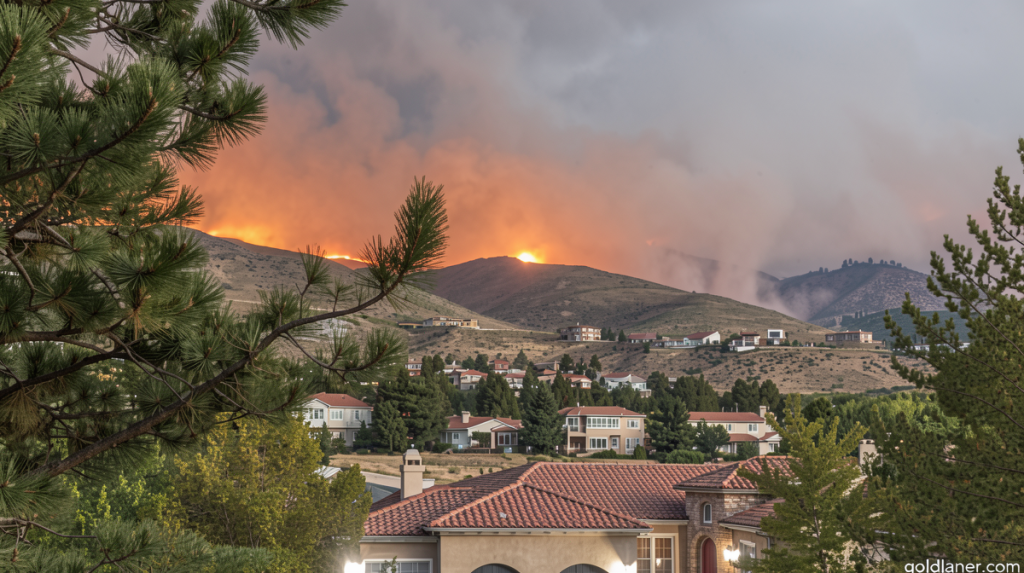
Hawk Fire Forces Reno Evacuations as Nevada Declares Emergency
Goldlaner.com – The fast-growing Hawk Fire forces mandatory evacuations across western Reno neighborhoods after consuming more than 10,500 acres of dry brush on the slopes above the city. Governor Joe Lombardo declared a state of emergency in Washoe County Saturday night as the blaze showed no containment and continued advancing toward populated areas. State fire officials had not identified the ignition cause as of late Saturday.
The proclamation unlocks additional state resources, centralizes interagency coordination through Nevada’s emergency operations center, and signals to residents that conditions demand heightened alertness. Under the state’s emergency management framework, the governor may direct agencies to operate under unified command—a mechanism Lombardo invoked explicitly in his announcement.
Why the Blaze Accelerated
Three converging conditions drove the fire’s explosive expansion through Saturday. Sustained gusty winds pushed flames uphill and across ridgelines. Relative humidity had fallen well below typical summer thresholds for the region. And the fuel bed—dense, parched brush accumulated over a dry spring—supplied abundant material for rapid combustion. Together, these factors turned a localized brush ignition into a large, fast-moving wildfire within hours.
Local terrain compounds the danger. Reno sits at the base of steep, south-facing slopes in the eastern Sierra Nevada foothills. When wind drives fire down those slopes toward the valley floor, flames can accelerate dramatically, outrunning ground crews and generating intense radiant heat that threatens structures below. A time-lapse recording from an Alert California monitoring camera, maintained by UC San Diego, captured the fire front racing down a slope toward Reno neighborhood lights late Saturday before smoke and darkness obscured the perimeter.
Evacuation Orders Expand Overnight
What began as a precautionary advisory early Saturday evening escalated sharply as the night progressed. Officials initially instructed roughly 1,000 households in western and northwestern Reno to prepare to leave, staging vehicles and gathering essentials. By later Saturday, a fire map distributed by authorities showed numerous residential zones shifting from advisory status to mandatory “go now” evacuation orders.
The perimeter widened overnight to encompass the Somersett neighborhood and additional areas to the north. Residents in those zones were told to depart immediately rather than await further instructions. The expansion reflected the fire’s continued downhill trajectory and crews’ inability to establish a containment line before dark.
Firefighting Response and Overnight Operations
Approximately 400 firefighters were engaged in direct attack and containment operations as of late Saturday. Helicopters conducted water-dropping sorties through the night, attempting to cool hot spots and slow the advance while ground crews built control lines. Officials acknowledged that high winds made containment significantly more difficult, limiting the effectiveness of aerial drops and forcing crews to work in shifting, low-visibility conditions. No percentage of containment had been reported by state fire officials as of the latest available update, indicating the situation remained fluid and that additional resources could be committed in coming hours.
“This is an active and rapidly evolving situation, and I urge everyone in the affected areas to remain vigilant.” — Governor Joe Lombardo
Lombardo posted the statement on X and separately directed those under evacuation orders to depart without delay. His declaration paired with an instruction for state agencies to coordinate through Nevada’s emergency operations center, centralizing command and resource allocation for the duration of the incident.
FAQ: What Reno Residents Need to Know
Do I need to evacuate if my neighborhood is under an advisory?
An advisory means conditions are close enough to warrant preparation. Stage your vehicle, gather medications, documents, and essentials, and monitor Washoe County alert channels. If the advisory upgrades to a mandatory order, leave immediately—do not wait for a second notice.
Where should I go if ordered to evacuate?
Follow routes directed by Washoe County emergency management. Avoid westbound canyon roads that may be closed by fire activity. Check the county’s official alert system or local news outlets for current shelter locations and road closures before departing.
How can I stay informed while displaced?
Monitor Washoe County’s emergency alert system, local broadcast stations, and the governor’s official social-media channels for updates on containment progress, road reopenings, and shelter availability. State fire officials issue periodic briefings; the absence of a containment percentage does not mean operations have stopped.
What should homeowners do to prepare for future brush fires on these slopes?
Maintain defensible space around structures, keep evacuation routes clear of debris, and register with local alert systems. The speed at which the fast-growing Hawk Fire moved Saturday underscored how quickly a brush ignition can transition into a life-threatening event when wind and fuel align.