
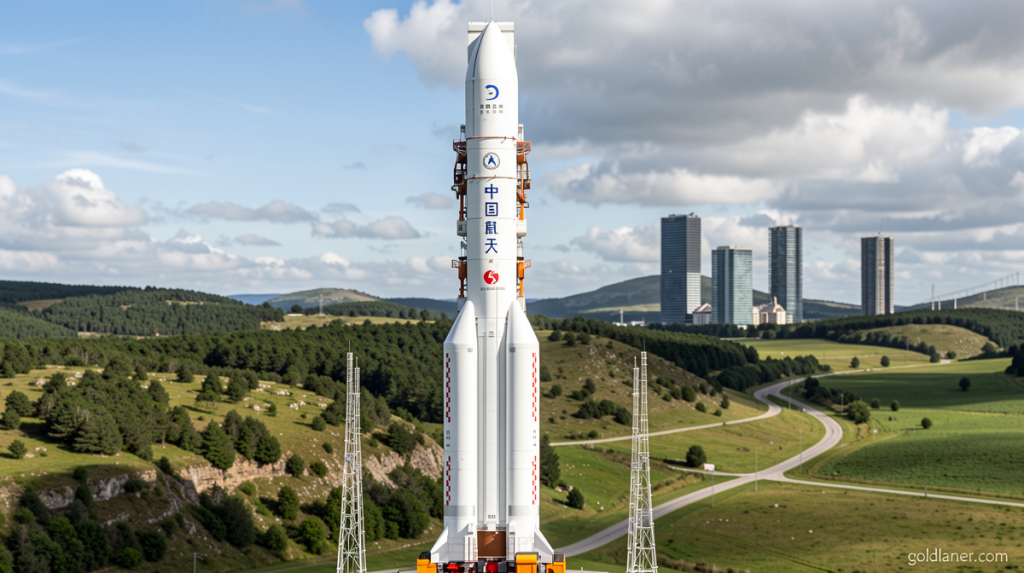
China Postpones Launch of Unprecedented Moon Probe
Goldlaner.com – China postpones launch of unprecedented water-ice sampling on the Moon. The robotic spacecraft that Beijing had readied to become the first probe ever to physically excavate frozen water from the lunar surface will not fly this year. The China Manned Space Engineering Office confirmed through state media that the Chang’e-7 mission “cannot take place during the planned window this year,” scrubbing a launch that had been anticipated as early as Sunday evening or Monday morning, Beijing time. No revised timeline or detailed technical explanation accompanied the announcement.
“The lunar probe does not meet launch conditions,” the statement read, adding that the “assessment was conducted following the principle of prudence, reliability and absolute mission success.”
The terse language left observers without a clear picture of what triggered the hold — whether a sensor malfunction, a propulsion anomaly, or a broader systems check prompted the decision. What is unambiguous, however, is the competitive pressure that makes every week of delay consequential.
A Race to Drill the Moon’s South Pole
Both Washington and Beijing have staked enormous strategic weight on the permanently shadowed craters clustered around the lunar south pole. Decades of orbital spectroscopy and radar sounding have suggested those dark, cold pockets harbor substantial deposits of water ice. Yet no spacecraft has ever lowered a drill, scoop, or sensor into that ice and returned a confirmed, in-situ measurement. Chang’e-7 was engineered specifically to close that gap: its payload includes instruments designed to excavate, analyze, and characterize subsurface ice at the pole.
The United States has made repeated attempts to reach the same goal. In 2025, Intuitive Machines, a Texas-based lunar-landing company, delivered a water-hunting drill package to the south pole. The spacecraft tripped during touchdown on the region’s notoriously uneven, boulder-strewn terrain and was unable to complete its science objectives. The episode underscored just how punishing the landing environment remains, even for vehicles purpose-built for it.
That competitive window, however, is narrowing rather than widening. Within roughly the next twelve months, multiple American spacecraft are slated to target the same polar terrain that Chang’e-7 is designed to investigate. Astrobotic Technologies, headquartered in Pittsburgh, has its Griffin lander ready for a south-pole insertion as early as late 2026. Separately, Jeff Bezos’s Blue Origin has outlined plans to deliver up to two robotic landers to the Moon next year; at least one of those vehicles may carry the VIPER rover, a NASA-built prospecting robot explicitly tasked with locating and quantifying water ice and other extractable lunar resources.
The postponement therefore resets a portion of the scoreboard. What had been shaping up as a Chinese first — the first direct, on-the-ground confirmation of lunar water ice — now faces a compressed schedule in which American hardware could arrive at the same coordinates before Chang’e-7 clears its next launch window.
Why the Ice Matters and What Comes Next
The strategic calculus behind the polar rush is straightforward. Water, once extracted, can be split into oxygen and hydrogen: breathable air for crews, potable water for long-duration habitation, and — combined with lunar regolith minerals — liquid rocket propellant that would dramatically reduce the cost of departing the Moon for deeper-space missions. A confirmed, accessible ice deposit would transform the south pole from a scientific curiosity into the logical anchor point for any permanent lunar base.
Whether the ice exists in quantities large enough and in geometries accessible enough to support those ambitions remains an open question. Orbital data constrain the total volume but cannot resolve grain size, depth profile, or the fraction locked in permanently shadowed terrain versus transiently deposited frost. That distinction is precisely what a ground-based probe like Chang’e-7 is built to answer.
“Chang’e-7 could help make important progress on this question, sharpening and focusing experiments for further exploration and testing,” Yuqi Qian, a lunar geologist at the University of Hong Kong, said.
Qian framed the mission’s significance in programmatic terms: with Chang’e-7, China’s lunar architecture is “shifting from an exploration program to a resource utilization program.” In other words, the era of simply landing and photographing gives way to an era of extracting, measuring, and planning around what the Moon actually contains. Beijing has not announced a new launch date; the statement stopped at the declaration that conditions were unmet and that the agency would reassess when appropriate.
Frequently Asked Questions
Why was the Chang’e-7 launch postponed? The China Manned Space Engineering Office stated that the probe “does not meet launch conditions” and that the decision followed a principle of prudence and absolute mission success. No specific technical fault was disclosed.
When might the mission launch next? No revised date has been published. The agency indicated it would reassess conditions, but gave no timeline beyond confirming the mission will not fly within the current year’s window.
What makes the lunar south pole so strategically important? Permanently shadowed craters there are believed to contain water ice that could supply breathable oxygen, drinking water, and rocket propellant for future crews and deeper-space missions, making the region a candidate anchor site for a permanent lunar base.
How does this delay affect the U.S.–China space race? American landers from Astrobotic Technologies and Blue Origin are scheduled to reach the same polar terrain within roughly twelve months. The slip compresses the window in which China could claim the first confirmed, in-situ measurement of lunar water ice.